- Services
Advertising disclosure: we earn commissions when you shop through the links below.
Cost-effective Arm PC processor with 10 Oryon cores and the same 45 TOPS NPU as the X Elite. Targets mainstream Copilot+ PCs with excellent battery life at a lower price point.
No on-device VRAM in our database for this product. Treat as a peripheral or robotics platform rather than an LLM host.
Generated from this product’s spec sheet. Editor reviews refine it over time.
The Qualcomm Snapdragon X Plus (X1P-64-100) represents the entry point into the Copilot+ PC ecosystem, specifically engineered to bring high-throughput NPU performance to mainstream mobile workstations. While positioned as a more budget-friendly alternative to the Snapdragon X Elite series, the X Plus maintains the exact same Hexagon NPU architecture, delivering 45 TOPS of INT8 performance. This makes it a strategic choice for AI engineers and developers who prioritize NPU-accelerated inference and energy efficiency over raw multi-core CPU performance.
Manufactured on the TSMC N4 (4nm) process, the X1P-64-100 features a 10-core Oryon CPU architecture. In the landscape of best AI PCs & laptops for running AI models locally, this chip competes directly with the Apple M3 and Intel Core Ultra (Series 1) offerings. However, its primary advantage lies in its dedicated AI silicon; while competitors often rely on GPU-heavy inference, the Snapdragon X Plus is designed for "always-on" AI workloads where power envelope and thermal throttling are primary concerns. For practitioners building agentic workflows or local-first applications, this chip provides the necessary headroom for background LLM tasks without exhausting the battery.
When evaluating the Qualcomm Snapdragon X Plus (X1P-64-100) for AI, the most critical metric is the unified memory architecture. Supporting up to 64GB of LPDDR5X, this chip offers a memory bandwidth of 135 GB/s. For local LLM inference, memory bandwidth is almost always the primary bottleneck for token generation speed (tokens per second). At 135 GB/s, the X Plus significantly outperforms standard x86 laptops, which typically hover around 50–80 GB/s, allowing for smoother interaction with quantized models.
Compared to the Apple M3 (which offers ~100 GB/s bandwidth in base configurations), the Snapdragon X Plus provides a wider pipe for data movement, which is essential when the Qualcomm Snapdragon X Plus (X1P-64-100) VRAM for large language models is fully utilized. Because the memory is unified, the "VRAM" is essentially the system RAM, allowing users to allocate significant portions of the 16GB, 32GB, or 64GB pools to the NPU/GPU.
The Qualcomm Snapdragon X Plus (X1P-64-100) AI inference performance is optimized for models ranging from 1B to 13B parameters. While 70B models are technically "loadable" on a 64GB RAM configuration, the 135 GB/s bandwidth will result in sub-optimal tokens per second, likely falling below the human reading speed.
For the best quality-to-speed tradeoff, practitioners should target INT8 quantization. While INT4 provides the highest speed, INT8 on the Hexagon NPU offers a superior balance of perplexity and performance for professional Qualcomm ai pcs & laptops for AI development.
The Snapdragon X Plus is not a training chip; it is a dedicated best AI chip for local deployment and inference.
For developers building local AI agents in 2025, the X Plus is an ideal testbed. It allows for the deployment of a local vector database (like ChromaDB or LanceDB) alongside a 7B or 8B parameter model. The 23W TDP ensures that the device can stay active as a "local brain" without significant power drain.
Engineers developing apps for the Windows on Arm ecosystem will find the X1P-64-100 the standard benchmark for mainstream performance. If an application runs well on the X Plus, it will perform excellently on the X Elite, making it the baseline for Qualcomm Snapdragon X Plus (X1P-64-100) local LLM software optimization.
For those who want to run a personal chatbot (via LM Studio, Jan.ai, or Ollama) without sending data to the cloud, this chip provides the necessary NPU acceleration to keep the experience fluid. It is particularly suited for users who need a thin-and-light laptop that doesn't sacrifice AI capabilities for portability.
The X Plus loses two CPU cores (10 vs 12) and has a slightly weaker GPU (3.8 vs 4.6 TFLOPS). However, for AI-specific tasks, the NPU is identical. If your workload is primarily NPU-bound (using quantized LLMs or Windows Copilot+ features), the X Plus offers significantly better value. You get the same 45 TOPS of AI compute at a lower price point.
The Intel Core Ultra 7 155H features an NPU capable of roughly 11 TOPS, which is significantly lower than the 45 TOPS found in the Snapdragon X Plus. While the Intel chip may have an edge in legacy x86 software compatibility, the Snapdragon X Plus is the superior choice for local LLM performance and NPU-accelerated tasks. The Snapdragon's 135 GB/s memory bandwidth also typically outclasses standard Intel-based laptop configurations, which is the deciding factor for token generation speed.
The Apple M3 is a formidable competitor with high single-core performance. However, base M3 models often start with 8GB or 16GB of RAM, which is insufficient for serious AI development. The Snapdragon X Plus laptops frequently ship with 16GB or 32GB as standard, and the 135 GB/s bandwidth provides a wider path for model weights than the base M3's 100 GB/s. For practitioners looking for the best hardware for local AI agents 2025 on a budget, the Snapdragon platform often provides more "VRAM" (system memory) for the money.
The top models this device can run at 4-bit, ranked by fit and speed.
Specs not available for scoring. This product is missing VRAM or memory bandwidth data.
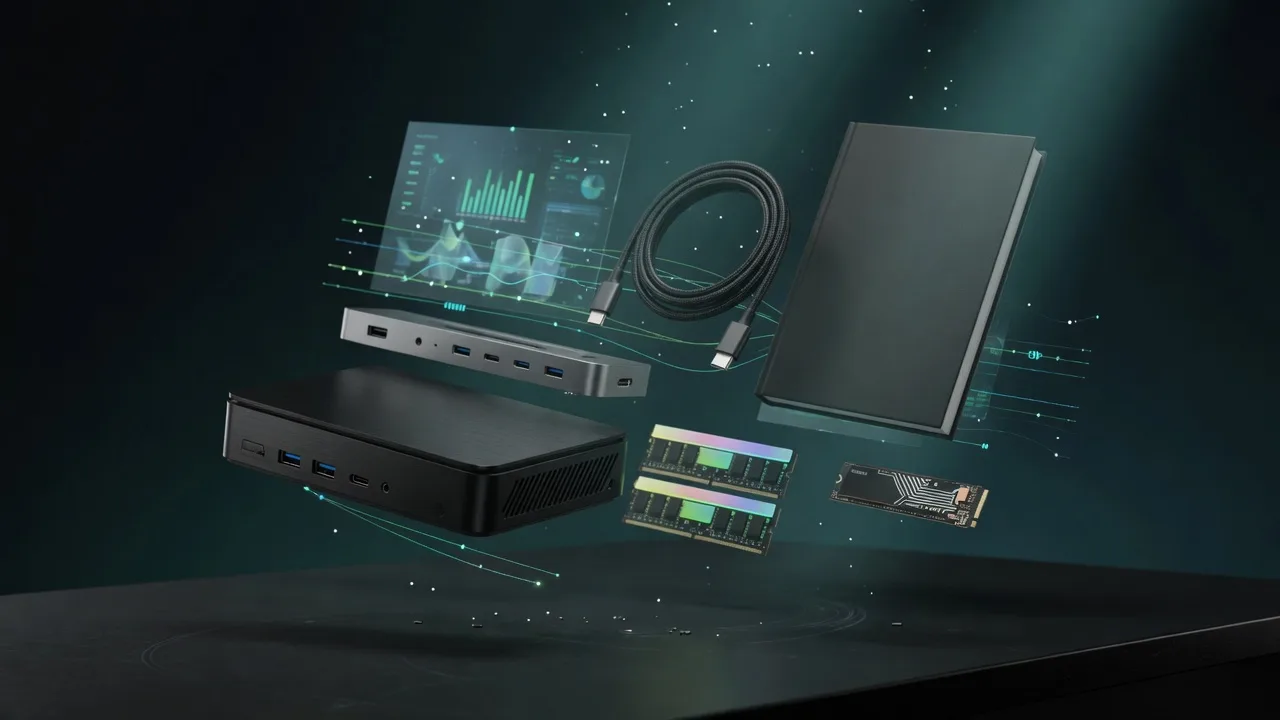
Also in Our Store
Docks, fast storage, cables, and a UPS sized for a local AI machine.

Rent this class of GPU by the hour before you buy. Live prices from RunPod and Vast.ai.

Find the break-even between buying this hardware and paying for a cloud API.
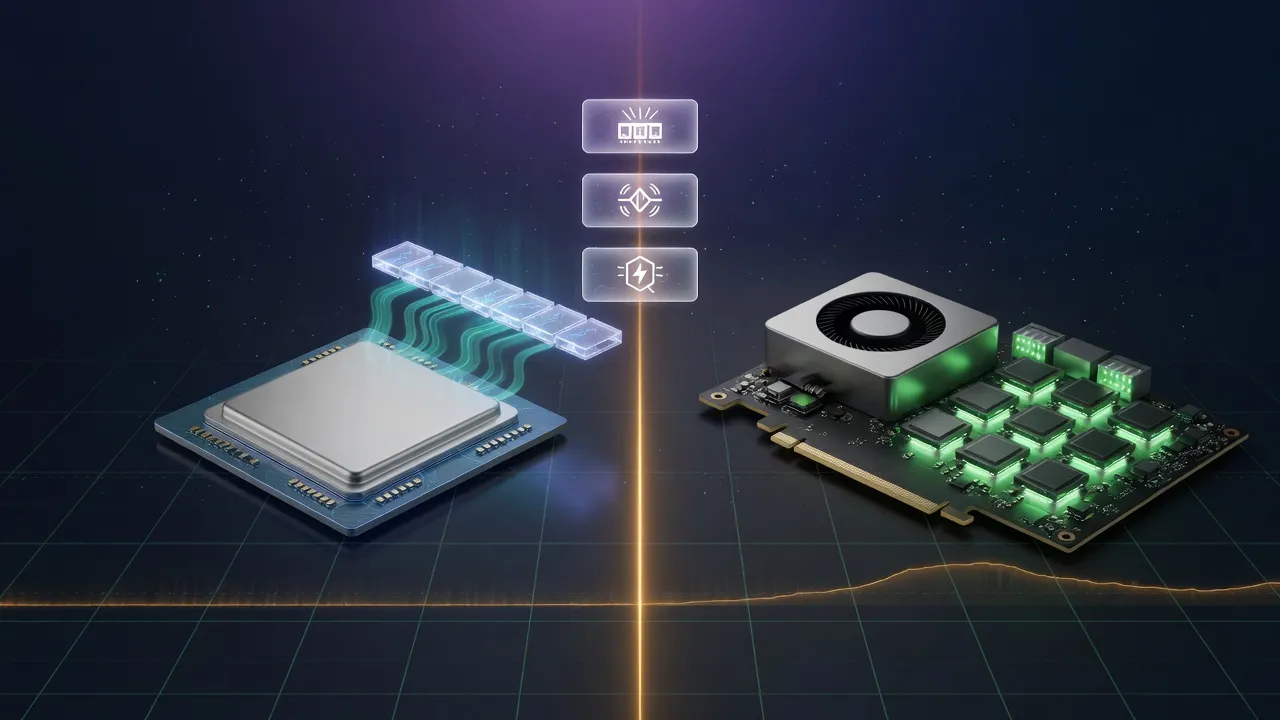
Mac vs NVIDIA for local inference, if you are still choosing a platform.