- Services
Advertising disclosure: we earn commissions when you shop through the links below.
Second-gen Arm PC processor with up to 18 Oryon Gen 3 cores (5.0 GHz), 80 TOPS NPU, and 228 GB/s memory bandwidth. Built on 3nm with Fusion Architecture for premium AI PCs shipping in 2026.
The Qualcomm Snapdragon X2 Elite Extreme represents the high-water mark for Arm-based Windows silicon, specifically engineered to bridge the gap between mobile efficiency and desktop-class AI throughput. As the flagship of Qualcomm’s second-generation PC platform, this SoC moves beyond the experimental phase of Windows-on-Arm, positioning itself as a primary workstation for developers building agentic workflows and local-first AI applications. Built on TSMC’s 3nm process, it introduces the Oryon Gen 3 CPU architecture and a significantly overhauled Hexagon NPU.
For practitioners, the Snapdragon X2 Elite Extreme is a high-end "AI PC" solution that competes directly with the Apple M4 Pro/Max and Intel’s Lunar Lake/Arrow Lake architectures. While previous generations focused on basic NPU tasks like background blur, the X2 Elite Extreme’s 80 TOPS NPU is designed for sustained local LLM inference and complex RAG (Retrieval-Augmented Generation) pipelines. It targets the "Prosumer" and "Developer" tiers, offering a power-efficient alternative to power-hungry discrete GPUs for users who need portability without sacrificing the ability to run 7B to 30B parameter models at usable speeds.
When evaluating the Qualcomm Snapdragon X2 Elite Extreme for AI inference performance, the most critical metrics are the NPU throughput and the memory subsystem. Unlike traditional x86 architectures that often rely on the GPU for inference, the X2 Elite Extreme utilizes a "Fusion Architecture" that tightly integrates the CPU, GPU, and NPU.
The heart of the AI workload is the Hexagon NPU, delivering 80 TOPS (INT8). This is a substantial leap from the 45 TOPS found in the first-generation X Elite, effectively doubling the overhead available for concurrent AI tasks. While TOPS is a raw metric, the real-world advantage lies in the NPU's ability to handle quantized integer math with high efficiency, preserving battery life during long inference sessions. The 18-core Oryon Gen 3 CPU, clocking up to 5.0 GHz, provides a 75% performance increase over the X1 Elite at the same power envelope, ensuring that pre-processing and tokenization do not become bottlenecks.
For local LLMs, memory bandwidth is almost always the primary constraint on tokens per second. The X2 Elite Extreme features a 228 GB/s memory bandwidth supporting up to 64GB of LPDDR5X.
With a 50W TDP, the X2 Elite Extreme is designed for high-performance laptops. It maintains a high performance-per-watt ratio, meaning it can sustain AI workloads longer than an x86 laptop with a discrete RTX GPU before thermal throttling or battery exhaustion occurs.
The Snapdragon X2 Elite Extreme is specifically designed for running larger on-device LLMs with its 80 TOPS NPU. The hardware's "sweet spot" is 4-bit and 8-bit quantized models optimized via the Qualcomm AI Stack (QNN).
The 53 MB of CPU cache and WiFi 7 connectivity support heavy multimodal workloads, such as running Whisper for real-time transcription alongside a vision-language model (VLM) like Llava. The 80 TOPS NPU handles the concurrent INT8 operations required to keep these models running in parallel without system-wide latency.
The Qualcomm Snapdragon X2 Elite Extreme for AI is not a general-purpose consumer chip; it is a specialized tool for local deployment.
When selecting the best AI chip for local deployment, the X2 Elite Extreme should be weighed against the following:
For practitioners looking for the best AI PCs & laptops for running AI models locally in 2026, the Snapdragon X2 Elite Extreme offers a compelling balance of high-capacity unified memory, class-leading NPU throughput, and the efficiency required for a truly mobile AI workstation.
The top models this device can run at 4-bit, ranked by fit and speed.
Specs not available for scoring. This product is missing VRAM or memory bandwidth data.
Also in Our Store
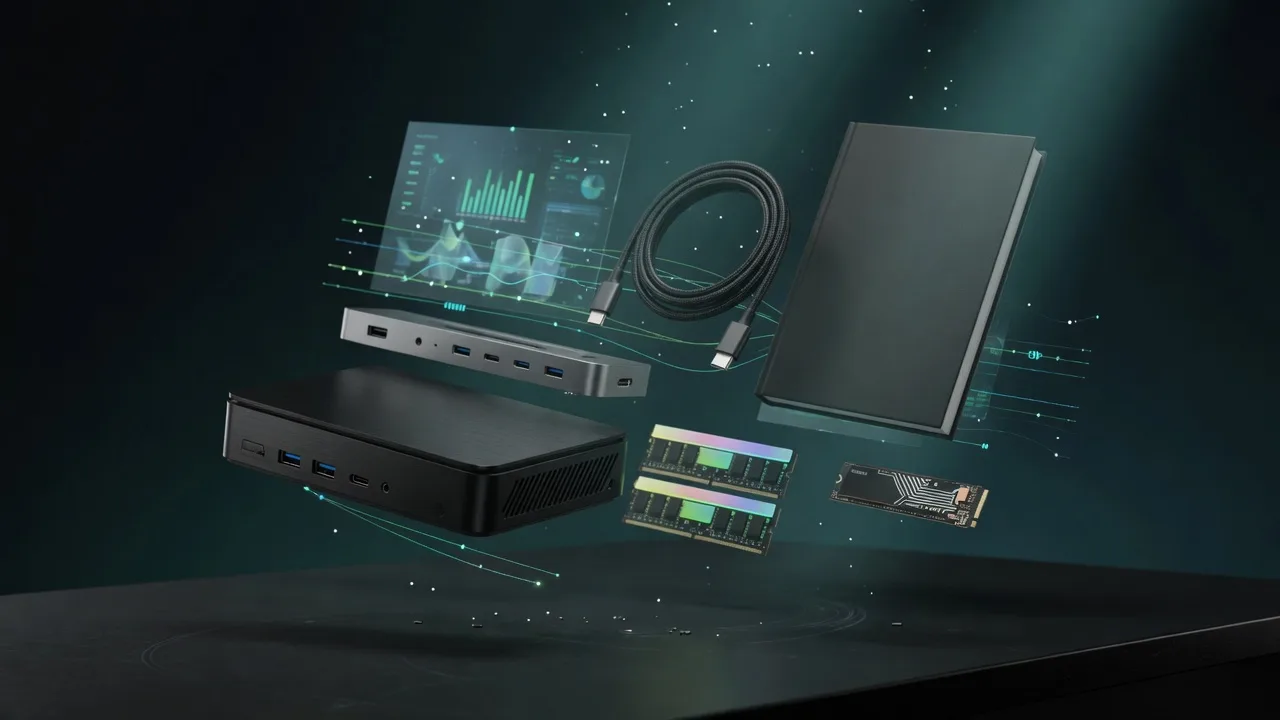
Docks, fast storage, cables, and a UPS sized for a local AI machine.

Rent this class of GPU by the hour before you buy. Live prices from RunPod and Vast.ai.
Find the break-even between buying this hardware and paying for a cloud API.
Mac vs NVIDIA for local inference, if you are still choosing a platform.