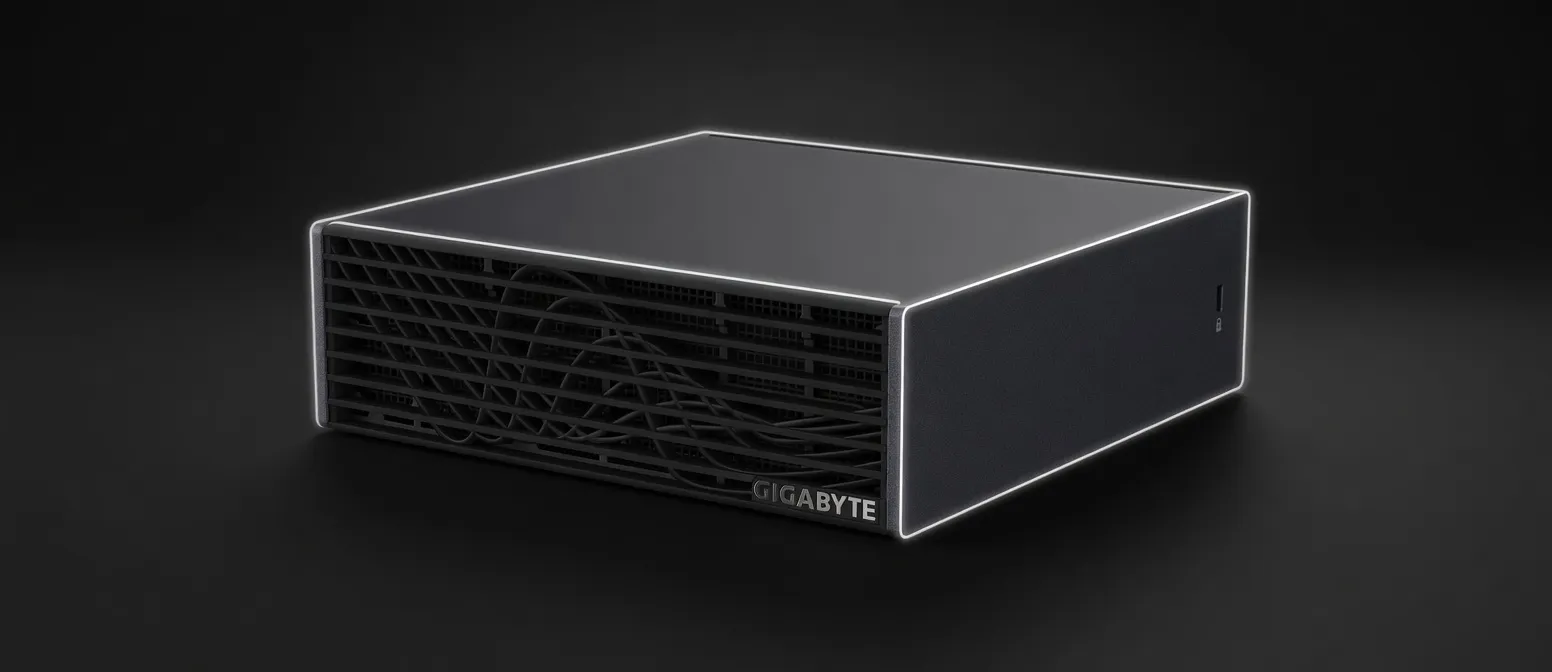
An aggressively priced GB10 personal supercomputer featuring a Delta 240W external PSU and highly efficient idle power characteristics.
Sized for production serving of 70B–200B class models at full or lightly-quantized precision. Overkill for a homelab; right call when the workload pays for itself in token volume.
Generated from this product’s spec sheet. Editor reviews refine it over time.
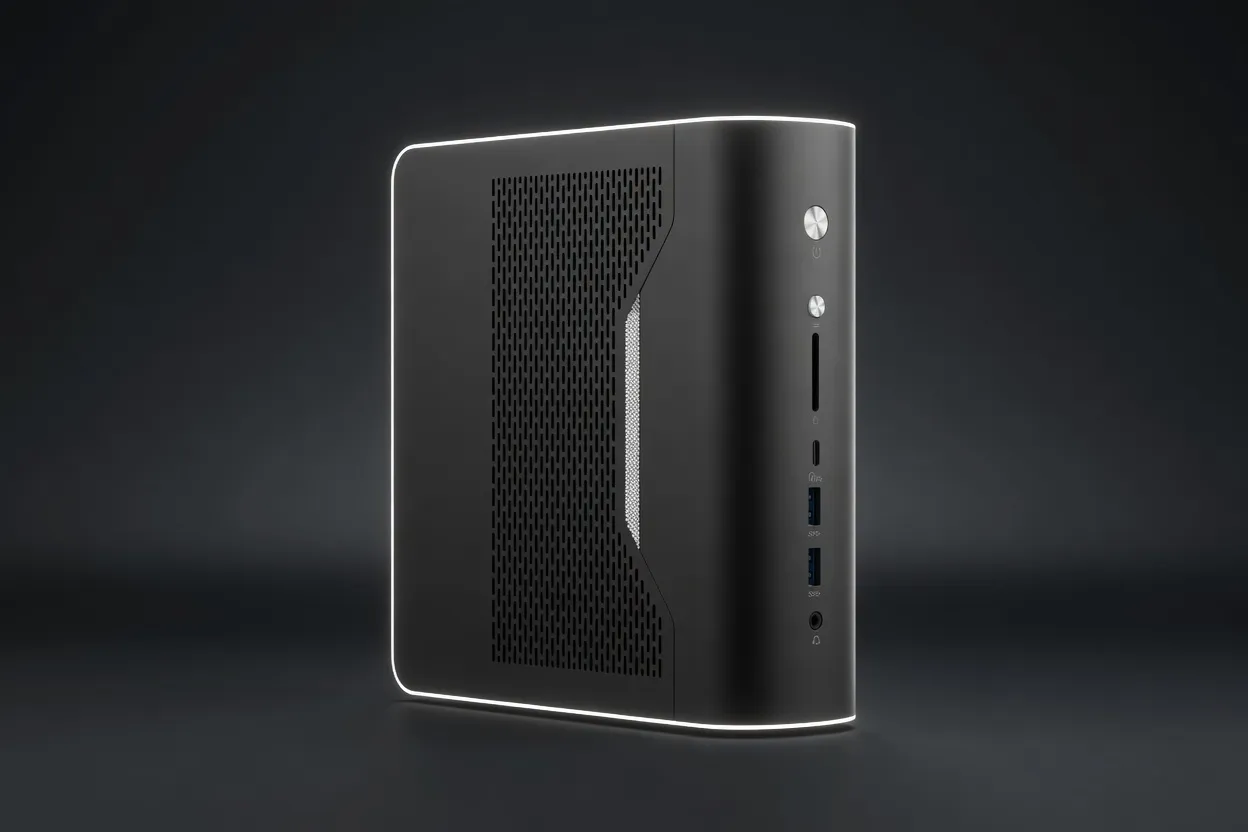
The GIGABYTE AI TOP ATOM is a high-density, small-form-factor workstation built on the NVIDIA GB10 Grace Blackwell foundation. Positioned as a "personal supercomputer," this 1-liter system is designed specifically for engineers and researchers who require massive VRAM capacity without the footprint or power draw of a traditional multi-GPU rack server. At a $3,999 MSRP, it targets the gap between high-end consumer desktops and enterprise-grade DGX systems.
While many AI PCs rely on integrated NPUs with limited memory, the AI TOP ATOM utilizes 128GB of unified LPDDR5X memory. This allows it to serve as a dedicated node for local LLM inference, agentic workflows, and fine-tuning. It competes directly with the Mac Studio (M2/M3 Ultra) and high-end DIY builds featuring dual RTX 3090/4090 GPUs, but offers a more streamlined, specialized software stack via the NVIDIA DGX OS.
The core of the GIGABYTE AI TOP ATOM is the NVIDIA GB10 Superchip, which integrates a 20-core Arm CPU (Cortex-X925 and Cortex-A725) with Blackwell-architecture AI acceleration. For practitioners, the most critical spec is the 128GB of unified VRAM. Unlike traditional PC architectures where the CPU and GPU compete for memory over a narrow bus, this unified pool allows the Blackwell accelerator to access the full 128GB directly.
The top models this device can run at 4-bit, ranked by fit and speed.
| Model | Grade | Speed | VRAM |
|---|---|---|---|
| Qwen3-30B-A3BAlibaba | SS | 40.8 tok/s | 5.4 GB |
| LFM2.5-8B-A1BLiquid AI | AA | 75.6 tok/s | 2.9 GB |
| Llama 3 8B InstructMeta | AA | 38.8 tok/s | 5.7 GB |
| Carnice-9b for Hermes agentkai-os | AA | 36.5 tok/s | 6.0 GB |
| PersonaPlex 7BNVIDIA |
The 273 GB/s memory bandwidth is the primary driver for GIGABYTE AI TOP ATOM tokens per second. While slower than the 1TB/s+ bandwidth found on H100s or high-end Mac Ultras, it is significantly faster than standard DDR5-based systems. This bandwidth ensures that large models remain responsive during local inference, particularly when running agentic loops that require frequent context processing.
The primary advantage of the GIGABYTE AI TOP ATOM for AI is its ability to host models that typically require dual-GPU setups. With 128GB of VRAM, you can bypass the "split-memory" bottleneck often seen when trying to run 70B+ models across multiple consumer cards.
For a 70B model at 4-bit quantization, users can expect roughly 8–12 tokens per second. While not "instantaneous" like a cloud-hosted H100, it is more than sufficient for local RAG (Retrieval-Augmented Generation) and autonomous agent tasks where privacy and zero latency-jitter are prioritized.
The GIGABYTE AI TOP ATOM for AI is not a general-purpose gaming rig; it is a dedicated inference and development node.
Choosing the best hardware for local AI agents in 2026 often comes down to a choice between the AI TOP ATOM, a Mac Studio, or a custom Linux PC.
The Mac Studio offers higher memory bandwidth (up to 800 GB/s), which translates to faster tokens per second for LLM inference. However, the ATOM utilizes the NVIDIA ecosystem (CUDA, TensorRT, DGX OS). For developers whose workflows rely on NVIDIA-specific optimizations or who need to mirror their production cloud environment (which is almost certainly NVIDIA-based), the ATOM is the superior tool.
A dual 4090 build provides 48GB of VRAM and significantly higher raw compute power. However, it requires a 1200W+ PSU, a massive chassis, and complex cooling. The ATOM provides nearly 3x the VRAM (128GB vs 48GB) in a 1-liter box using a fraction of the power. If your bottleneck is model size rather than raw training speed, the ATOM is the more efficient and cost-effective choice for running 200B parameter models.
The GIGABYTE AI TOP ATOM represents a shift toward specialized AI hardware for the desk. It prioritizes VRAM capacity and energy efficiency, making it one of the most practical AI PCs for running AI models locally without the overhead of enterprise data center infrastructure.
| AA |
| 45.9 tok/s |
| 4.8 GB |