- Services
Advertising disclosure: we earn commissions when you shop through the links below.
Apple's next-gen chip with Neural Accelerators in every GPU core, delivering 4x peak AI compute vs M4. Built on 3nm with up to 10-core GPU, 32GB unified memory, and 153.6 GB/s bandwidth.
Manufacturer's suggested retail price. Current prices can be higher or lower. This is not a live price.
A 70B Q4 quant fits with usable context budget left over. Sweet spot if you want a single card that handles every open model worth running locally today.
Generated from this product’s spec sheet. Editor reviews refine it over time.
The Apple M5 represents a significant architectural shift in Apple Silicon, moving beyond the incremental gains of previous generations to prioritize high-throughput AI inference. Built on TSMC’s 3rd-generation 3nm process, the M5 is designed for engineers and researchers requiring a high-efficiency workstation for local development and agentic workflows. While the M-series has always utilized a unified memory architecture, the M5 introduces a dedicated Neural Accelerator within every GPU core, resulting in 4x peak AI compute compared to the M4.
Positioned as the entry point for professional Apple Silicon for AI development, the M5 competes directly with high-end mobile workstations and mid-range discrete GPU setups. For practitioners, the M5 is a specialized tool for on-device deployment and local LLM experimentation. It bridges the gap between consumer-grade hardware and dedicated AI accelerators, offering a 25W TDP that makes it the premier choice for energy-efficient local AI agents in 2025.
The defining characteristic of the Apple M5 for AI is its memory architecture. With up to 32GB of LPDDR5X unified memory clocked at 9600 MT/s, the chip provides 153.6 GB/s of memory bandwidth. In the context of LLM inference, memory bandwidth is almost always the primary bottleneck for token generation speed. While 153.6 GB/s is lower than the "Max" or "Ultra" variants of previous chips, the M5 compensates with its revamped GPU architecture.
The integration of Neural Accelerators into each of the 10 GPU cores represents a fundamental change in how the chip handles matrix multiplication. By offloading these operations from the standard shaders to specialized hardware within the GPU, the M5 achieves significantly higher TFLOPS for FP16 and INT8 operations. This is further supported by Metal 4, which introduces optimized kernels for transformer-based architectures, reducing the overhead when running local LLMs.
Operating at a 25W TDP, the M5 offers a performance-per-watt ratio that remains unmatched by x86 alternatives paired with discrete Nvidia GPUs. This makes it the best AI chip for local deployment in environments where thermal management and power draw are constraints, such as edge computing or mobile development rigs.
When evaluating Apple M5 VRAM for large language models, the 32GB unified memory pool is the critical factor. Because the CPU and GPU share this memory, practitioners can allocate the vast majority of it (typically up to 75-80% depending on macOS overhead) to the model weights and KV cache.
The M5 is the ideal hardware for running 7B at Q4 with 32GB unified memory configurations. At this scale, the model fits entirely within the high-speed memory with ample room for a large context window (32k+ tokens).
For practitioners, the best quality-to-speed tradeoff on the M5 is typically found at 4-bit (Q4_K_M) or 5-bit (Q5_K_M) quantization. While the chip can technically load larger models (like a heavily quantized 27B model), the 153.6 GB/s bandwidth will cause a noticeable drop in tokens per second, likely falling into the 8-12 t/s range, which may be insufficient for complex agentic workflows.
The Apple M5 is engineered for specific professional and enthusiast profiles:
For those building apps on the "Apple Intelligence" stack or using CoreML, the M5 is the standard-bearer. The 4x jump in AI compute over the M4 significantly reduces compile times for model optimization and allows for faster iterative testing of local RAG (Retrieval-Augmented Generation) pipelines.
If you are looking for the best hardware for local AI agents 2025, the M5’s low power draw allows it to run 24/7 as a local inference server without significant electricity costs or noise. Its ability to handle 7B and 14B models makes it perfect for personal assistants that require low-latency responses.
The 25W TDP and 3nm efficiency make the M5 a candidate for edge nodes where high-performance inference is required without the footprint of a server rack. It is particularly effective for on-site data processing where privacy and data sovereignty are required.
To understand the M5's value, it must be compared against existing silicon and PC alternatives.
The M5’s primary advantage over a mid-range Nvidia setup is the memory ceiling. While an RTX 4060 Ti is faster in pure compute, it is limited to 16GB of VRAM. The M5’s 32GB capacity allows it to run larger models and longer context windows that would simply OOM (Out of Memory) on the Nvidia card. However, for training or fine-tuning (LoRA), the Nvidia ecosystem (CUDA) remains the industry standard, whereas the M5 is strictly an inference powerhouse.
While the M4 Pro may offer higher raw bandwidth in some configurations, the M5's per-core Neural Accelerators give it a distinct advantage in Apple M5 AI inference performance. The 4x peak AI compute metric suggests that for specific transformer operations, the M5 will outperform the previous generation's "Pro" chips in throughput, despite having a lower core count.
The Snapdragon X Elite is a strong competitor in the Windows-on-ARM space with a capable NPU. However, the M5’s Metal 4 framework and the deep integration of unified memory give it a systematic advantage for developers using libraries like llama.cpp or MLX. The M5 offers a more mature software ecosystem for practitioners running local LLMs.
The Apple M5 stands as a highly specialized, 32GB GPU for AI tasks that prioritizes memory capacity and architectural efficiency over raw clock speeds. For the practitioner focused on local inference, it represents the most balanced entry point into high-performance AI on the macOS ecosystem.
The top models this device can run at 4-bit, ranked by fit and speed.
| Model | Grade | Speed | VRAM |
|---|---|---|---|
| Holo4-35B-A3BHcompany | SS | 52.9 tok/s | 2.3 GB |
| LFM2.5-8B-A1BLiquid AI | AA | 42.5 tok/s | 2.9 GB |
| Qwen3-30B-A3BAlibaba | AA | 23.0 tok/s | 5.4 GB |
| Gemma 4 E2B ITGoogle | AA | 33.3 tok/s | 3.7 GB |
| Apertus 8BEPFL, ETH Zurich, CSCS | BB | 22.9 tok/s | 5.4 GB |
Among 6 similar devices, the Apple M5 ranks #6 for memory and #6 for memory bandwidth.
Also in Our Store
Docks, fast storage, cables, and a UPS sized for a local AI machine.

Rent this class of GPU by the hour before you buy. Live prices from RunPod and Vast.ai.
Find the break-even between buying this hardware and paying for a cloud API.
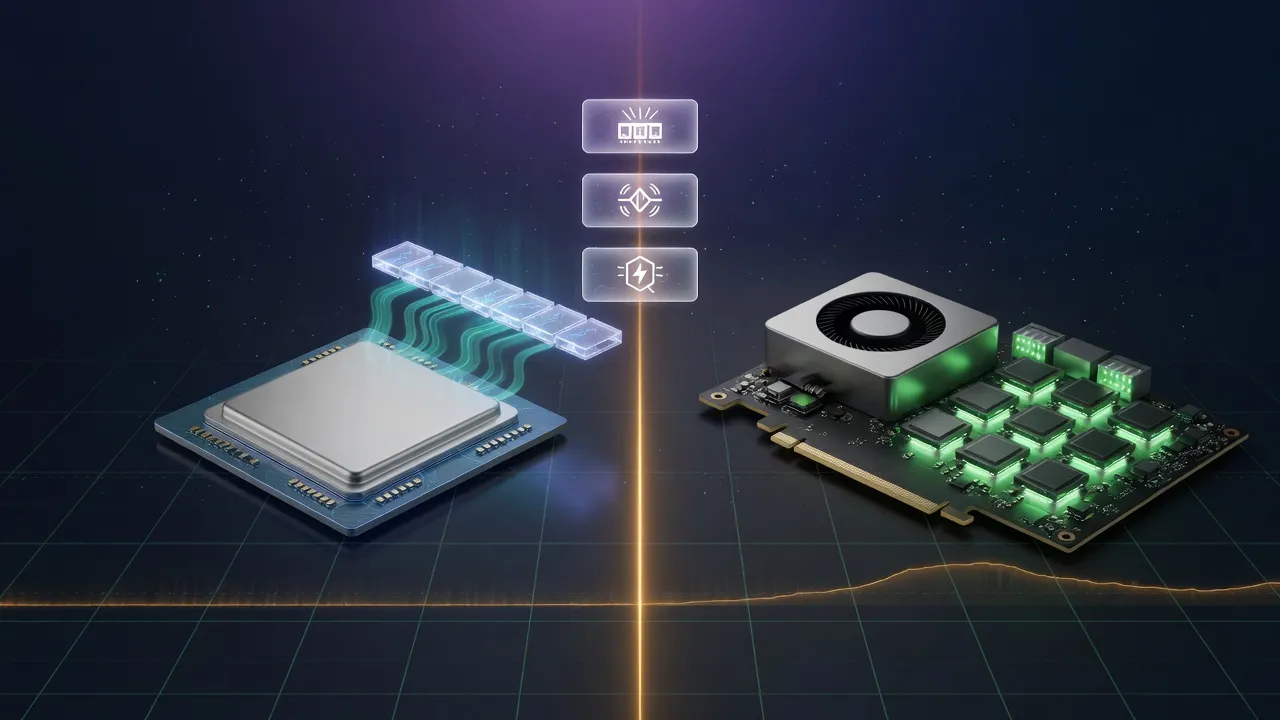
Mac vs NVIDIA for local inference, if you are still choosing a platform.