- Services
Advertising disclosure: we earn commissions when you shop through the links below.
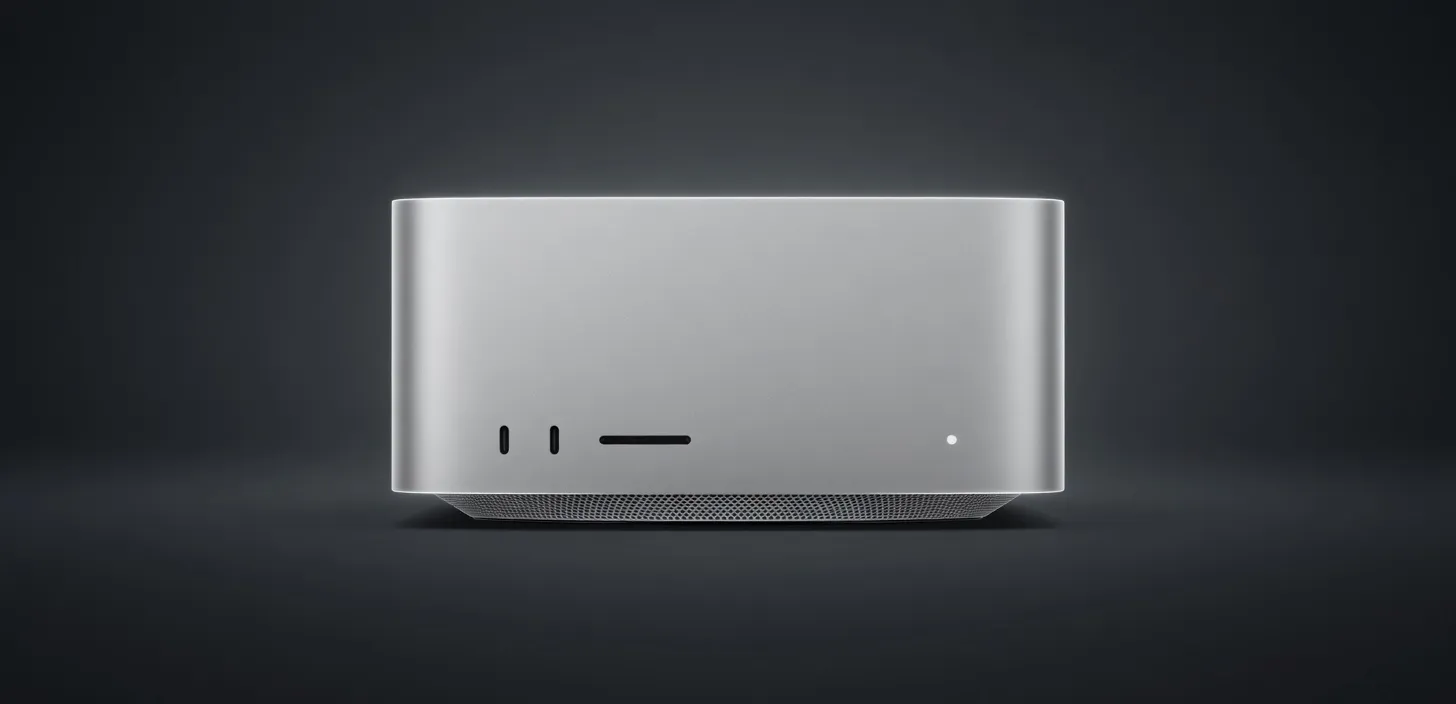
Third-gen Mac Studio with M4 Max bringing the world's fastest CPU core, up to 40-core GPU with hardware ray tracing, and up to 128GB unified memory at 546 GB/s. First Mac Studio with Thunderbolt 5.
Sized for production serving of 70B–200B class models at full or lightly-quantized precision. Overkill for a homelab; right call when the workload pays for itself in token volume.
Generated from this product’s spec sheet. Editor reviews refine it over time.
The Apple Mac Studio (M4 Max, 2025) represents the high-water mark for single-node AI inference in a desktop form factor. Developed by Apple as the mid-tier powerhouse between the Mac mini and the Mac Pro, this iteration leverages the M4 Max SoC to bridge the gap between prosumer hardware and dedicated workstation-class silicon. For AI engineers and researchers, the Mac Studio is a production-ready appliance designed specifically to solve the "VRAM bottleneck" that plagues consumer-grade GPUs.
In the current market, the Mac Studio (M4 Max, 2025) for AI development occupies a unique niche. While NVIDIA remains the king of training, the M4 Max’s unified memory architecture makes it a formidable competitor to multi-GPU PC builds. It competes directly with the NVIDIA RTX 6000 Ada and dual-RTX 4090 configurations, offering a more power-efficient, compact, and "plug-and-play" alternative for local LLM deployment and agentic workflow orchestration.
The defining feature of the Apple Mac Studio (M4 Max, 2025) VRAM for large language models is its Unified Memory Architecture (UMA). Unlike traditional PC architectures where the CPU and GPU have separate memory pools, the M4 Max allows the GPU to access up to 128GB of LPDDR5X memory. For AI practitioners, this means the ability to load massive model weights into memory without the latency of PCIe bus transfers.
Inference speed (tokens per second) is primarily bound by memory bandwidth. The M4 Max configuration with a 40-core GPU delivers 546 GB/s of bandwidth. This is a significant leap over the base M4 and M4 Pro chips, allowing for high-throughput inference on models that would otherwise crawl on consumer hardware. While an NVIDIA RTX 4090 offers higher raw bandwidth (approx. 1 TB/s), the Mac Studio provides a much larger total capacity, 128GB vs. 24GB, at a fraction of the power draw.
The M4 Max features a 16-core Neural Engine rated at 38 TOPS (INT8). While the Neural Engine is optimized for CoreML tasks, most LLM practitioners will utilize the 40-core GPU via Metal Performance Shaders (MPS) for frameworks like Llama.cpp, MLX, and Ollama. The inclusion of hardware-accelerated ray tracing and improved second-gen 3nm architecture ensures that the GPU can handle both matrix multiplication for LLMs and complex vector math for multimodal models efficiently.
The 2025 Mac Studio is the first in its line to feature Thunderbolt 5, providing up to 120Gb/s of throughput. For engineers building local agent clusters, this allows for ultra-fast data transfer between high-speed storage arrays or external accelerators. The 10Gb Ethernet port remains standard, making it a "production ready" choice for small teams running local inference servers.
The primary reason to choose the Apple Mac Studio (M4 Max, 2025) for local LLM work is the 128GB memory ceiling. This capacity allows for the execution of models that are physically impossible to run on standard consumer hardware.
With 128GB of unified memory (typically allowing ~90-100GB to be allocated to the GPU), you can run:
The 128GB GPU for AI is a game-changer for Vision-Language Models (VLMs) like Pixtral or LLaVA. Furthermore, the massive memory pool allows for the use of "long-context" models. You can load a 32B model and still have 80GB of RAM available for the KV cache, enabling the processing of entire codebases or long PDF sets in a single prompt.
The Mac Studio is the premier Apple silicon for AI development. If you are building agents that require constant local testing, the M4 Max provides the stability of macOS with the power of a workstation. It is the ideal "dev box" for fine-tuning small models (PEFT/LoRA) and running local RAG (Retrieval-Augmented Generation) pipelines.
For teams building agentic workflowsthe Mac Studio can act as a local hub. Its 128GB of memory allows it to run multiple models simultaneously, for example, a Llama 3.1 70B "Manager" agent and two smaller 8B "Worker" agents, without hitting OOM (Out of Memory) errors.
For researchers handling sensitive data that cannot leave the local network, the Mac Studio (M4 Max, 2025) is the best AI chip for local deployment in an office environment. It is nearly silent even under full load and fits on a standard desk, unlike rack-mounted servers or loud, multi-GPU PC towers.
The RTX 6000 Ada is a powerhouse with 48GB of VRAM and significantly higher CUDA performance. However, a single 6000 Ada costs roughly $7,000, more than triple the MSRP of the Mac Studio. To match the 128GB capacity of the Mac Studio, you would need three RTX 6000s. The Mac Studio is the clear winner for capacity-per-dollar, while NVIDIA remains the choice for raw compute speed and training.
The M4 Max core architecture is significantly more efficient than the previous Ultra generation. While the M2 Ultra can support up to 192GB of memory, the M4 Max offers faster single-core CPU performance and the latest Neural Engine. For practitioners who need to run 70B models at maximum speed, the M4 Max's 546 GB/s bandwidth and improved architecture often outperform the older Ultra chips in real-world inference latency.
A dual 4090 build provides 48GB of VRAM and superior TFLOPS. However, these builds require massive power supplies (1200W+), custom cooling, and a large chassis. The Mac Studio (M4 Max, 2025) provides nearly 3x the VRAM (128GB) in a 7.7-inch enclosure, making it the superior choice for running large-parameter models that simply won't fit on dual consumer GPUs.
The top models this device can run at 4-bit, ranked by fit and speed.
| Model | Grade | Speed | VRAM |
|---|---|---|---|
| AliceAI-Foundation-80B-A3B-Baseyandex | SS | 51.5 tok/s | 8.5 GB |
| Mixtral 8x7B InstructMistral AI | SS | 38.7 tok/s | 11.4 GB |
| DiffusionGemma 26B-A4BGoogle | SS | 41.9 tok/s | 10.5 GB |
| Gemma 4 26B-A4B ITGoogle | SS | 39.9 tok/s | 11.0 GB |
| North Mini CodeCohere | SS | 52.4 tok/s | 8.4 GB |
Among 6 similar devices, the Apple Mac Studio (M4 Max, 2025) ranks #3 for memory and #4 for memory bandwidth.
Also in Our Store
Docks, fast storage, cables, and a UPS sized for a local AI machine.

Rent this class of GPU by the hour before you buy. Live prices from RunPod and Vast.ai.
Find the break-even between buying this hardware and paying for a cloud API.
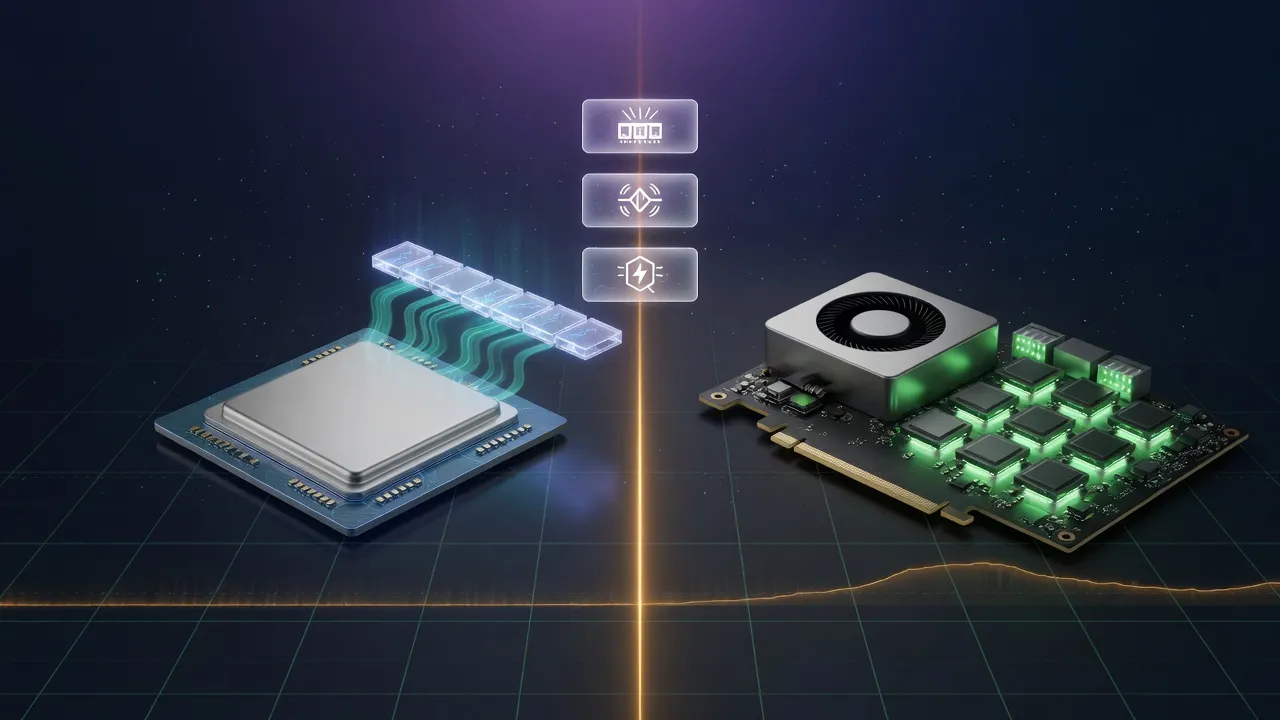
Mac vs NVIDIA for local inference, if you are still choosing a platform.