- Services
Advertising disclosure: we earn commissions when you shop through the links below.
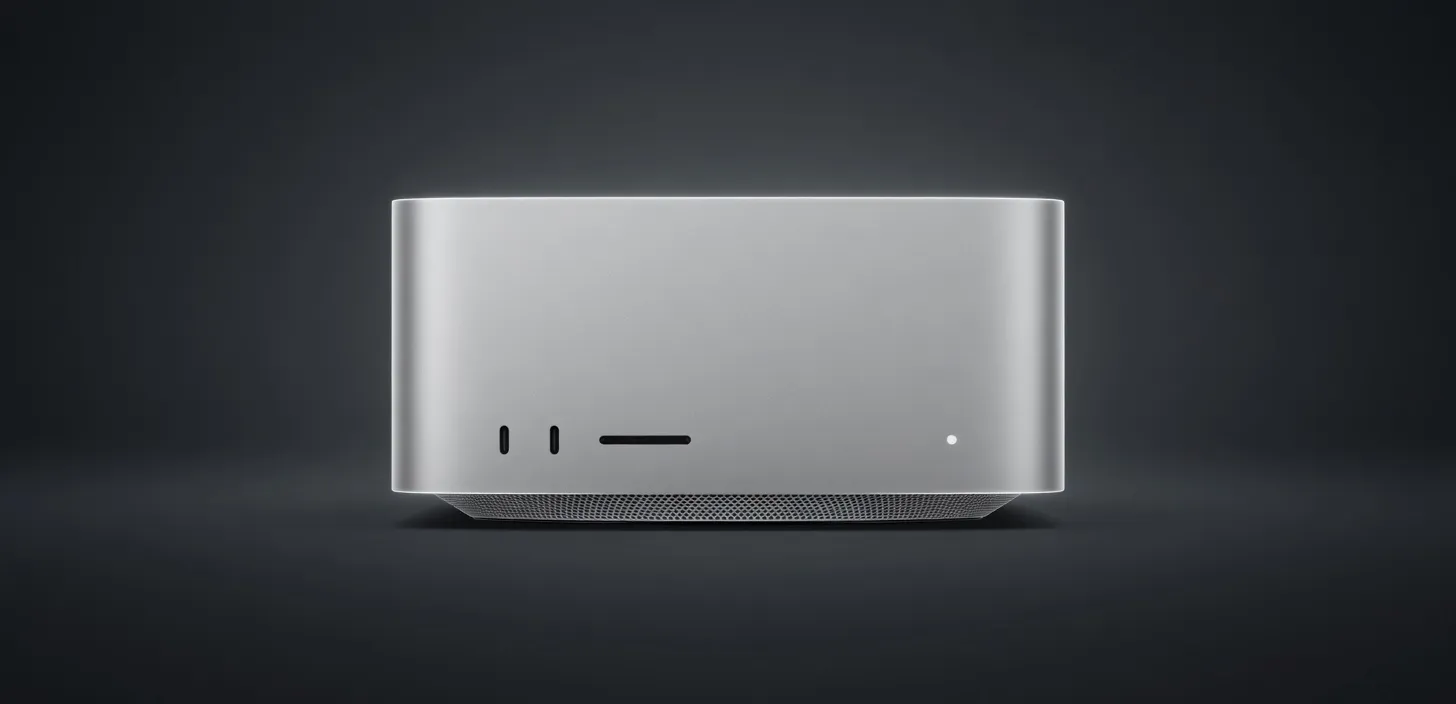
The most powerful Mac ever made. M3 Ultra fuses two M3 Max dies for a 32-core CPU, 80-core GPU, and up to 512GB unified memory at 819 GB/s. Can run LLMs with 600B+ parameters entirely in memory.
Sized for production serving of 70B–200B class models at full or lightly-quantized precision. Overkill for a homelab; right call when the workload pays for itself in token volume.
Generated from this product’s spec sheet. Editor reviews refine it over time.
The Apple Mac Studio (M3 Ultra, 2025) represents the current ceiling for single-node local inference. By utilizing Apple’s UltraFusion architecture to interconnect two M3 Max dies, the M3 Ultra effectively operates as a monolithic SoC with a massive unified memory pool. For AI engineers and researchers, the Mac Studio is not a workstation in the traditional sense; it is a high-bandwidth inference engine capable of loading models that previously required multi-GPU clusters or data-center-grade hardware.
While many developers look toward the M4 series for single-core efficiency, the M3 Ultra remains the "Gold Standard" for local LLMs due to its 512GB unified memory capacity. Because Apple Silicon allows the GPU to access the entire system RAM, this machine bypasses the 24GB VRAM bottleneck found on consumer-grade NVIDIA cards. It competes directly with multi-GPU RTX 5090 or A6000 Ada setups, offering a more compact, power-efficient, and "plug-and-play" alternative for production-ready agentic workflows.
The primary metric that defines Apple Mac Studio (M3 Ultra, 2025) AI inference performance is its 819 GB/s memory bandwidth. In LLM inference, the bottleneck is rarely compute (TFLOPS) but rather how fast weights can be moved from memory to the processor. At 819 GB/s, the M3 Ultra provides the throughput necessary to maintain high tokens-per-second (t/s) even on high-parameter models.
Compared to a dual NVIDIA RTX 6000 Ada setup, the Mac Studio draws significantly less power (370W max system draw vs. 600W+ for dual GPUs), making it suitable for standard office circuits without dedicated cooling or power infrastructure.
The Apple Mac Studio (M3 Ultra, 2025) VRAM for large language models changes the math on quantization. While most users are forced to use 4-bit (Q4_K_M) or 8-bit quantizations to fit models on consumer GPUs, the 512GB capacity allows for running massive models at FP16 or high-bit quantizations.
For a 70B parameter model (e.g., Llama 3.1 70B), users can expect between 15–25 tokens per second depending on the quantization level and context window usage. For the 405B model, expect 1–3 tokens per second, slow for a chatbot, but revolutionary for a local machine performing complex reasoning or synthetic data generation.
The Mac Studio (M3 Ultra, 2025) is the best hardware for local AI agents 2025 specifically for those who need to maintain data privacy while working with frontier-level models.
When evaluating the Apple Mac Studio (M3 Ultra, 2025) vs. DIY PC Builds, the decision usually comes down to memory capacity vs. raw compute speed.
An NVIDIA-based system with two or three RTX 5090s will offer higher raw TFLOPS and faster inference on smaller models (under 70B parameters) due to faster GDDR7/GDDR6X memory speeds. However, even a triple-5090 setup only provides 96GB of VRAM. The Mac Studio’s 512GB capacity is over 5x larger, allowing it to run models that simply will not load on a consumer NVIDIA build.
Both machines share the same SoC and memory limits. The Mac Pro offers PCIe expansion, which is useful for dedicated storage controllers or networking cards, but for AI inference, the Mac Studio provides identical performance in a much smaller footprint for a lower price point.
The primary advantage is the Unified Memory Architecture (UMA). In a PC, moving data between system RAM and GPU VRAM creates a massive bottleneck. On the M3 Ultra, the CPU and GPU share the same pool of 512GB LPDDR5, eliminating data duplication and latency. This makes it the best apple silicon for running AI models locally where model size is the primary constraint.
The top models this device can run at 4-bit, ranked by fit and speed.
| Model | Grade | Speed | VRAM |
|---|---|---|---|
| Mixtral 8x7B InstructMistral AI | SS | 58.0 tok/s | 11.4 GB |
| AliceAI-Foundation-80B-A3B-Baseyandex | SS | 77.3 tok/s | 8.5 GB |
| DiffusionGemma 26B-A4BGoogle | AA | 62.9 tok/s | 10.5 GB |
| Gemma 4 26B-A4B ITGoogle | AA | 59.9 tok/s | 11.0 GB |
| Xing4.0-29B-A4BChina Telecom AI | AA | 58.8 tok/s | 11.2 GB |
Among 6 similar devices, the Apple Mac Studio (M3 Ultra, 2025) ranks #1 for memory and #1 for memory bandwidth.
Also in Our Store
Docks, fast storage, cables, and a UPS sized for a local AI machine.

Rent this class of GPU by the hour before you buy. Live prices from RunPod and Vast.ai.
Find the break-even between buying this hardware and paying for a cloud API.
Mac vs NVIDIA for local inference, if you are still choosing a platform.