
- Services
Advertising disclosure: we earn commissions when you shop through the links below.
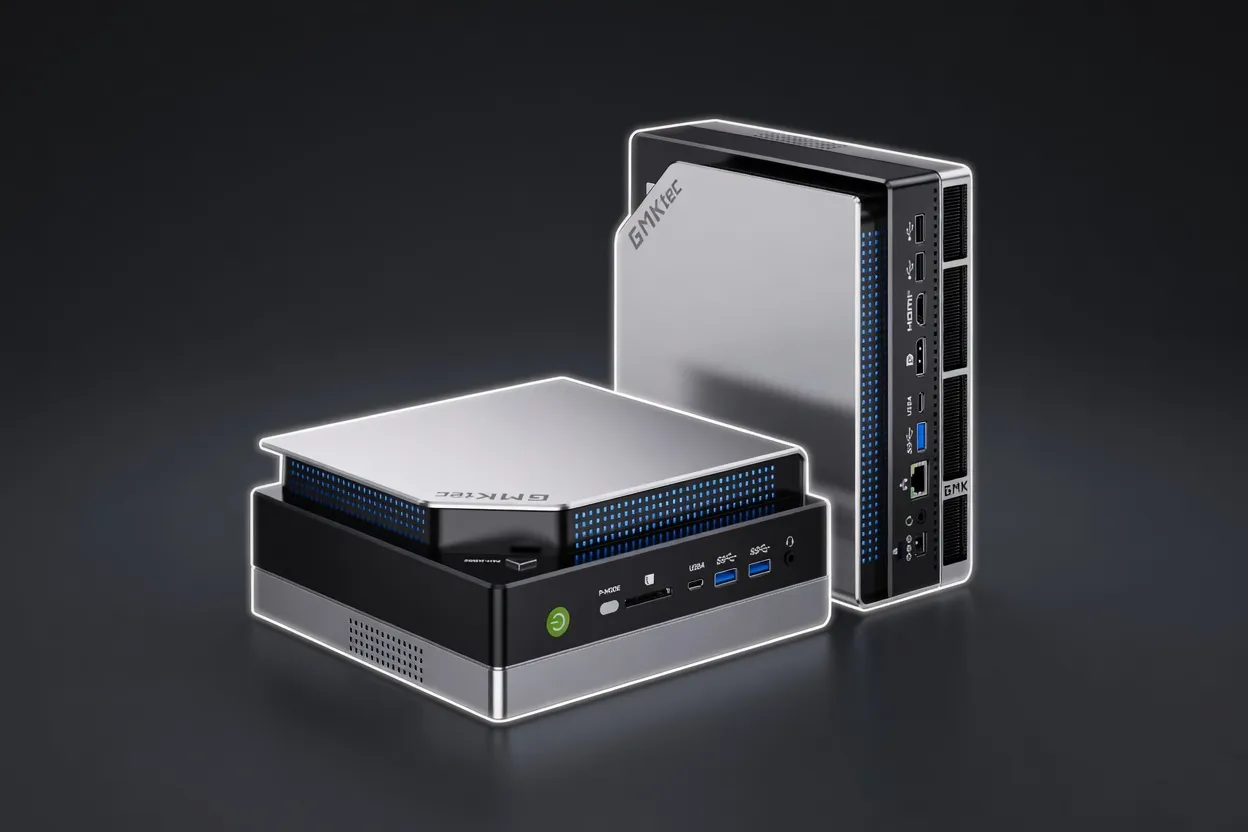
Flagship Strix Halo mini PC with 128GB unified LPDDR5X-8000 and Radeon 8060S. Unlocks the full 96GB GPU allocation — runs 70B at Q5 and Qwen3-235B sparse models locally. Won the American Good Design Platinum Award 2025.
Manufacturer's suggested retail price. Current prices can be higher or lower. This is not a live price.
Sized for production serving of 70B–200B class models at full or lightly-quantized precision. Overkill for a homelab; right call when the workload pays for itself in token volume.
Generated from this product’s spec sheet. Editor reviews refine it over time.
The GMKtec EVO-X2 (Ryzen AI Max+ 395 128GB) is a flagship mini PC purpose-built for local AI inference. It leverages AMD’s Strix Halo APU, a 16-core Zen 5 CPU paired with a Radeon 8060S iGPU and XDNA 2 NPU, to deliver 96 GB of unified GPU-allocatable memory in a compact, low-power chassis. At $1,999, it occupies the prosumer tier: more capable than a consumer laptop, far more energy-efficient than a multi-GPU workstation, and directly competitive with entry-level server-grade inference rigs.
This is not a general-purpose desktop. The EVO-X2 is engineered for one task: running large language models and other AI workloads locally, without cloud dependency. Its 128 GB of LPDDR5X-8000 unified memory can allocate up to 96 GB to the GPU, enabling models that would otherwise require a $10,000+ setup. The design won the American Good Design Platinum Award 2025, reflecting its industrial and thermal engineering, a metal chassis with triple-fan cooling keeps sustained loads under 70 °C.
For developers and researchers who need to run 70B-parameter models at Q5 quantization, or experiment with sparse 235B models, the EVO-X2 is currently the most accessible hardware that can do so in a desk-friendly form factor.
The headline spec is the 96 GB of GPU-accessible memory. This is not a discrete GPU with dedicated VRAM; it’s unified memory shared between the CPU and GPU via the Radeon 8060S iGPU (40 RDNA 3.5 compute units). The full 96 GB allocation is unlocked by default on this SKU, no BIOS tweaks or memory reservation tricks required. This is the largest unified memory pool available in any mini PC as of mid-2025.
The 128 GB of LPDDR5X-8000 runs on a 256-bit bus, delivering 256 GB/s bandwidth. That’s roughly 60% of a desktop RTX 4090 (1 TB/s) but more than enough for token generation at reasonable batch sizes. For context, a Mac M2 Ultra with 192 GB unified memory peaks at 800 GB/s, but costs over $5,000. The EVO-X2’s bandwidth is a limiting factor for very large models (235B+), but for the 70B–120B range it’s well-matched to the compute throughput.
The XDNA 2 NPU provides 50 TOPS for integer operations, but the real workhorse for LLM inference is the iGPU’s FP16/INT4 matrix units. The Radeon 8060S iGPU delivers approximately 12.5 TFLOPS (FP16), comparable to an RTX 4060 Ti. Combined with the CPU’s 16 Zen 5 cores (boost up to 5.1 GHz), the system achieves ~50 tokens/s on 7B models and ~23 tokens/s on 20B models in real-world benchmarks (e.g., GPT-OSS-20B at 23.8 tok/s out of the box on Ubuntu).
At 140W peak TDP, the EVO-X2 consumes less than a third of a typical gaming GPU. This makes it viable for edge deployment, home labs running 24/7, or offices where noise and heat matter. The triple-fan cooling keeps the APU under 70 °C during sustained inference, though brief throttling may occur after 15 minutes of peak load (per Mini PC Reviewer tests).
This is the critical question for any practitioner. The EVO-X2’s 96 GB unified memory and 256 GB/s bandwidth define a clear capability envelope.
| Model Size | Quantization | Approx. VRAM Usage | Feasibility |
|---|---|---|---|
| 7B | Q4_K_M | ~5 GB | Effortless, runs at >50 tok/s |
| 20B | Q5_K_M | ~14 GB | Fast (23–30 tok/s) |
| 70B | Q5_K_M | ~48 GB | Sweet spotfits with headroom |
| 120B | Q4_K_M | ~72 GB | Possible with effort, ~15 tok/s |
| 235B | Sparse (50%) | ~96 GB | ~11 tok/s, requires sparse inference support |
The unified memory architecture excels at multimodal models (e.g., LLaVA, Qwen-VL) because image embeddings share the same pool without PCIe transfers. Long-context tasks (128K+ tokens) are feasible for models up to 70B; beyond that, context length must be reduced to avoid OOM.
Based on benchmarks from nishtahir.com and Mini PC Reviewer:
For production inference servers, batch size 1 is typical; for hobbyist use, these speeds are comfortable for interactive chat on models up to 70B.
The GMKtec EVO-X2 is currently the most cost-effective way to get 96 GB of unified memory for AI inference in a compact, low-power package. It fills a gap between consumer laptops and enterprise workstations, making large local models accessible to individual developers and small teams.
The top models this device can run at 4-bit, ranked by fit and speed.
| Model | Grade | Speed | VRAM |
|---|---|---|---|
| Nemotron 3.5 Bolt 74B-A9B 24GBNVIDIA | SS | 34.3 tok/s | 43.7 GB |
| NVIDIA Nemotron 3.5 Bolt 74B-A9B 24GBNVIDIA | SS | 34.3 tok/s | 43.7 GB |
| Holo4-35B-A3BHcompany | SS | 88.1 tok/s | 20.9 GB |
| Nemotron 3.5 LightningNvidia | SS | 88.1 tok/s | 18.0 GB |
| LFM2.5-24B-A2BLiquid AI | SS | 45.9 tok/s | 17.0 GB |
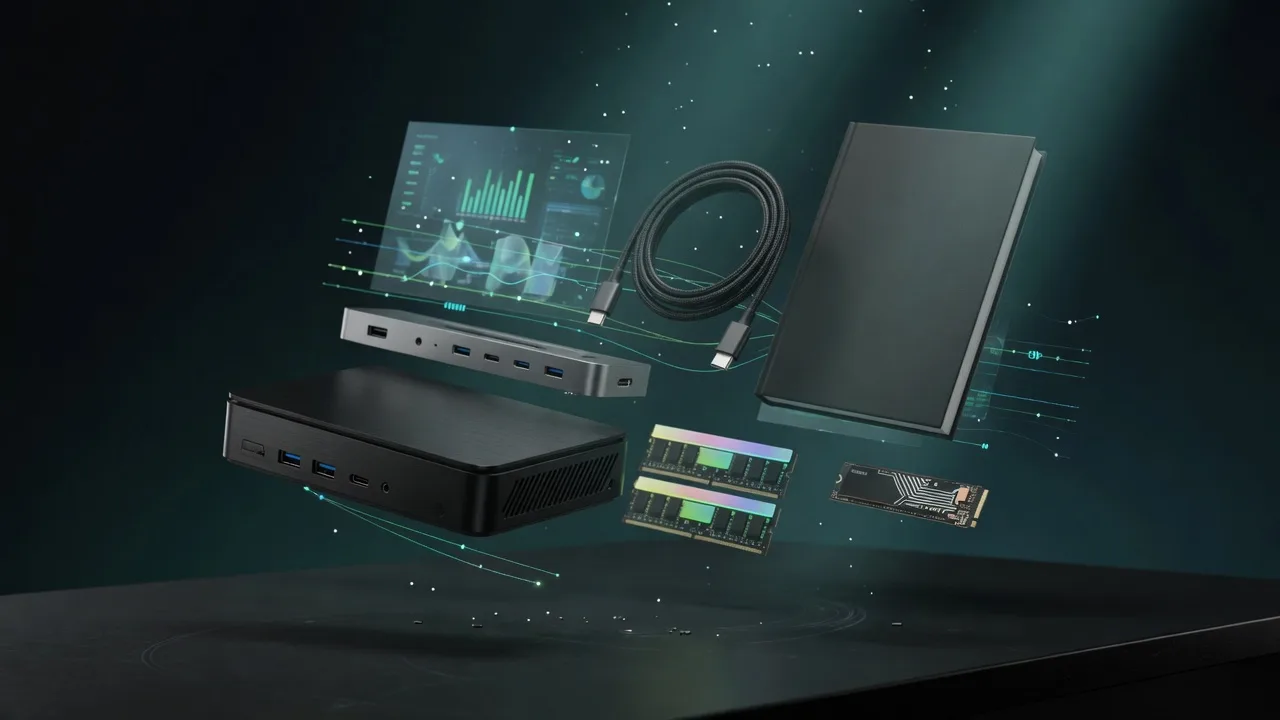
Also in Our Store
Docks, fast storage, cables, and a UPS sized for a local AI machine.
Rent this class of GPU by the hour before you buy. Live prices from RunPod and Vast.ai.
Find the break-even between buying this hardware and paying for a cloud API.
Mac vs NVIDIA for local inference, if you are still choosing a platform.
