How to Become an AI-First Company: The Playbook I Use With My Clients
A practical playbook for becoming an AI-first company. Mindset, AI audit, roadmap, agents, and culture, from a working AI consultant.
Last updated: Aug 30, 202611 mins read
Table of Contents
📝 Audio Version
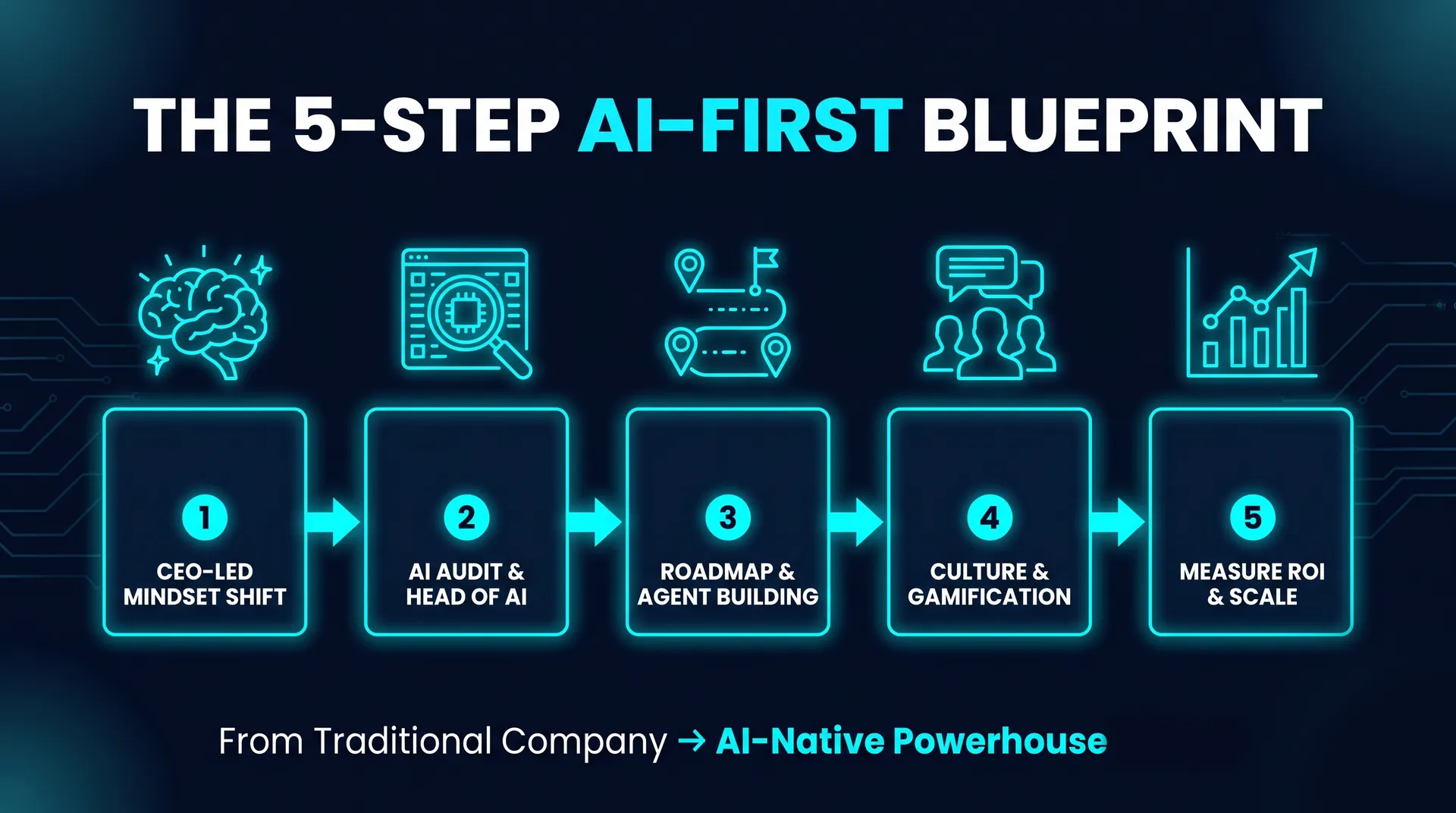
The Five Step AI First Playbook
Asking ChatGPT to write your emails was yesterday. Right now, your biggest competitors are shipping 10, 20, 30 AI agents and replacing 40 hours of weekly work. While most teams are running a few random pilots, the leaders are pulling ahead and the gap is getting wider every quarter.
This is the exact playbook I use to turn normal companies into AI-first operators. Mindset, audit, roadmap, agents, culture. No fluff, no theory. It is what I run for my consulting clients at madebyagents.com, and I am going to walk you through every step.
AI-first does not mean "we use ChatGPT". It does not mean your marketing team has a Notion page of prompts. It means AI is the operating system of the company. Every workflow, every department, every hiring decision assumes AI will execute or optimize the work. If you turned the AI off tomorrow, the business would not function.
Three quick definitions so we are speaking the same language:
- AI-enabled: AI bolted onto legacy processes as a feature.
- AI-first: AI is the default for every workflow. Existing operations get redesigned around it.
- AI-native: The company was built around AI from day one.
Most established companies will end up AI-first, not AI-native. That is the realistic path, and it is the one this playbook is built for.
The urgency is real. McKinsey's State of AI 2025 report shows 88% of organizations now use AI in at least one function, but only about 6% are capturing disproportionate value 1. BCG's 2025 study of 1,250 companies found that 60% generate no material value from their AI investment, while the 5% who lead expect 2x revenue growth and 40% greater cost reductions by 2028 2. The gap between "we use AI" and "we are AI-first" is exactly where competitive advantage is being built right now.
Before the playbook, you need to know what you are walking into. MIT's NANDA project found that 95% of generative AI pilots deliver no measurable P&L impact 3. Gartner predicts more than 40% of agentic AI projects will be cancelled by the end of 2027 because of escalating costs, unclear value, and weak controls 4.
Why does it happen?
- Bad data. Without clean, accessible, governed data, agents are useless.
- Pilot purgatory. The proof of concept never makes it into actual workflows.
- No executive owner. AI gets dumped on the IT team and stalls.
- Wrong use cases. Companies build flashy front-office demos when the back-office work is where the ROI lives.
- Overengineering. Someone tries to replace SAP with three engineers and an LLM.
The companies that succeed do something different. They run this playbook, in order, and they do not skip steps.
This is the non-negotiable starting point, and it has to come from the top.
The whole company needs to change its identity. You are now an AI-first company. That means:
- Slow processes get traded for fast and adaptable ones.
- Silos get replaced with "we are water". Information and tools flow across departments.
- Fear of change gets replaced with the assumption that AI is the new operating system.
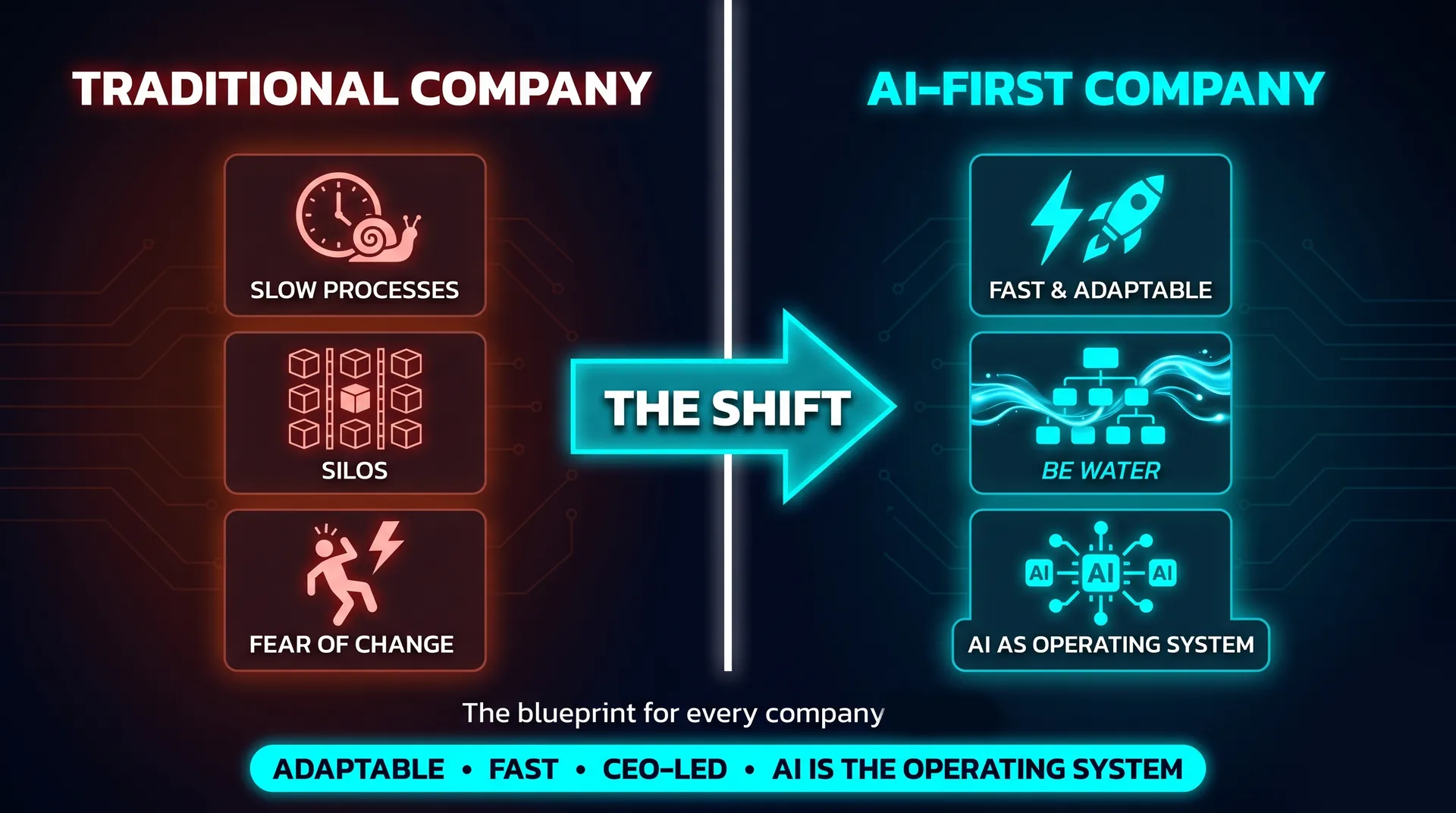
The CEO has to lead this visibly. Not through a memo. Through every all-hands, every product review, every hiring conversation. AI is not a project for the IT team anymore. It belongs in marketing, support, finance, recruiting, engineering, sales, and ops. Every department.
A Forbes Technology Council piece in December 2024 put it cleanly: "Every company has to become AI-first. AI has to become their revenue engine. It is not enough to just automate processes, such as customer support, with AI. This is the bare minimum. Companies have to get AI into their core" 5. That is the bar.
The cautionary tale is what happens when leaders frame this badly. Klarna pushed AI-first hard, ran a hiring freeze, and let an AI chatbot replace the work of about 700 agents. They saved roughly $60M, but the CEO admitted in 2025 that quality suffered and they started rehiring humans 6. Duolingo announced an AI-first shift, faced a public backlash, and lost 400,000+ TikTok followers in days 6.
The lesson is simple: AI-first is about amplifying your people, not replacing them on a press release.
This can be someone you assign internally or someone you hire. It can also be a dedicated external partner. The role does not need a fancy title. It needs ownership.
The Head of AI runs a full audit of every department. Marketing, support, engineering, recruiting, finance, sales, ops. They map workflows, talk to the people doing the work, and rank where AI can move the needle. A single dedicated person doing this can find millions in hidden opportunities. I do this for my clients and the audit alone usually pays for the entire engagement multiple times over.
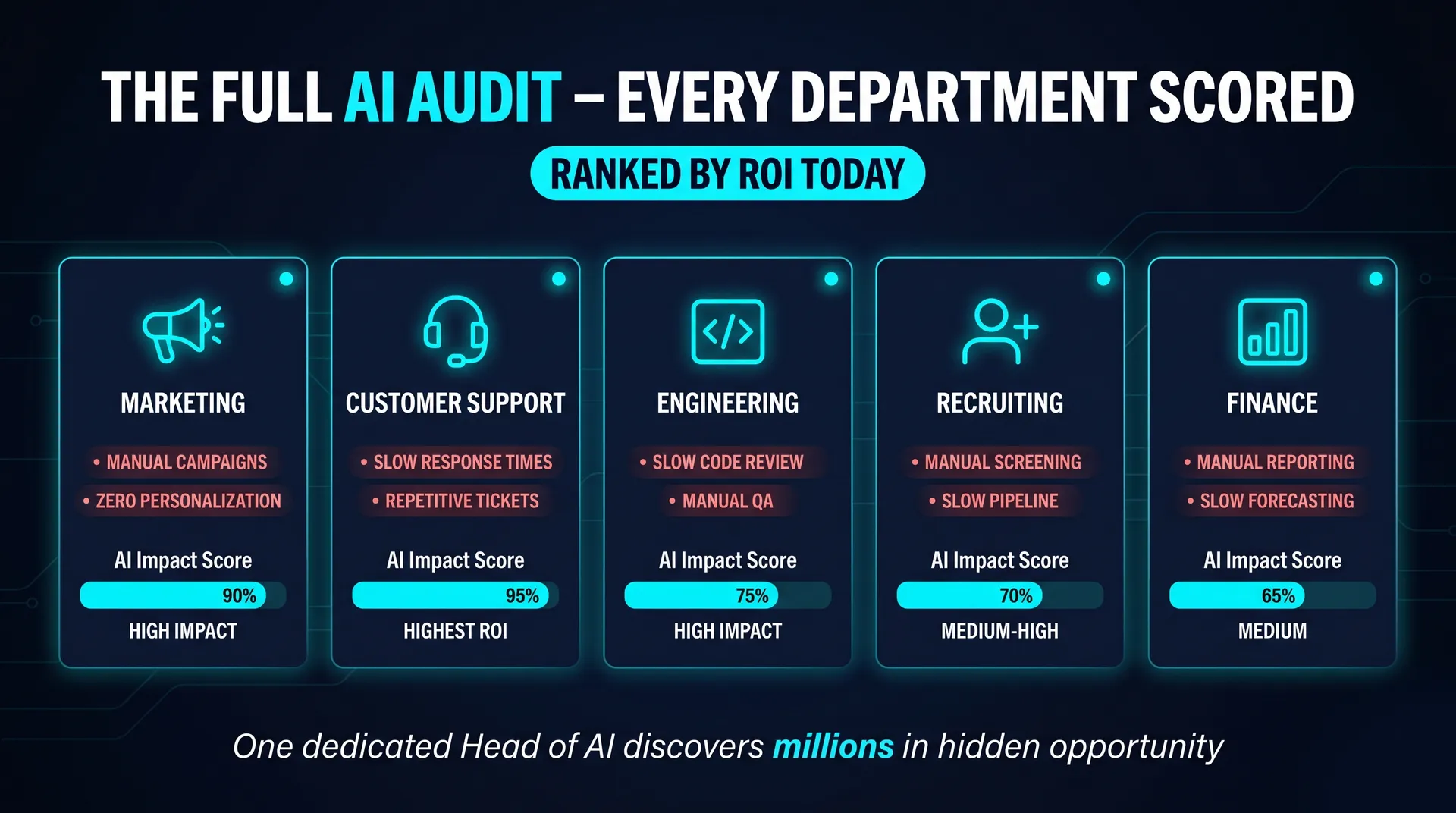
A few things make or break the audit:
- Data quality is everything. Bad data is the number one reason audits fail. Without clean, accessible, governed data, the agents you build later will be useless.
- It is not a wish list. The output is a ranked roadmap with savings and revenue estimates, effort, and dependencies. Tailored to your company. Based on facts, not vibes.
- It covers shadow AI. Most companies already have employees pasting customer data into ChatGPT. The audit needs to surface this, not punish it.
Should you hire a full-time Head of AI? My rule of thumb: if you are under 50 people, an external AI partner running the audit and shipping the first wave of agents is faster and cheaper. Once you have 5+ agents in production and a clear roadmap, then it makes sense to bring the role in-house.
The audit produces a long list. The roadmap is what you actually do.
Plot every initiative on a 2x2: effort on the x-axis, business impact on the y-axis.
- High impact, low effort: Do these first. These are your 90-day wins.
- High impact, high effort: Plan carefully. Assign a senior owner. These are your quarterly bets.
- Low impact, low effort: Quick wins to keep momentum.
- Low impact, high effort: Avoid. This is where the SAP-replacement fantasies go to die.
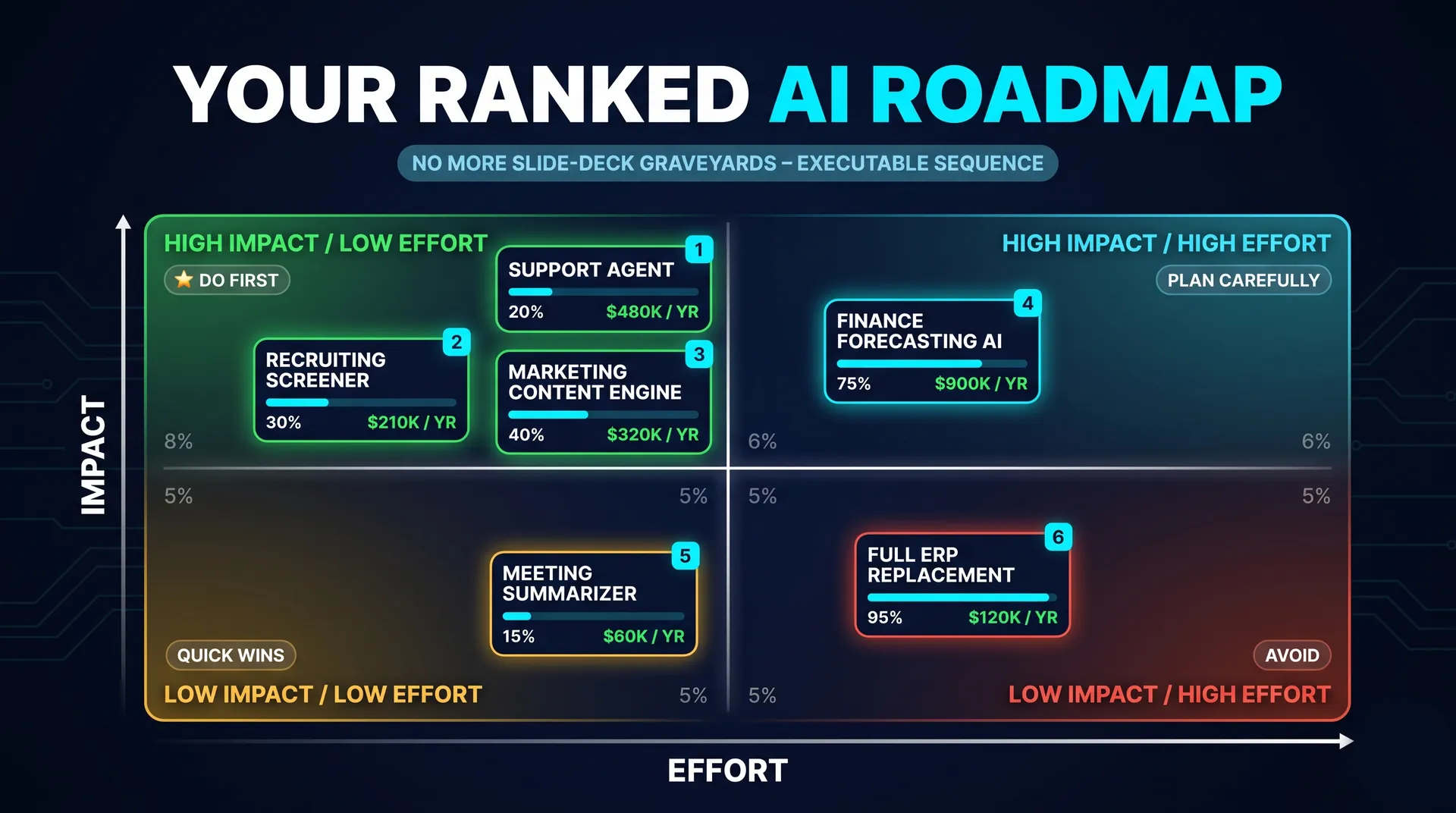
What "high impact, low effort" looks like in practice: a support agent that triages and answers tier-1 tickets, a marketing content engine, an AI-powered recruiting screener, a finance reconciliation agent. These are concrete, scoped, and can ship in 2 to 6 weeks.
What you avoid at the start: building a full ERP replacement, rewriting your CRM, or letting a side project sprawl into "we are building our own foundation model."
The 90-day pilot rule is non-negotiable. If a pilot cannot ship something useful into a real workflow in 90 days, kill it and pick another one.
Here is where most companies break themselves. They turn everyone into an AI builder.
I see it constantly. The marketing manager starts vibe-coding agents in Claude or Cursor all day. He is now spending weeks or months building something a developer would ship in a few days. His actual marketing job stalls. The technology stack he builds is fragile. The token bill is enormous. Weeks of time wasted, thousands of dollars in tokens wasted, and the agent does not even work.
This is the wrong model. Here is the right one:
Domain experts define the what. Developers define the how.
The marketing manager knows the workflow. He writes the standard operating procedure. He knows what good output looks like and what edge cases break the process.
The developer or AI partner knows the stack. They wire the tools, pick the models, handle the data access, set up the evaluation harness, and ship something maintainable.
Together they decide on the necessary tools and data: which SaaS platforms, which APIs, which corporate accounts, whether you need local models for privacy or cost. Then comes testing with real workflows and real users, then launch with monitoring on outputs, cost, and ROI.
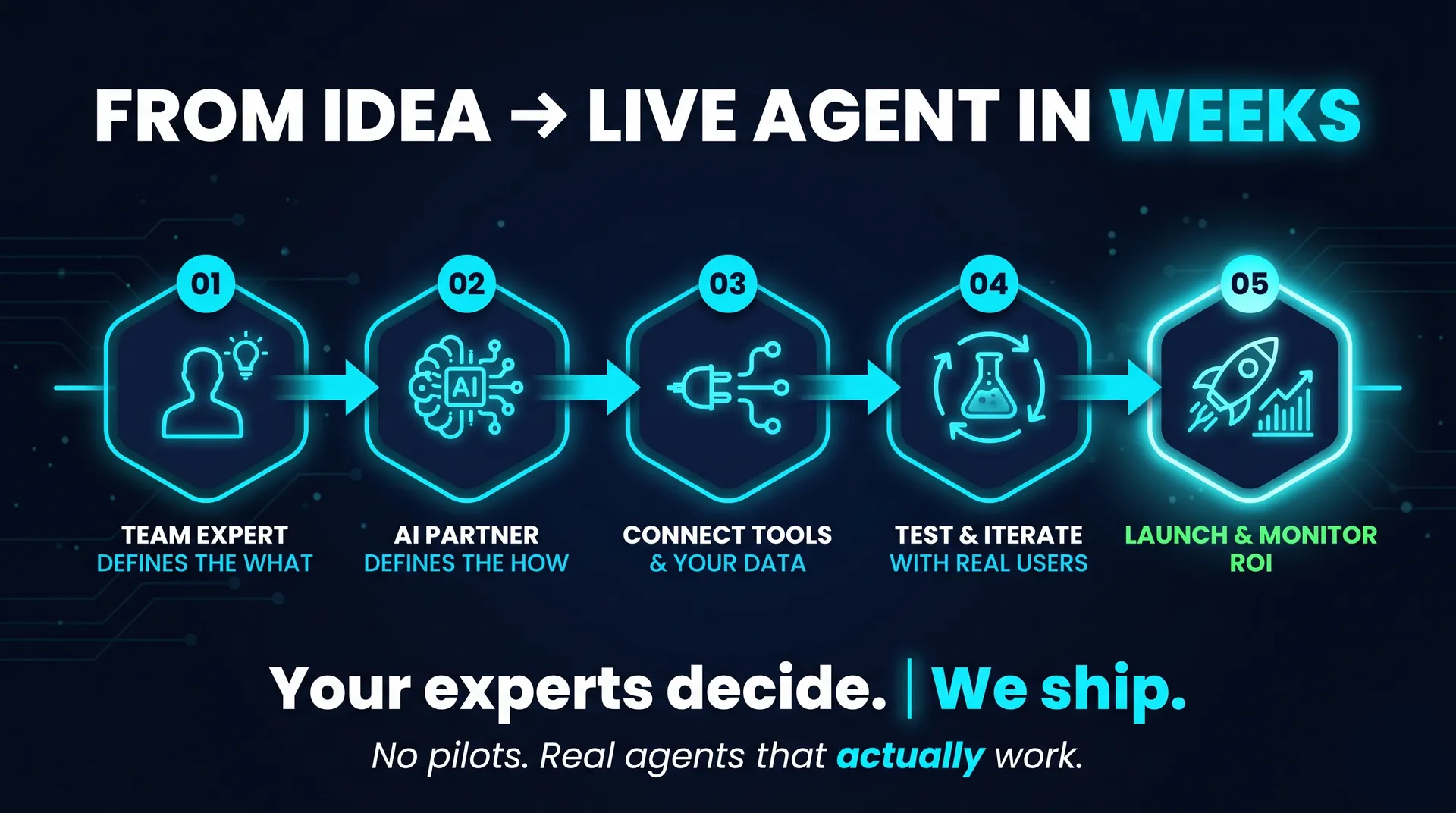
This pairing matters because of one quiet truth: most agents are not the right answer. Sometimes a script is enough. Sometimes a deterministic workflow is enough. The decision rule I use:
- Deterministic problem with clear rules → write a script.
- Multi-step process with predictable branching → build a workflow.
- Reasoning across uncertainty, ambiguity, or unstructured input → build an agent.
If you skip this distinction, you end up with the "we built 12 agents and nobody uses any of them" pattern that shows up everywhere on Reddit and Hacker News.
The real differentiator is culture and execution. The mindset shift in step 1 was the headline. This is the everyday version.
Things I have seen actually work:
- An AI Slack channel for ideas, wins, and inspiration. No hype, no doomerism. People share what they tried, what worked, and what failed. It runs itself once it gets going.
- Monthly AI workshops. Recorded so new hires can binge them during onboarding. One person organizes, but everyone contributes. This is where the team levels up together.
- Adoption tracking. Build a simple form or dashboard to track which agents are actually being used and what performance gains they produce. Building agents is cool. Running agents that nobody uses is expensive.
- A way to flag negative ROI fast. An agent that lowers output quality or runs up infrastructure costs without saving time is worse than no agent. You need to see this in the numbers, not in vibes.
- Proprietary tools and methods over time. Once your team gets fluent, they will start building internal tools 10x faster than before. Keep these focused, owned by developers, and tied to real workflows.
- Internal Hackathons. Every company should run an internal AI hackathon. How it works: Form teams of 3-4 people. Each has 24 hours to build an internal tool or feature. Each team presents a 3-minute demo. Judge it on "wow factor" and usefulness. The winning team gets $1000 each to pimp up their workspace. Rather than simply pitching ideas, you have X new ideas come to life with working prototypes.
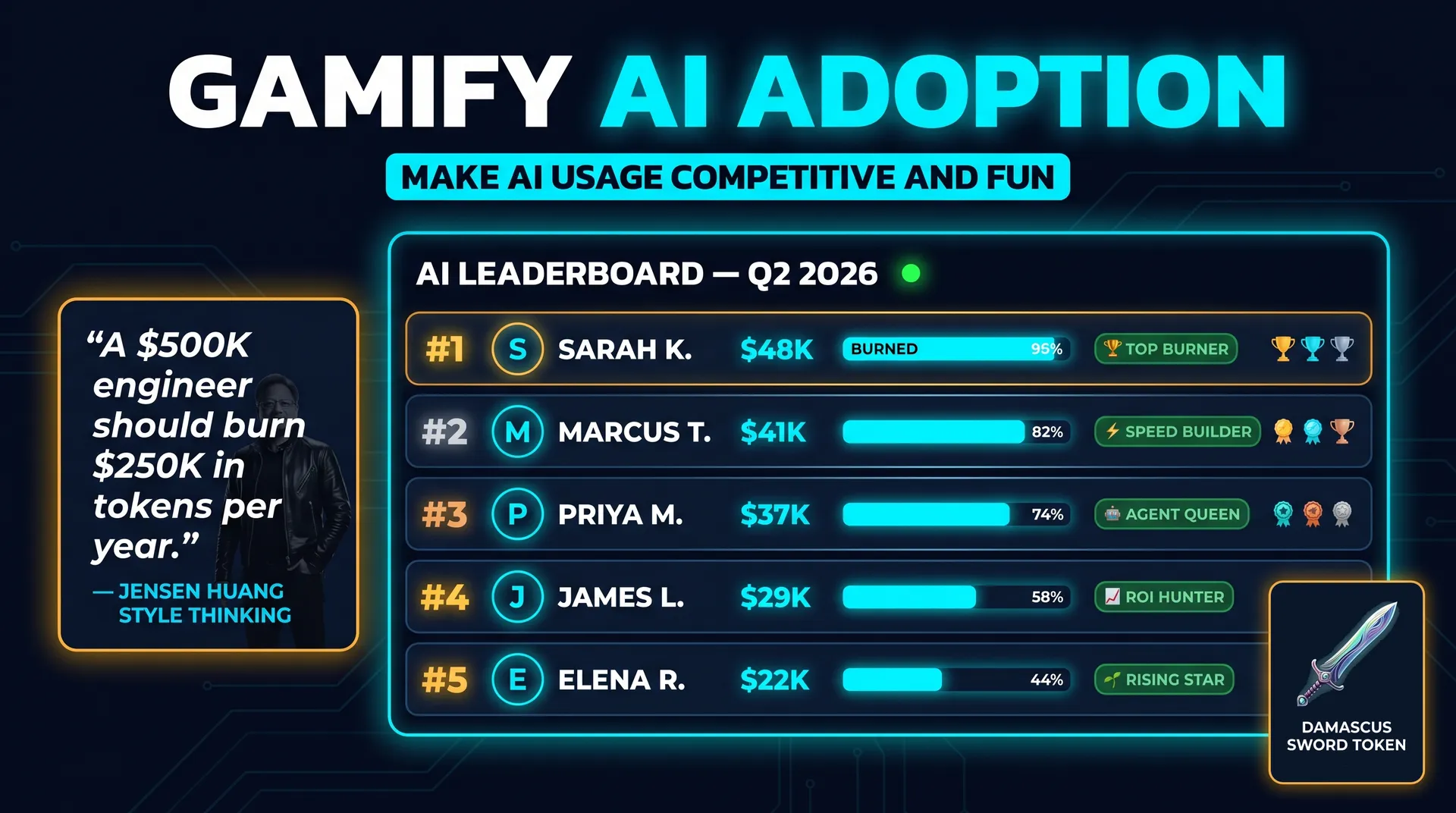
A note on gamification, because this is where the Jensen Huang quote becomes relevant. At NVIDIA's GTC 2026, the CEO of NVIDIA said: "If that $500,000 engineer did not consume at least $250,000 worth of tokens, I am going to be deeply alarmed" 7. He compared an engineer not using AI tokens to a chip designer using paper and pencil instead of CAD.
His point is right. In an AI-first company, using AI to do the job faster is the new normal. If your senior people are not spending tokens, they are not doing the job. You will be left behind.
The funny twist: token usage is also easy to manipulate. There is a clip going around where a founder claims his agents burn 140 billion tokens a month, and most of it is one agent motivating another agent. Token usage is a useful proxy for AI adoption, but it is not the goal. ROI is the goal. Watch both.
After running this with several companies, the pitfalls show up in the same order every time:
- Building too many agents at once. The stack bloats, nothing is owned, and the team loses track of what runs where. Keep the count small until each agent has a clear owner and clear ROI.
- Ignoring governance, ethics, privacy, and compliance. Especially data leakage. Surveys consistently show large percentages of employees pasting sensitive data into AI tools. You need a sanctioned tool list and a basic policy before you scale.
- Internal resistance, often driven by fear of layoffs. This is real and you have to address it head-on. The honest framing is that AI will change roles. Some tasks go away. New tasks appear. Make this explicit and pair it with retraining.
- Hype distraction. Every week there is a new model, a new framework, a new vibe-coding tool. Stay focused on shipping. Run a quarterly tech review, not a daily one.
- Overengineering. This is the bottom-right of the matrix again. The full ERP replacement. The bespoke foundation model. The eight-layer multi-agent system that does what a Zapier workflow could do.
- Treating security as an afterthought. This one is getting expensive fast. The Lovable platform was found exposing source code, database credentials, and customer AI chats from 170+ apps because of a row-level security misconfiguration 8. Anthropic disclosed a state-sponsored campaign in late 2025 where attackers used a jailbroken Claude Code agent to run an espionage operation that was 80-90% automated 9. When you adopt agents, you adopt their attack surface. Treat it like production infrastructure from day one.
Realistic ranges I see with clients:
- A single-process pilot: 2 to 6 weeks.
- Multi-process integration across one department: 6 to 12 weeks.
- Becoming meaningfully AI-first across the company: 6 to 18 months of sustained effort.
The companies that get there fastest run all of this in parallel. Audit and roadmap up front, agents shipping by week 4, culture shift starting from day one, governance and security set up alongside the first production agent. A dedicated technical person leads hosting, cost control, and security. That person is non-negotiable.
- Get the CEO to lead the mindset shift. AI is the operating system, not an IT project.
- Appoint a Head of AI (internal or partner) and run a full audit with a ranked roadmap.
- Prioritize on impact vs effort. High-impact, low-effort wins first. Kill anything that cannot ship in 90 days.
- Pair domain experts with developers to build agents. Do not let everyone vibe-code.
- Invest in culture: Slack channel, monthly workshops, adoption tracking, ROI on every agent. Treat security as production from day one.
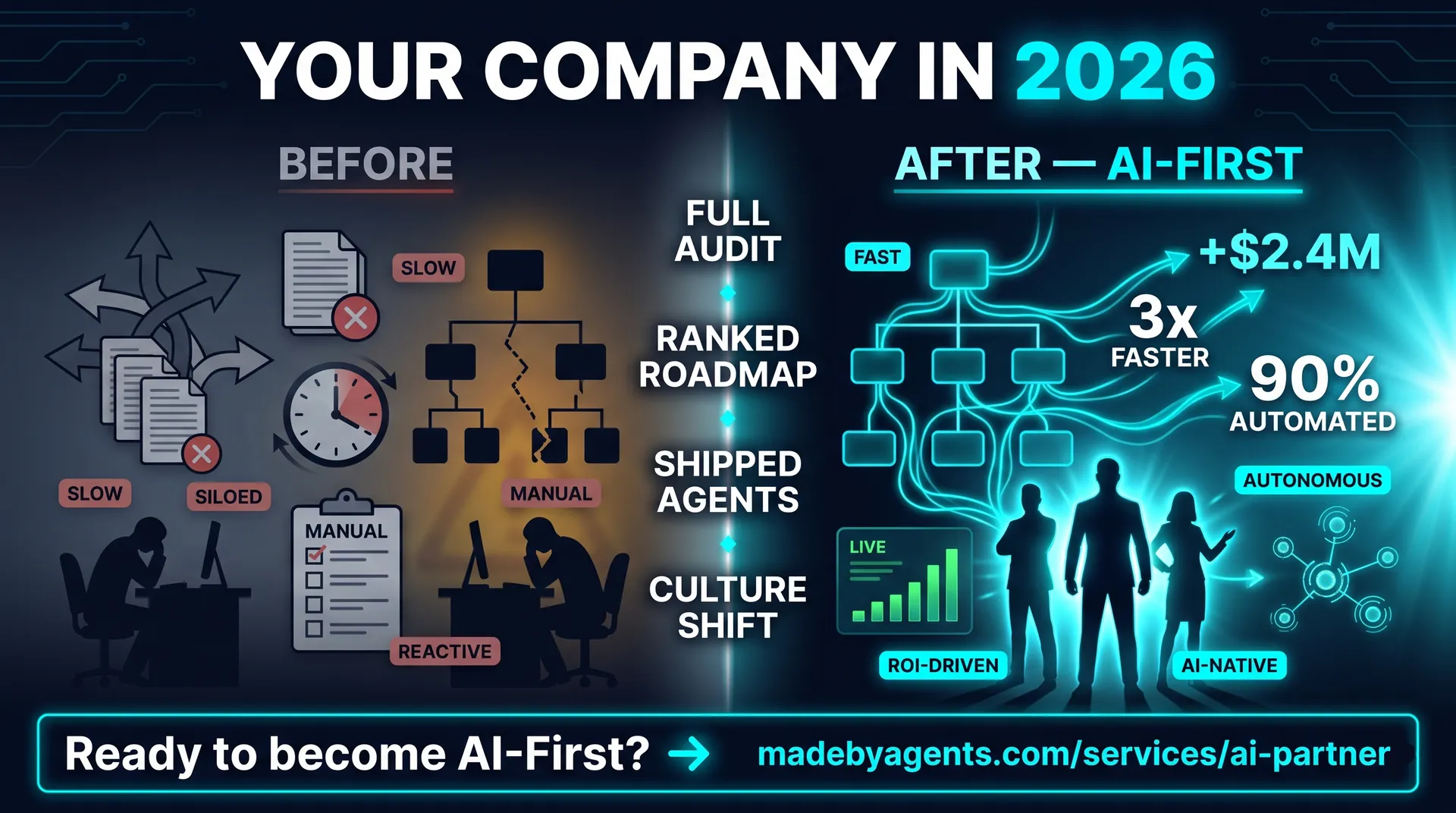
If you want me or my team to run the audit and ship the first agents for you, that is exactly what I do at madebyagents.com/services/ai-partner. The full process, the deliverables, and a few bonuses are on that page.
That is the playbook. Now go ship.
- "The State of AI 2025: Agents, innovation, and transformation". McKinsey & Company. November 2025.
- "The Widening AI Value Gap (Build for the Future 2025)". Boston Consulting Group. September 2025.
- "95% of generative AI pilots at companies are failing, MIT report finds". Fortune. August 18, 2025.
- "Gartner Predicts Over 40% of Agentic AI Projects Will Be Canceled by End of 2027". Gartner. June 25, 2025.
- "Tech In 2025: Industry Leaders Detail Their Top Challenges". Forbes Technology Council. December 2024.
- "Going AI-first appears to be backfiring on Klarna and Duolingo". Fast Company. 2025.
- "Nvidia engineers should use AI tokens worth half their annual salary every year". Tom's Hardware. March 23, 2026.
- "Lovable flaw exposed source code, credentials and AI chats". Computing.co.uk. 2026.
- "Disrupting the first reported AI-orchestrated cyber espionage campaign". Anthropic. November 2025.
About the author

Tobias Wupperfeld
Tobias is an independent AI engineer and operator who has shipped AI systems inside startups and scale-ups across fintech, procurement, engineering, and more. He runs Made By Agents focused on agentic coding and consults for companies, where he leads AI integration across processes and product lines.
Keep Reading
More Guides From the Blog
We write about coding agents, multi-agent systems, AI pair programming, and the engineering practices we use with clients. Hands-on lessons from real projects, not high-level theory.
Browse All Articles