- Services
Advertising disclosure: we earn commissions when you shop through the links below.
HP announced the OmniBook 5 on October 1, 2026, a 14-inch Windows laptop starting at $699.99. It moves to Intel Wildcat Lake chips, with a Core 5 315 in the base model and up to a Core 7 350, paired with 8GB of RAM and a 256GB SSD at the low end. A 1920 x 1200 OLED display is standard across the range, and HP lists up to 34 hours of local video playback on OLED models. It goes on sale in October through HP.com and Best Buy in the US.
Manufacturer's suggested retail price. Current prices can be higher or lower. This is not a live price.
The HP OmniBook 5 arrives as a compact, ultra-portable 14-inch laptop engineered for entry-level mobile computing and edge AI workloads. Starting at an accessible MSRP of $699.99, the device transitions the OmniBook line to Intel Wildcat Lake architecture, featuring silicon options ranging from the Intel Core 5 315 in the base tier up to the Intel Core 7 350. Configurable with 8GB to 16GB of system memory and up to a 1TB SSD, it packages modern efficiency into a chassis measuring just 11.7 mm thick and weighing 1.16 kg (2.56 lb).
For practitioners seeking the best hardware for running AI models locally on a modest budget, the OmniBook 5 occupies a specific niche. It is strictly an edge client, sitting firmly in the consumer productivity tier rather than serving as a workstation or heavy-compute rig. Hardware enthusiasts tracking Unknown hardware for AI development will find that while its memory ceiling limits large-scale experimentation, its efficiency profile, paired with an integrated NPU and an energy-efficient Wildcat Lake compute block, makes it a viable testbed for lightweight agents, local embeddings, and small language model (SLM) inference on the go.
The laptop stands out mechanically by pairing this efficiency with a standard 14-inch 1920 x 1200 OLED display covering 100% of the DCI-P3 color space at 300 nits. Combined with up to 34 hours of local video playback and a compact 65W GaN charger, it functions well as an on-the-move development companion for developers prototyping client-side AI applications.
Assessing the HP OmniBook 5 for AI requires looking past marketing claims of general compute power and analyzing the real bottlenecks of local model inference: memory capacity, memory bandwidth, and compute throughput.
The most critical parameter for local deep learning workloads is unified system memory. Because the system relies on integrated graphics and an onboard NPU, system RAM is shared dynamically between the OS and AI runtimes.
When evaluating HP OmniBook 5 VRAM for large language models, practitioners must remember there is no dedicated video memory pool. Everything runs out of shared memory allocated via GGUF runtimes (like llama.cpp) or framework-specific buffers.
HP OmniBook 5 AI inference performance is well-suited for smaller, highly quantized models, but it is not viable hardware for running 70B parameter models. Attempting to run a 70B model even at 2-bit quantization requires far more memory than this machine's maximum 16GB allocation.
Instead, the machine excels within the 1B to 8B parameter envelope:
llama.cpp using Q4_K_M or Q3_K_L quantization. Expect generation rates in the range of 5 to 9 tokens per second on CPU execution, which is readable for personal desktop assistants but too slow for high-throughput batch operations.Multimodal vision models (such as LLaVA 7B or Pixtral) push the system memory to its breaking point due to the added image projection tokens and vision encoder weights. Furthermore, expanding context windows to 32k or 128k tokens demands several gigabytes of extra memory for the KV cache alone, which will quickly trigger out-of-memory errors on this class of hardware.
The HP OmniBook 5 local LLM experience is designed for edge clients and portable development environments rather than heavy model lifecycle engineering.
In the sub-$800 category, the OmniBook 5 faces direct competition from both Apple Silicon and AMD-based alternatives.
The standard 8GB/16GB MacBook Air models remain benchmark competitors for mobile inference. Apple unified memory architectures provide higher raw memory bandwidth (100 to 150 GB/s), which gives the MacBook Air a clear advantage in raw tokens per second when evaluating 7B or 8B parameter models. However, the HP OmniBook 5 counters with a significantly lower entry price point ($699.99), native Windows/Linux toolchain flexibility, and a standard 1200p OLED display, which Apple does not offer at this price tier.
Competitors featuring AMD Ryzen AI chips offer strong integrated graphics performance via RDNA architecture, which accelerates ROCm and Vulkan-based inference paths. The OmniBook 5, utilizing Intel Wildcat Lake, leans heavily on Intel OpenVINO software integration and power efficiency. The OmniBook 5 is thinner (11.7 mm) and lighter (1.16 kg), making it the superior ultra-portable machine for travel, though the AMD alternative may hold a slight edge in raw compute throughput for continuous FP16/INT4 matrix multiplications.
For engineers seeking the best AI chip for local deployment on a strict budget, the HP OmniBook 5 delivers reliable utility for SLMs, provided you choose the 16GB memory configuration to maintain workable runtime overhead.
The top models this device can run at 4-bit, ranked by fit and speed.
Specs not available for scoring. This product is missing VRAM or memory bandwidth data.
Also in Our Store
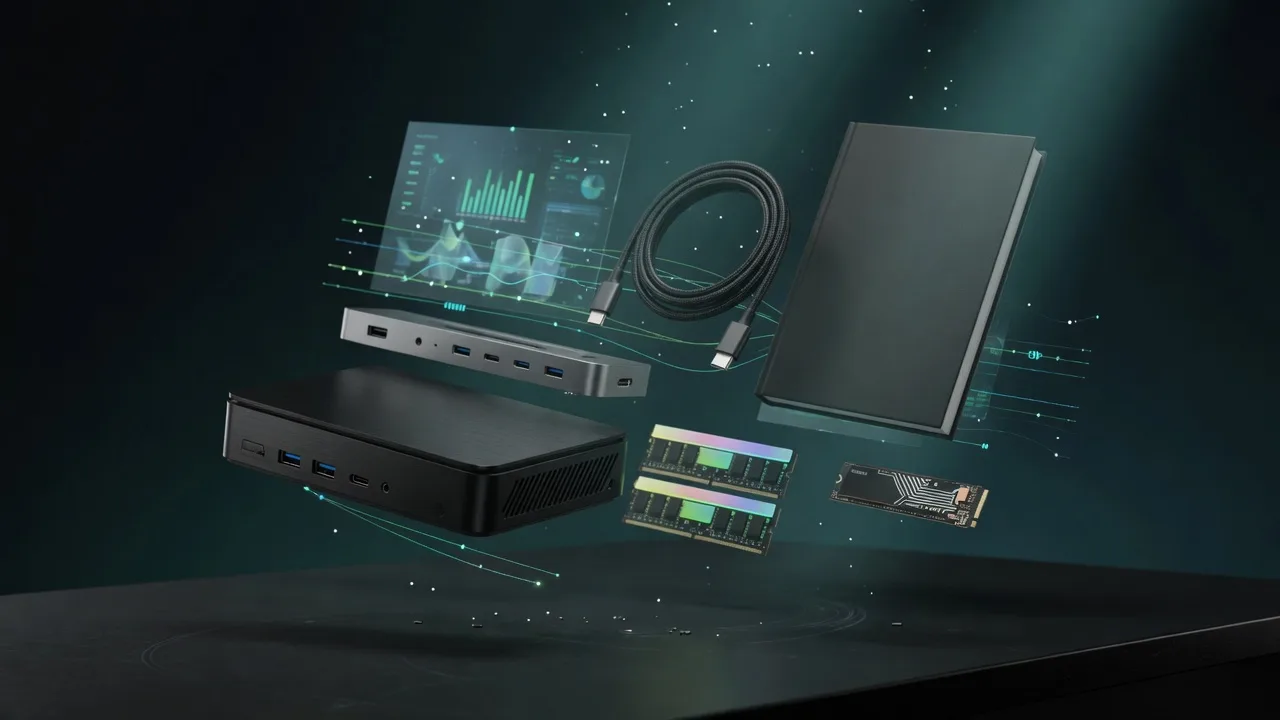
Docks, fast storage, cables, and a UPS sized for a local AI machine.

Rent this class of GPU by the hour before you buy. Live prices from RunPod and Vast.ai.

Find the break-even between buying this hardware and paying for a cloud API.
Mac vs NVIDIA for local inference, if you are still choosing a platform.