
- Services
Advertising disclosure: we earn commissions when you shop through the links below.
MSI EdgeMesa N AI+ is a 1.2 litre compact desktop built around NVIDIA's RTX Spark N1X superchip, pairing a 20-core Grace CPU with a 6,144-core Blackwell RTX GPU and up to 128GB of LPDDR5X-9600 unified memory. MSI rates the chip at up to 1 petaFLOP of FP4 AI performance and positions the machine for persistent local AI agents and model development. Two US configurations are listed: 64GB memory with a 1TB SSD at $4,699, and 128GB with a 4TB SSD at $7,999. I/O includes four 20Gbps USB-C ports, HDMI 2.1b, 10GbE and Wi-Fi 7, and Windows 11 Home ships with Pro optional.
Manufacturer's suggested retail price. Current prices can be higher or lower. This is not a live price.
The MSI EdgeMesa N AI+ is an ultra-compact 1.2-liter desktop engineered specifically to address the biggest bottleneck in local machine learning: graphics memory capacity. Built around the NVIDIA RTX Spark N1X superchip, the system integrates a 20-core NVIDIA Grace CPU and a 6,144-core Blackwell RTX GPU across a coherent NVLink-C2C interconnect. Instead of routing data through a constrained PCIe bus, the processor and graphics engine share a single pool of up to 128GB of LPDDR5X-9600 unified memory. At an entry price of $4,699 for the 64GB tier and $7,999 for the 128GB tier, this platform targets AI practitioners, autonomous agent developers, and engineering teams that require local, zero-leakage inference for enterprise models.
In the landscape of AI compute, the machine occupies a specialized prosumer-to-workstation tier. While high-end desktop rigs relying on discrete consumer GPUs are capped at 24GB or 32GB of VRAM per card without complex multi-GPU pooling, the EdgeMesa N AI+ provides a monolithic memory space capable of holding massive parameter weights in their entirety. It brings data-center architectural principles down to a form factor measuring just 152 x 147 x 53 mm with a 140W platform TDP. For teams evaluating Unknown hardware for AI development, this system shifts the focus from raw rackmount wattage to high-density, always-on local execution.
Selecting the MSI EdgeMesa N AI+ for AI comes down to whether your workflows prioritize uninterrupted autonomous execution or standard cloud APIs. Running persistent multi-agent workflows around the clock on public cloud infrastructure incurs mounting token and hosting costs. By packaging data-center-grade Grace and Blackwell silicon into a sub-two-liter aluminum chassis with native CUDA runtime support, this platform stands out as a dedicated candidate for the best hardware for local AI agents in 2026.
The compute engine inside the MSI EdgeMesa N AI+ is NVIDIA's RTX Spark N1X superchip. It unites a 20-core ARM-based NVIDIA Grace CPU with an enterprise-class Blackwell RTX GPU containing 6,144 CUDA cores. Unlike standard desktop configurations where weights must transfer between system RAM and discrete GPU VRAM, NVIDIA's NVLink-C2C delivers a high-speed, coherent bidirectional pipeline. This setup makes the entire 64GB or 128GB physical memory pool directly addressable by Blackwell Tensor cores.
1Hardware Architecture Overview2+-----------------------------------------------------------------+3| MSI EdgeMesa N AI+ |4| |5| +-------------------------+ +-------------------------+ |6| | NVIDIA Grace CPU | | Blackwell RTX GPU | |7| | 20 ARM Cores | | 6,144 CUDA Cores | |8| +------------+------------+ +------------+------------+ |9| | | |10| +----------------+----------------+ |11| | |12| NVLink-C2C Interconnect |13| | |14| +----------------+----------------+ |15| | Unified Memory Pool | |16| | 64GB / 128GB LPDDR5X-9600 | |17| | 256-bit Bus (~307 GB/s) | |18| +---------------------------------+ |19+-----------------------------------------------------------------+
Memory architecture dictates local LLM performance. The EdgeMesa N AI+ routes its LPDDR5X-9600 across a 256-bit memory bus, delivering roughly 307 GB/s of theoretical memory bandwidth. In transformer inference, autoregressive token generation is predominantly memory-bandwidth bound. While 307 GB/s does not match the 1 TB/s to 2 TB/s found on wider buses or discrete HBM clusters, having up to 128GB of addressable memory removes the physical barrier that prevents dense 70B and 120B parameter architectures from fitting onto local workstations.
On the compute side, MSI rates the system at up to 1 petaFLOP of FP4 AI performance. Blackwell architecture introduces native micro-tensor scaling formats, allowing practitioners to run quantized FP4 weights directly on hardware with minimal perplexity degradation compared to standard FP16 or INT8 alternatives. This makes the Spark N1X a viable contender for the best AI chip for local deployment when operating within sub-150W envelopes.
System cooling and I/O are optimized for 24/7 operational stability:
The practical value of MSI EdgeMesa N AI+ VRAM for large language models depends directly on memory footprint calculations. In unified architectures, the operating system, context caches, and model weights reside in the same pool. On the 128GB configuration, roughly 115GB to 120GB can be allocated strictly to model weights and KV cache.
1Memory Allocation (128GB Unified Pool)2+------------------------------------------------------------------+3| Model Weights: 70B-120B (40GB - 80GB) |4+------------------------------------+-----------------------------+5| KV Cache: Context Window (10-35GB) | OS & Runtime Buffer (~8GB) |6+------------------------------------+-----------------------------+
The 128GB variant serves as dedicated hardware for running 70B parameter models without offloading compromises.
Because prompt evaluation is compute-bound and token generation is memory-bandwidth bound, the system delivers distinct performance profiles across model tiers:
The definitive sweet spot for this hardware is FP4 and Q4_K_M. Blackwell hardware accelerates FP4 execution, allowing practitioners to minimize weight footprints without incurring the latency penalties often seen when dequantizing non-standard integer sizes on older tensor architectures.
The EdgeMesa N AI+ is tailored for production environments and local developer setups that have outgrown consumer VRAM limits:
Understanding where the EdgeMesa N AI+ fits involves comparing it against the two dominant alternatives in local machine learning: Apple Silicon desktops and multi-GPU x86 workstations.
1Local AI Hardware Architectural Comparison2+---------------------+-----------------------+-----------------------+-----------------------+3| Feature | MSI EdgeMesa N AI+ | Apple Mac Studio M2 | Dual RTX 4090 Desktop |4| | (128GB) | Ultra (128GB) | (48GB Total) |5+---------------------+-----------------------+-----------------------+-----------------------+6| Unified Memory | Up to 128GB | Up to 192GB | None (24GB per card) |7| Memory Bandwidth | ~307 GB/s | ~800 GB/s | ~1,008 GB/s (per GPU) |8| Software Ecosystem | Native CUDA / TensorRT| Metal / MLX | Native CUDA / TensorRT|9| Max Monolithic Model| ~120B (Quantized) | ~120B+ (Quantized) | ~70B (Split via vLLM) |10| Power Consumption | 140W TDP | ~150W TDP | 600W - 850W+ |11| Chassis Volume | 1.2 Liters | 3.7 Liters | 40+ Liters |12+---------------------+-----------------------+-----------------------+-----------------------+
Apple's Mac Studio equipped with M-series Ultra chips has long been regarded as some of the best hardware for running AI models locally due to its high memory ceiling (up to 192GB) and high bandwidth (up to 800 GB/s). The Mac Studio delivers faster token generation speeds on 70B models due to that raw memory throughput.
However, the EdgeMesa N AI+ holds a major software advantage: it is an authentic NVIDIA platform. The broader enterprise AI ecosystem, including TensorRT-LLM, Triton Inference Server, custom CUDA kernels, and deep quantization libraries, targets NVIDIA first. Apple Silicon requires translation through Metal Performance Shaders (MPS) or framework-specific tools like MLX. For developers whose end-target deployment is data-center NVIDIA infrastructure, the EdgeMesa eliminates cross-platform framework discrepancies.
Building a custom desktop with two 24GB GPUs (such as dual RTX 3090 or 4090 cards) costs slightly less and delivers vastly superior memory bandwidth (over 1 TB/s per card), yielding much faster token generation on 70B models.
However, dual-GPU setups max out at 48GB of total VRAM, which limits context size and bars you from running dense models above 70B parameters without CPU offloading. Furthermore, a dual-GPU workstation requires a full-tower chassis, draws 700W to 900W under load, and generates significant ambient heat and noise. The EdgeMesa N AI+ gives up raw token generation speed in exchange for a 128GB unified memory ceiling, a 140W power envelope, and a compact 1.2-liter desk footprint. If your primary constraint is model parameter capacity rather than raw tokens per second, the EdgeMesa N AI+ represents an exceptionally dense compute investment.
The top models this device can run at 4-bit, ranked by fit and speed.
Specs not available for scoring. This product is missing VRAM or memory bandwidth data.
Also in Our Store
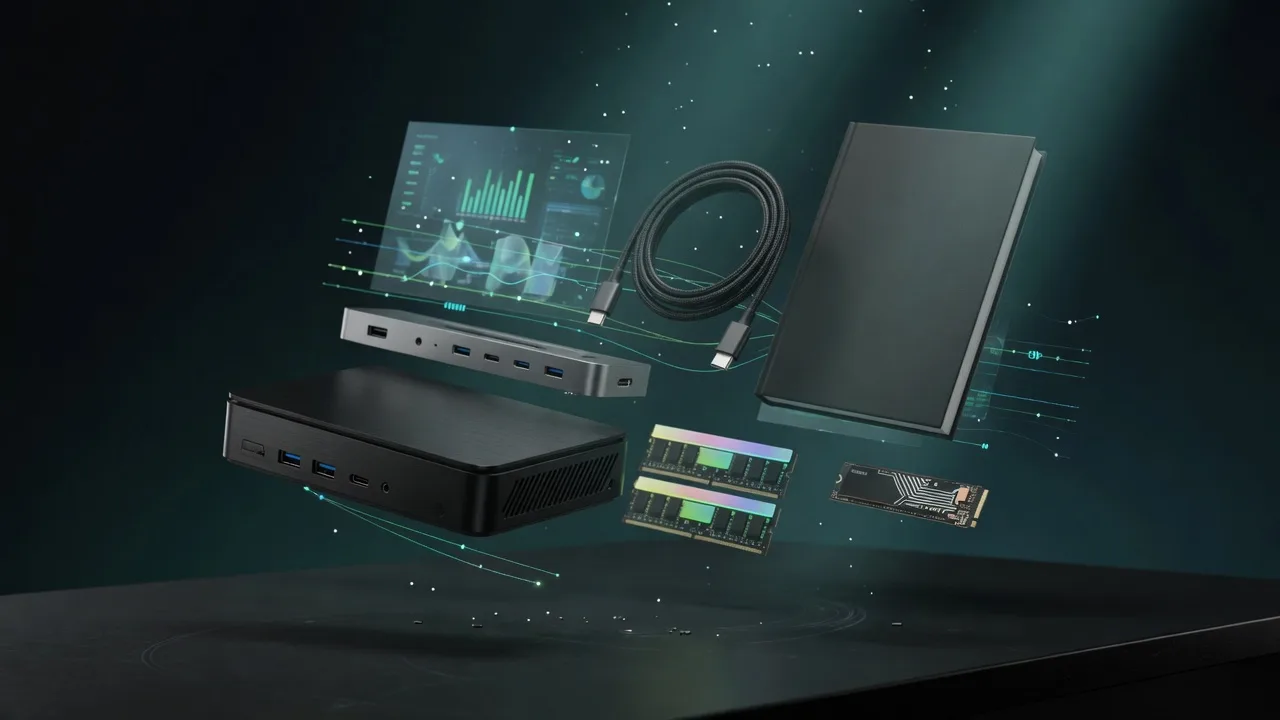
Docks, fast storage, cables, and a UPS sized for a local AI machine.

Rent this class of GPU by the hour before you buy. Live prices from RunPod and Vast.ai.
Find the break-even between buying this hardware and paying for a cloud API.
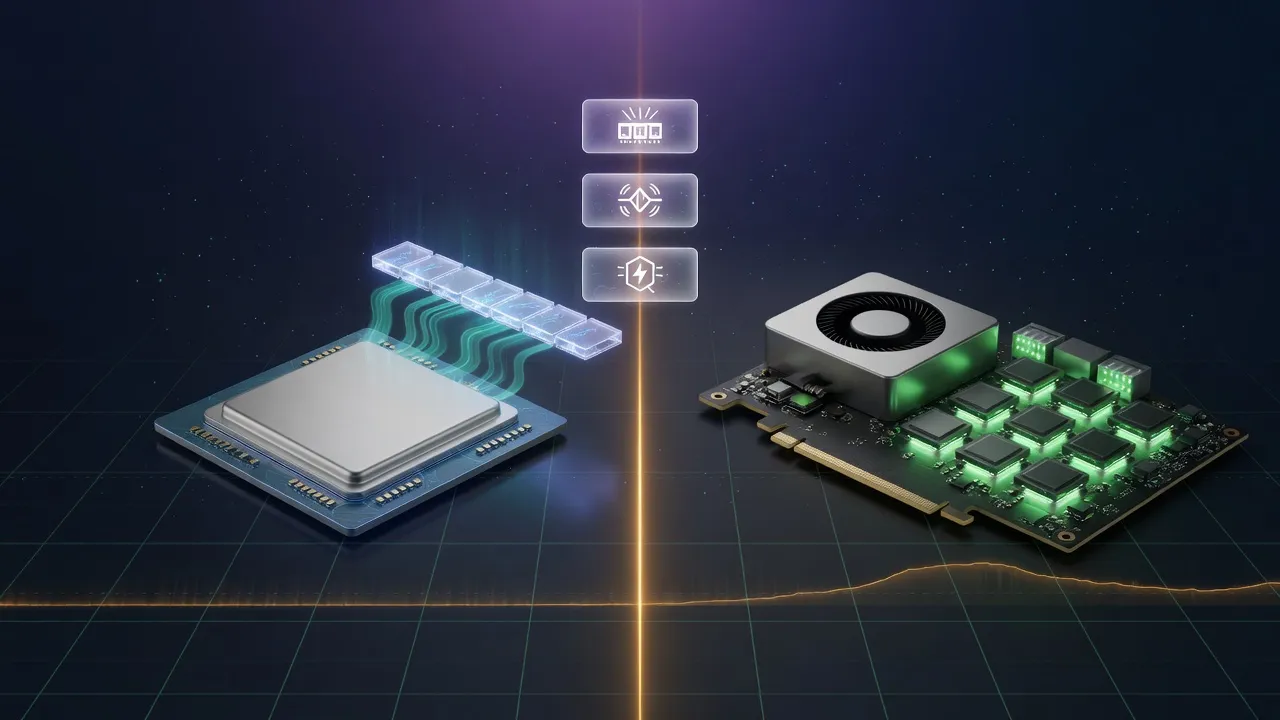
Mac vs NVIDIA for local inference, if you are still choosing a platform.
