- Services
Advertising disclosure: we earn commissions when you shop through the links below.
Microsoft's Surface Pro 12-inch is a 2-in-1 Windows tablet with a detachable keyboard and a 165-degree kickstand. It runs a 6-core Qualcomm Snapdragon X2 Plus chip with an 80 TOPS NPU for on-device AI work. The 12-inch PixelSense LCD is 2196 x 1464 at 90 Hz, with up to 15.5 hours of video playback. It starts at $1,149 and ships October 13, 2026.
Microsoft's Surface Pro, 12-inch is a fanless 2-in-1 Windows tablet with a detachable keyboard and a 165-degree kickstand, built around Qualcomm's Snapdragon X2 Plus platform. The chip is a 6-core part with an 80 TOPS NPU, paired with 16GB of unified memory and either 256GB or 512GB of SSD. It starts at $1,149, is available for pre-order, and ships October 13, 2026.
For AI workloads, that combination lands it in a specific tier: a portable client machine that runs small and mid-size language models locally, not a workstation and definitely not a server. The 80 TOPS NPU makes it a Copilot+ class device, which means it gets the Windows AI feature set (Studio Effects, Recall, local translation, image generation in Paint) with acceleration. The 16GB memory pool is what actually determines which models you can load, and it is the number to focus on when evaluating the Surface Pro, 12-inch for AI.
What makes it interesting is the form factor. There are plenty of laptops with more raw compute at this price. There are very few tablets that run Windows, weigh this little, last up to 15.5 hours on video playback, and can hold a 7B or 14B parameter model in memory while you work on battery. If your workflow involves local inference on a device you can hold in one hand, this is one of the few credible options.
The specs that matter for inference, and what each one means in practice:
One caveat on memory bandwidth: notebook vendors rarely publish it for Snapdragon X-class parts, and Microsoft has not listed it here. Bandwidth is the single biggest determinant of single-stream token generation speed, since every generated token requires reading the full weight set. Without a published figure, treat any tokens-per-second claim, including the estimates below, as an order-of-magnitude guide rather than a benchmark.
The 16GB unified pool is the hard ceiling. Within it, the practical sweet spot is 7B to 8B parameters at Q4_K_M or Q5_K_M quantization. That range gives you near-full quality on most tasks with roughly 5GB to 6GB of weights.
What fits comfortably:
Q4_K_M (about 4.9GB) or Q5_K_M (about 5.7GB). The default choice.Q4_K_M to Q5_K_M.Q4_K_M.Q6_K, which leaves plenty of room for long context.Q4_K_M (about 9GB). These fit, but you will be running close to the limit with a browser open.What does not fit: Mixtral 8x7B at Q4 needs roughly 26GB. Qwen 2.5 32B at Q4_K_M needs about 19GB. Any 70B model is out of reach entirely, so if you are shopping for hardware for running 70B parameter models, this is not the device. You need 48GB of dedicated VRAM or a Mac with 64GB+ unified memory.
Expected generation speed, assuming a Q4_K_M 8B model and a CPU/GPU path via llama.cpp or Ollama:
Those figures are estimates for a 6-core Snapdragon X2 Plus class part, not measured numbers. Prompt processing (prefill) will feel the 6-core CPU, especially on long documents. For interactive chat with an 8B model, expect a usable but not snappy experience. For agentic loops that make many sequential calls, the latency adds up fast.
Quantization guidance: Q4_K_M is the quality-to-speed sweet spot on this hardware. Going to Q8_0 roughly doubles the memory footprint for marginal quality gains and noticeably slower generation, since you are bandwidth-bound. Going below Q4 (to Q3_K or IQ2) buys you the ability to load a 20B-plus model, but quality degrades enough that an 8B at Q4 usually wins.
Multimodal: text-plus-vision models like Qwen2-VL 7B or Gemma 3 4B will run, but image encoding is compute-heavy and the 6-core CPU plus shared memory make it slow. Treat vision as a demo capability, not a production path. Long context is limited more by the KV cache than the weights: at 32K context on an 8B model, the cache alone can eat 2GB to 4GB, so use Q8_0 KV cache quantization and keep contexts under 16K if you want headroom.
Q4_K_M in Ollama or LM Studio runs entirely offline, no API keys, no data leaving the device. The tablet form factor is a genuine advantage over a laptop for casual use.MacBook Air 13-inch (M4, 16GB/256GB, $999): The most direct competitor for local AI work. Same 16GB unified memory ceiling, but Apple's MLX framework and Metal acceleration give it a more mature local LLM tooling story than Windows on Arm today. Expect the MacBook Air to generate tokens faster on 7B and 8B models. You pick the Surface Pro, 12-inch when you need a touchscreen, a pen, a detachable keyboard, Windows application compatibility, or the tablet form factor. You pick the MacBook Air when raw local inference throughput is the priority.
Surface Pro 13-inch (Snapdragon X Elite): More cores, a larger display, and better sustained performance for the same class of workload, at a higher price. If you mostly work docked or on a desk and want the fastest Surface Pro for AI, the 13-inch is the better buy. The 12-inch wins on portability and price.
RTX 4060 laptop (8GB VRAM, roughly $900 to $1,100): Dedicated VRAM and CUDA make it dramatically faster for prefill and fine-tuning, and it can run models that overflow the Surface's shared pool more gracefully. It is also two to three times heavier, has a fraction of the battery life, and runs hot and loud. For local AI agents in 2026 that need low latency and CUDA support, the RTX laptop is the pragmatic pick. For a device you actually carry, the Surface Pro is.
The top models this device can run at 4-bit, ranked by fit and speed.
Specs not available for scoring. This product is missing VRAM or memory bandwidth data.
Also in Our Store
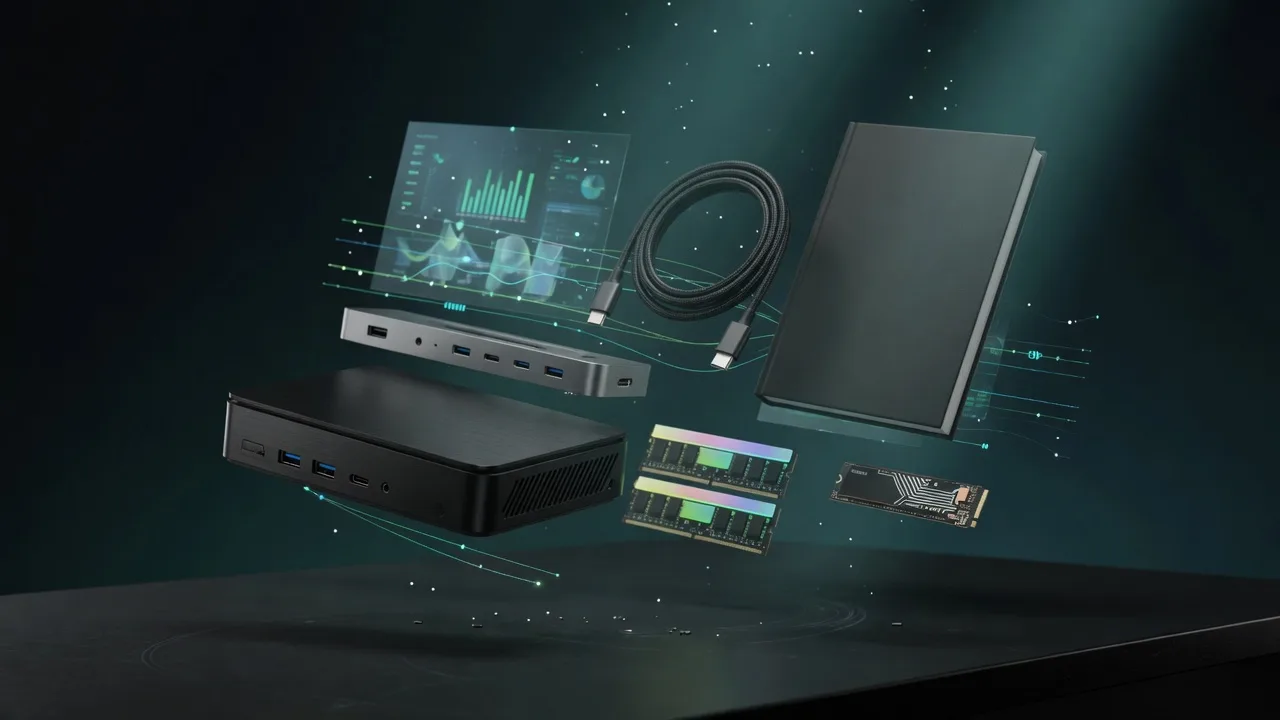
Docks, fast storage, cables, and a UPS sized for a local AI machine.
Rent this class of GPU by the hour before you buy. Live prices from RunPod and Vast.ai.
Find the break-even between buying this hardware and paying for a cloud API.
Mac vs NVIDIA for local inference, if you are still choosing a platform.