- Services
Advertising disclosure: we earn commissions when you shop through the links below.
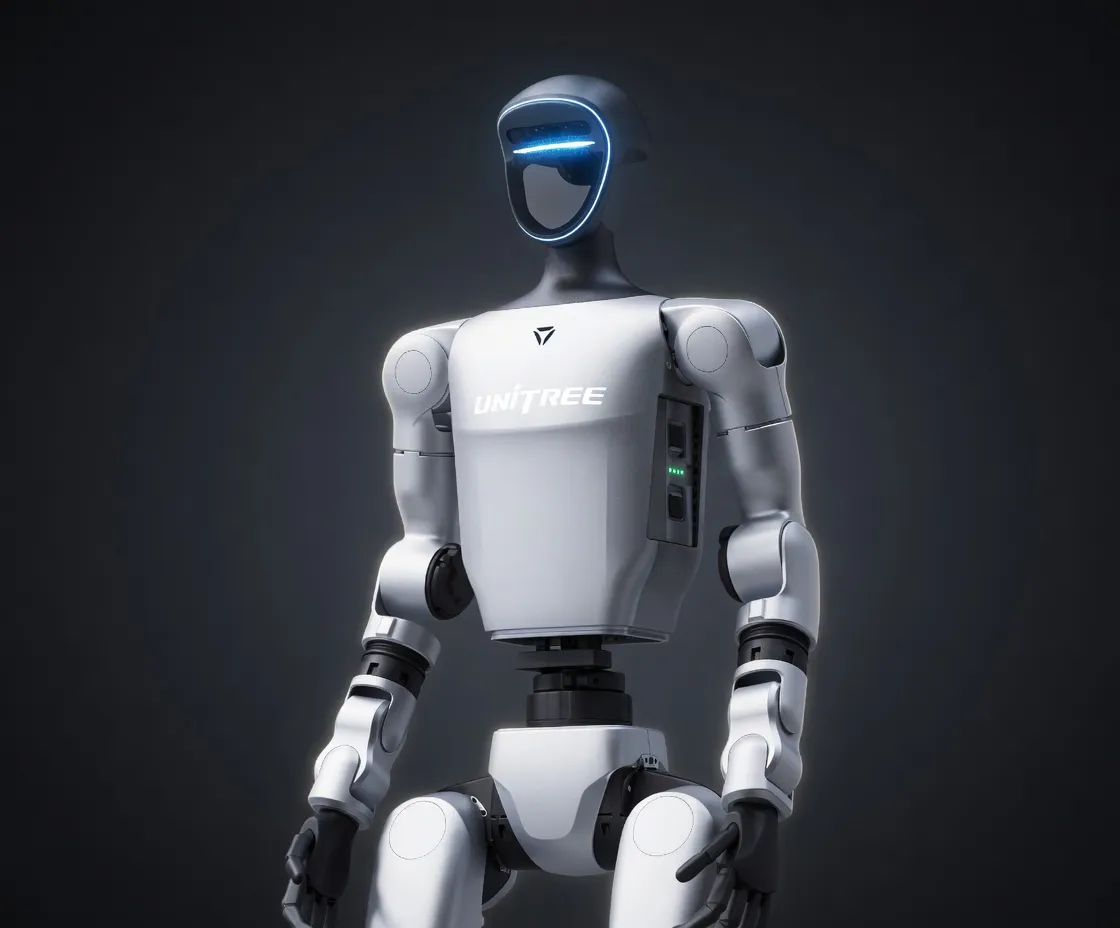
Full-size humanoid robot (180cm, 47kg) with 360 N·m joint torque and high walking speed. One of the most affordable full-size bipedal platforms available for commercial and research use.
Manufacturer's suggested retail price. Current prices can be higher or lower. This is not a live price.
The Unitree H1 is a full-size bipedal platform engineered to bridge the gap between high-end robotics research and commercial deployment. Developed by Unitree Robotics, the H1 stands 180cm tall and weighs approximately 47kg, making it one of the most agile and robust humanoid platforms currently available. While many humanoid projects remain in the prototype or pre-order phase, the H1 is positioned as an "in-stock" solution for enterprise and research teams who require immediate access to a mobile, bipedal agent.
For those evaluating the Unitree H1 Humanoid Robot for AIits significance lies in its combination of high-torque actuation (360 N·m) and integrated edge compute. Unlike static servers, the H1 is designed for embodied AI, where local LLMs and vision-language models (VLMs) drive physical interaction in real-time. It competes directly with platforms like the Boston Dynamics Atlas (research-only) or the Figure 01, but distinguishes itself by being a more accessible, modular platform for developers building the next generation of local AI agents.
The H1’s capacity for autonomous decision-making is powered by an onboard NVIDIA Jetson-based compute module. For practitioners, this means the Unitree H1 Humanoid Robot AI inference performance is tied to the Jetson Orin series architecture. This setup provides the high-performance-per-watt necessary for a battery-powered humanoid to process sensor fusion and neural network inference simultaneously.
While the H1 is an agile physical platform, its utility for AI development depends on its ability to run sophisticated models at the edge. The Jetson-based architecture allows for hardware-accelerated inference of TensorRT-optimized models. When comparing the Unitree H1 Humanoid Robot vs. Agility Robotics Digit, the H1 offers a more open SDK environment, making it a preferred choice for teams who want to deploy custom-trained reinforcement learning (RL) policies or local LLM controllers.
The primary constraint for Unitree Robotics humanoid robots for AI development is the onboard VRAM and the compute-heavy requirements of bipedal locomotion. To maintain a stable gait while running cognitive tasks, developers must balance the weight of the control stack with the requirements of the LLM.
The H1 is designed to run quantized models that fit within the Jetson’s unified memory architecture. For Unitree H1 Humanoid Robot local LLM deployment, we recommend the following:
Running a 70B parameter model locally on the H1's default onboard compute is generally not feasible for real-time interaction due to VRAM limitations and the resulting low tokens per second. However, for "Agentic Workflows," practitioners often use the H1 as an edge node that offloads heavy reasoning to a local workstation (e.g., an NVIDIA RTX 6000 Ada station) while handling low-latency perception and motor control on the Jetson Orin.
The Unitree H1 is not a consumer toy; it is a $90,000 enterprise-grade tool for best hardware for local AI agents 2025 evaluations.
Companies developing autonomous inspection routines or warehouse logistics use the H1 to test bipedal navigation in human-centric environments. The 360 N·m torque allows the robot to navigate uneven terrain and recover from impacts, which is critical for real-world AI deployment.
The H1 is a premier platform for researchers focusing on Reinforcement Learning (RL). By using the provided Python and ROS 2 SDKs, researchers can train policies in simulation (e.g., NVIDIA Isaac Gym) and deploy them directly to the H1 hardware. This "Sim-to-Real" pipeline is the standard for modern humanoid development.
For teams building agents that must operate without a constant cloud connection, the H1 provides the necessary compute to run SLAM, object detection, and speech-to-text locally. This is vital for privacy-sensitive environments or remote industrial sites.
When choosing the best humanoid robots for running AI models locally, the H1 is often compared to the Unitree G1 and the Boston Dynamics Spot (though Spot is a quadruped).
The Unitree H1 remains the most viable full-size bipedal platform for developers who need to move their AI models out of the chat box and into the physical world. Its high-speed walking capability and Jetson-based compute make it a formidable edge AI node for 2025.
The top models this device can run at 4-bit, ranked by fit and speed.
Specs not available for scoring. This product is missing VRAM or memory bandwidth data.
Also in Our Store
Docks, fast storage, cables, and a UPS sized for a local AI machine.

Rent this class of GPU by the hour before you buy. Live prices from RunPod and Vast.ai.

Find the break-even between buying this hardware and paying for a cloud API.
Mac vs NVIDIA for local inference, if you are still choosing a platform.