
- Services
Advertising disclosure: we earn commissions when you shop through the links below.
The Ryzen AI Max PRO 485 is an 8-core, 16-thread APU from AMD for commercial laptops and desktops, part of the Ryzen AI Max PRO 400 series codenamed Gorgon Halo. It combines Zen 5 CPU cores with Radeon 8050S integrated graphics and an XDNA 2 NPU rated at 50 TOPS. It supports up to 192 GB of unified LPDDR5x-8533 memory, of which up to 160 GB can serve as GPU memory, at a 55 W default TDP with a 45 to 120 W configurable range. AMD lists global availability with Windows 11, RHEL and Ubuntu support.
Sized for production serving of 70B–200B class models at full or lightly-quantized precision. Overkill for a homelab; right call when the workload pays for itself in token volume.
Generated from this product’s spec sheet. Editor reviews refine it over time.
The AMD Ryzen AI Max PRO 485 represents a structural shift for mobile and compact desktop AI computing. Built on the Gorgon Halo architecture using TSMC's 4nm FinFET process, this 8-core, 16-thread APU merges high-IPC Zen 5 CPU cores, a 32-Compute-Unit Radeon 8050S integrated graphics engine, and a dedicated 50 TOPS XDNA 2 NPU onto a unified FP11 socket. What elevates this silicon for local AI workloads is its memory subsystem: a 256-bit memory controller supporting up to 192 GB of unified LPDDR5x-8533 RAM, of which up to 160 GB can be mapped directly to the integrated GPU.
For engineers and ML researchers, having a 160GB GPU for AI in a portable or small-form-factor package solves the single most restrictive bottleneck in local inference: VRAM capacity. Traditional consumer desktop GPUs hit a hard ceiling at 24 GB, requiring expensive multi-GPU PCIe interconnects or dedicated enterprise cards to load frontier models. By delivering workstation-grade memory pooling within a standard 55 W default envelope (configurable between 45 W and 120 W), the Ryzen AI Max PRO 485 redefines what is possible on local client hardware. It bridges the gap between power-hungry desktop rigs and enterprise accelerators, giving developers a self-contained runtime for large language models, autonomous agent stacks, and local experimentation.
Whether you are configuring workstations for local development or evaluating platforms from systems integrators listing this hardware for AI development, the processor targets practitioners who prioritize raw addressable capacity and energy efficiency over extreme data-center throughput. With native Linux support across RHEL and Ubuntu alongside Windows 11, it integrates cleanly into existing ROCm and Vulkan deployment pipelines.
Evaluating the AMD Ryzen AI Max PRO 485 for AI workloads requires looking at three distinct compute blocks alongside the memory architecture:
llama.cpp or vLLM, it executes unified FP16, BF16, and quantized INT4/INT8 compute.While the 273.1 GB/s memory bandwidth is lower than the multi-terabyte speeds found on discrete HBM architectures, it is broad enough to make the platform an effective local execution engine for large footprints that simply refuse to fit on standard GPUs.
The defining feature of the AMD Ryzen AI Max PRO 485 VRAM for large language models is sheer capacity. Because autoregressive token generation depends on moving model weights from memory to compute cores on every token step, tokens per second scale primarily with memory bandwidth, while parameter capacity is dictated by total VRAM.
For smaller architectures, the APU delivers responsive generation suitable for interactive developer tooling:
This processor stands out as capable hardware for running 70B parameter models without needing tensor parallelism across multiple discrete cards:
The performance sweet spot for this hardware is Q4_K_M or Q5_K_M. These formats preserve reasoning benchmarks while keeping footprint small enough to leave 80 GB to 100 GB of free memory for enormous context allocations (128k+ tokens) or multi-agent memory buffers.
The chip is engineered for environments where privacy, mobility, and memory headroom outweigh raw batch throughput:
Understanding where the APU fits among the best hardware for running AI models locally requires comparing it against its closest architectural peers.
The Apple M4 Max offers unified memory configurations up to 128 GB with higher memory bandwidth (up to 546 GB/s), delivering roughly double the tokens per second on 70B models. However, the Ryzen AI Max PRO 485 provides a larger maximum pool (192 GB total system, 160 GB VRAM), runs native x86-64 Linux distributions with direct ROCm access, and operates within modular PC environments rather than Apple's closed ecosystem.
A desktop equipped with two 24 GB cards offers 48 GB total VRAM over much faster GDDR6X bandwidth (around 1 TB/s per card), producing 25+ tokens per second on 70B models. However, that setup consumes 600 W to 900 W of system power, generates substantial heat, and caps out at models that fit inside 48 GB. The Ryzen AI Max PRO 485 draws a fraction of the power, fits into portable or mini-ITX profiles, and accommodates models twice that size without offloading.
For developers seeking the best hardware for local AI agents in 2026, the AMD Ryzen AI Max PRO 485 delivers a compelling compromise: it trades top-tier generation speed for unprecedented memory capacity in an efficient, compact form factor.
The top models this device can run at 4-bit, ranked by fit and speed.
| Model | Grade | Speed | VRAM |
|---|---|---|---|
| Nemotron 3.5 Bolt 74B-A9B 24GBNVIDIA | SS | 36.6 tok/s | 43.7 GB |
| NVIDIA Nemotron 3.5 Bolt 74B-A9B 24GBNVIDIA | SS | 36.6 tok/s | 43.7 GB |
| Qwen3-30B-A3BAlibaba | SS | 40.8 tok/s | 21.0 GB |
| Holo4-35B-A3BHcompany | SS | 94.0 tok/s | 20.9 GB |
| Nemotron 3.5 LightningNvidia | SS | 94.0 tok/s | 18.0 GB |
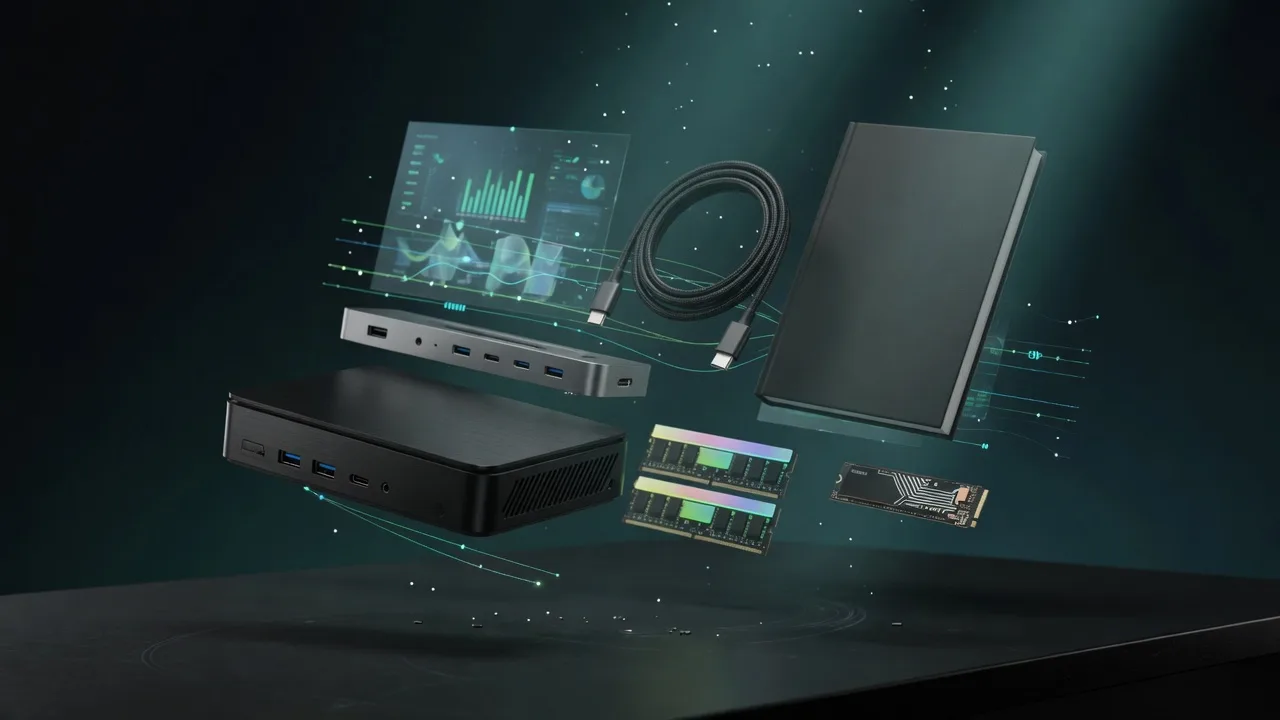
Also in Our Store
Docks, fast storage, cables, and a UPS sized for a local AI machine.

Rent this class of GPU by the hour before you buy. Live prices from RunPod and Vast.ai.
Find the break-even between buying this hardware and paying for a cloud API.
Mac vs NVIDIA for local inference, if you are still choosing a platform.
