- Services
Advertising disclosure: we earn commissions when you shop through the links below.
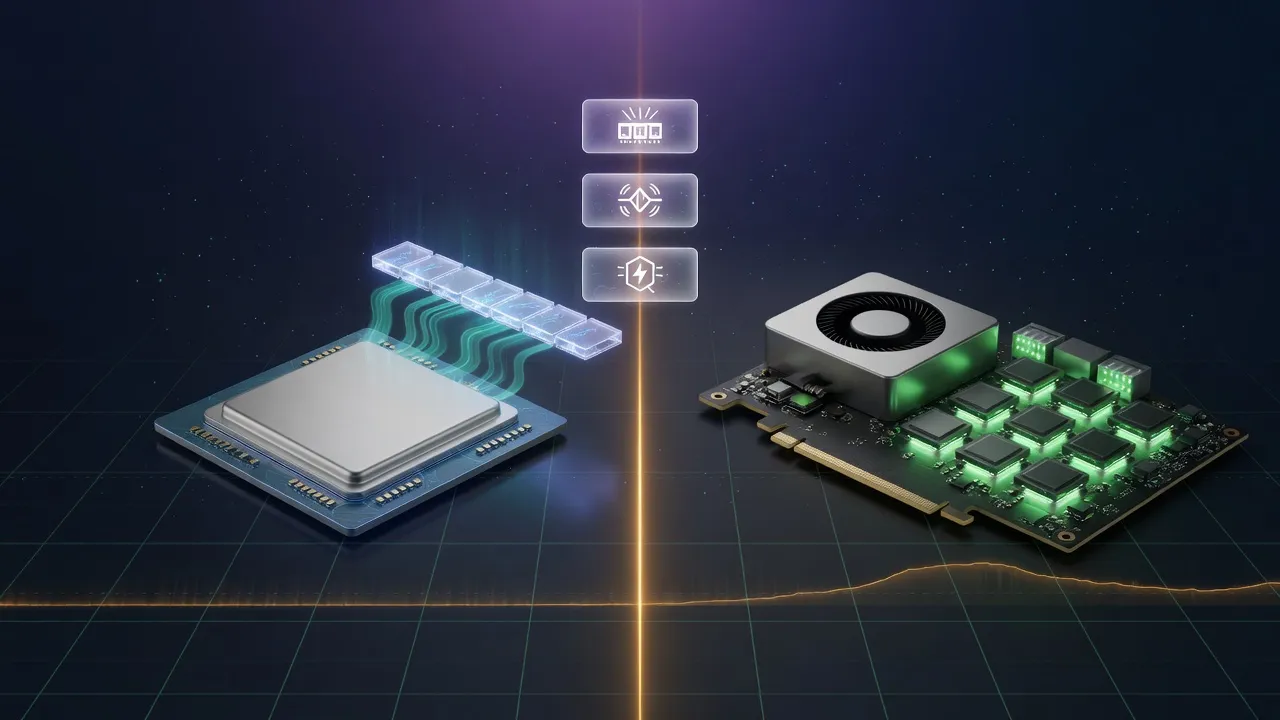
NVIDIA's RTX Spark N1X desktop is a compact Windows PC built for local AI work. It pairs a 20-core NVIDIA Grace CPU with a 6,144-core Blackwell RTX GPU and up to 128GB of unified LPDDR5X memory at a 140W TDP. NVIDIA rates AI performance at up to 1 petaflop and says the system can run models up to 120 billion parameters locally. Systems from ASUS, Dell and MSI are on sale now, with Acer, GIGABYTE, HP and the Microsoft Surface RTX Spark Dev Box following.
Sized for production serving of 70B–200B class models at full or lightly-quantized precision. Overkill for a homelab; right call when the workload pays for itself in token volume.
Generated from this product’s spec sheet. Editor reviews refine it over time.
The RTX Spark N1X Desktop represents a major architectural shift for local machine learning workstations. By combining a 20-core NVIDIA Grace CPU with a 6,144-core Blackwell RTX GPU on a unified memory substrate, the platform brings enterprise superchip engineering to a compact 140W desktop form factor. Rather than routing tensor data across bandwidth-choked PCIe lanes between separate system RAM and dedicated GPU VRAM, the N1X uses up to 128GB of unified LPDDR5X memory. This enables practitioners to load and execute models that previously demanded multi-GPU rackmount servers or custom enterprise hardware.
Positioned in the prosumer and developer desktop tier, the RTX Spark N1X Desktop bridges the gap between power-hungry dual-GPU setups and ultra-low-power mobile SoCs. Systems built around this platform, including OEM designs like the ASUS ProArt GR1X, Dell, and MSI implementations, target AI engineers, autonomous agent developers, and researchers who require massive local context and parameter capacities without drawing 800W from the wall. For developers evaluating Unknown hardware for AI development, the N1X platform offers the distinct advantage of native CUDA ecosystem compatibility paired with large unified memory pools.
In the broader AI hardware landscape, the N1X Desktop competes directly with high-memory Apple silicon workstations (such as the Mac Studio) and AMD Strix Halo systems (like the Ryzen AI Max 395). However, unlike non-NVIDIA unified memory alternatives that rely on Metal or ROCm translation layers, the RTX Spark platform runs directly on NVIDIA's established CUDA software stack. For engineering teams evaluating the best hardware for local AI agents 2026, the combination of 128GB addressable capacity and fifth-generation Tensor Cores makes the RTX Spark N1X Desktop for AI one of the most capable turnkey options on the market.
The top models this device can run at 4-bit, ranked by fit and speed.
Specs not available for scoring. This product is missing VRAM or memory bandwidth data.
Also in Our Store
Docks, fast storage, cables, and a UPS sized for a local AI machine.
Evaluating hardware for local machine learning requires analyzing compute density, memory capacity, and bus architecture. The RTX Spark N1X Desktop packages datacenter-derived architecture into a highly constrained 140W power envelope.
1RTX Spark N1X Desktop Architecture:2+--------------------------------------------------------------+3| 140W Unified SoC |4| |5| +------------------------+ +------------------------+ |6| | 20-Core NVIDIA Grace | | 6,144-Core NVIDIA | |7| | CPU | | Blackwell GPU | |8| +------------------------+ +------------------------+ |9| | | |10| +--------------+---------------+ |11| | |12| 256-bit Memory Interface |13| | |14| +----------------------------------+ |15| | Up to 128GB Unified LPDDR5X VRAM | |16| +----------------------------------+ |17+--------------------------------------------------------------+18| Networking: 10GbE | Compute: 1 PFLOPS | OS: Windows 11 |19+--------------------------------------------------------------+
The core compute engine is a 6,144-core NVIDIA Blackwell RTX GPU featuring fifth-generation Tensor Cores. NVIDIA rates the system at up to 1 petaflop of aggregate AI performance, leveraging native FP4 and FP8 precision support introduced with the Blackwell architecture. These precision formats double or quadruple compute density compared to standard FP16 execution, significantly accelerating matrix multiplication workloads during the prefill (prompt processing) phase of LLM inference.
Complementing the GPU is a 20-core NVIDIA Grace CPU. In complex agentic workflows, the host CPU handles vector database indexing, JSON parsing, tool execution, and environment interaction. Having 20 physical high-throughput cores ensures that the CPU does not bottleneck the GPU during multi-step tool-calling routines.
The standout specification is the 128GB GPU for AI memory pool. Using a 256-bit memory interface width, the unified LPDDR5X architecture provides a single, zero-copy memory pool shared dynamically between the Grace CPU and Blackwell GPU. In typical workstation builds, loading a 70B parameter model requires either two 24GB GPUs with aggressive 4-bit quantization or two to three RTX 4090/5090 cards spanning multiple PCIe slots. The N1X accommodates these models in a single mini-PC enclosure.
While the 256-bit bus does not match the raw bandwidth of multi-channel HBM3e found on H100/B200 enterprise accelerators, it provides enough throughput for interactive local generation while avoiding the thermal and acoustic penalties of high-wattage desktop GPUs.
At a maximum TDP of 140W, the RTX Spark N1X Desktop operates quietly under sustained loads. Integrated 10-gigabit Ethernet ensures rapid ingestion of multi-gigabyte training weights, embeddings, and dataset caches directly from local network-attached storage.
Memory capacity dictates model viability, while memory bandwidth dictates generation speed. With 128GB of addressable unified VRAM, the RTX Spark N1X Desktop VRAM for large language models eliminates out-of-memory errors on intermediate-to-large open weights. NVIDIA targets this hardware for running 120B parameter models locally.
The 128GB memory ceiling provides remarkable flexibility across quantization levels:
In practical RTX Spark N1X Desktop AI inference performance, token generation speeds align well with real-time operational requirements:
The sweet spot for this hardware is FP8 and INT4 quantization. Running models like Qwen 2.5 72B or Llama 3.1 70B at FP8 preserves near-lossless mathematical precision while fully exploiting Blackwell's native fifth-generation Tensor Core pipelines.
The RTX Spark N1X Desktop is engineered for specific operational environments where cloud latency, data privacy, or hardware footprints prevent standard server deployments.
For engineers running autonomous multi-agent systems (e.g., AutoGen, CrewAI, LangGraph), memory usage spikes quickly. Agents often maintain their own conversation histories, system prompts, and tool schemas. The 128GB unified memory pool allows developers to spin up multiple local LLM instances or run a single 70B model with massive scratchpad context without crashing the host system.
Organizations handling proprietary code, protected health information (PHI), or financial telemetry cannot send data to third-party API endpoints. The N1X Desktop serves as a compliant, self-contained workstation. The inclusion of Windows 11 enterprise support and 10GbE allows secure integration into localized domain networks.
While the 140W TDP and memory interface width make full pre-training of massive models impractical, the N1X Desktop excels at downstream adaptation:
Understanding where the RTX Spark N1X Desktop fits requires comparing it against the two most relevant hardware configurations in its class: Apple Silicon and custom multi-GPU desktop towers.
| Feature / Metric | RTX Spark N1X Desktop | Apple Mac Studio (M2/M3 Ultra) | Dual NVIDIA RTX 4090 Desktop |
|---|---|---|---|
| Unified / VRAM Pool | Up to 128GB Unified LPDDR5X | Up to 192GB Unified Memory | 48GB Dedicated GDDR6X (2x 24GB) |
| Max Practical Model Size | 120B parameters | 120B+ parameters | ~70B parameters (at INT4) |
| Software Ecosystem | Native CUDA, TensorRT-LLM | MLX, Metal, llama.cpp | Native CUDA, TensorRT-LLM |
| TDP / Power Draw | 140W | ~100W - 150W | 900W - 1200W (system total) |
| Form Factor | Ultra-compact Mini-PC | Compact Desktop | Full ATX Tower / E-ATX |
| Primary Limitation | Memory bus width (256-bit) | Non-CUDA software barriers | High power, limited total VRAM |
Apple's M-series Ultra chips offer wider memory buses and memory pools scaling up to 192GB. However, Apple hardware relies entirely on Apple Silicon software stacks like MLX or CPU-delegated execution. The RTX Spark N1X Desktop maintains the indispensable advantage of native CUDA support. Developers building software targeting NVIDIA-powered cloud instances (such as AWS, Azure, or RunPod) can write, test, and profile TensorRT-LLM and Triton kernels directly on their local workstation without refactoring code for Metal.
A workstation with dual RTX 4090 cards delivers higher raw memory bandwidth and fast raw tokens per second on smaller models. However, it tops out at 48GB of total VRAM, severely limiting context length on 70B models and making 120B models impossible to run without offloading to slow system RAM. Additionally, a dual-GPU PC draws nearly 1,000 watts under full load, generates substantial heat, and requires a massive chassis. The N1X Desktop delivers more than double the addressable VRAM in a compact box drawing only 140W.
For developers seeking the best hardware for running AI models locally within a streamlined desktop footprint, the RTX Spark N1X Desktop represents the premier AI chip for local deployment where raw VRAM capacity and CUDA compatibility matter above all else.