- Services
Advertising disclosure: we earn commissions when you shop through the links below.
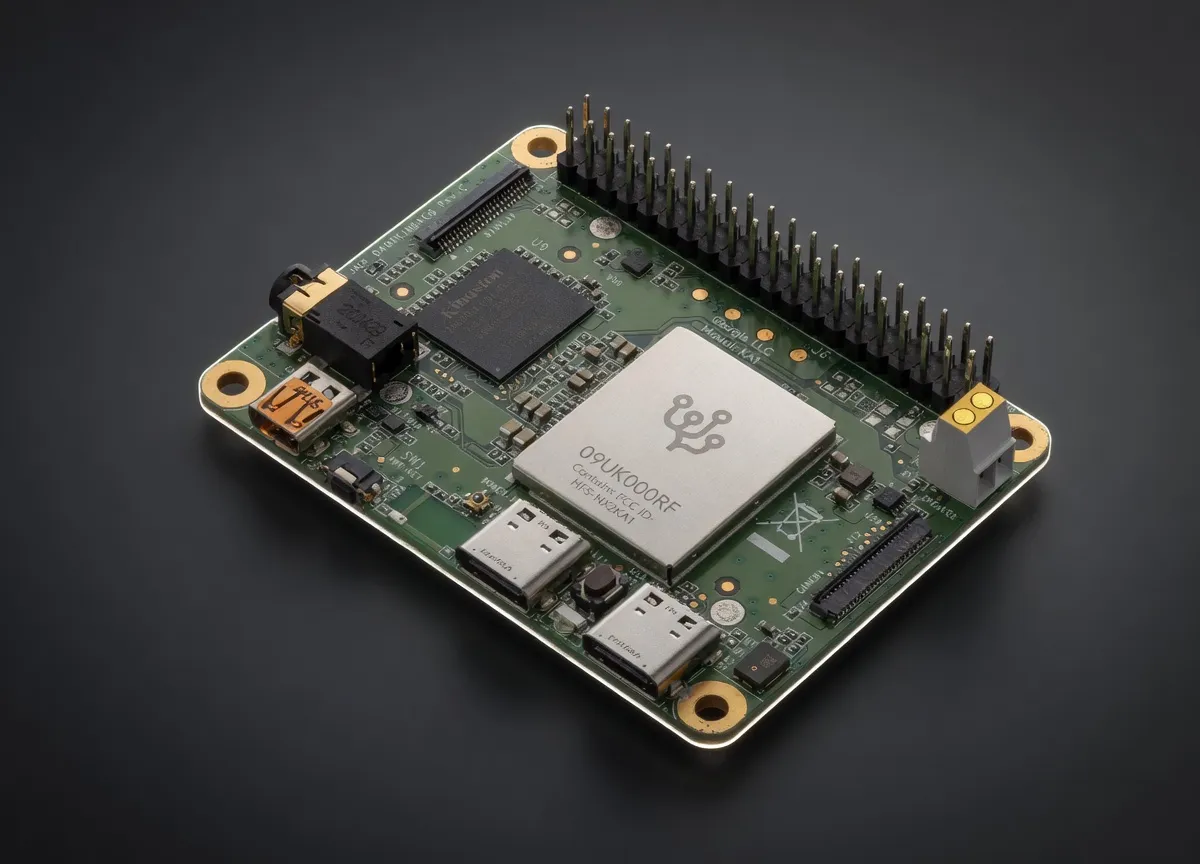
Arduino's VENTUNO Q is a single-board computer for robotics and edge AI, built on a dual-brain design that pairs a Qualcomm Dragonwing IQ8 (QCS8275) processor with an STM32H5F5 microcontroller. The IQ8 side runs Ubuntu Linux and provides up to 40 dense TOPS of NPU acceleration for local LLMs, VLMs, vision and speech models, while the STM32H5 runs the Arduino Core on Zephyr RTOS for sub-millisecond motor, CAN-FD, PWM and GPIO control. It ships with 16 GB LPDDR5 RAM, 64 GB eMMC and an M.2 NVMe Gen.4 slot, plus Wi-Fi 6, Bluetooth 5.3, 2.5 Gb Ethernet, HDMI and three MIPI-CSI camera inputs. It is listed for pre-order at an introductory EUR 298.99, with delivery about four weeks out.
Good balance for indie developers running local copilots and chat. 30B+ models are reachable but only with aggressive quantization and short context.
Generated from this product’s spec sheet. Editor reviews refine it over time.
The Arduino VENTUNO Q is a single-board computer built for robotics and edge AI, and it takes a fundamentally different approach to local inference than most hardware in its class. Instead of a single general-purpose processor, it uses a dual-brain architecture: a Qualcomm Dragonwing IQ8 (QCS8275) running Ubuntu Linux for AI workloads, paired with an STM32H5F5 microcontroller running the Arduino Core on Zephyr RTOS for real-time control. The result is a board that can run local LLMs, vision models, and speech pipelines while simultaneously driving motors, CAN-FD, PWM, and GPIO with sub-millisecond determinism.
For practitioners evaluating the best hardware for running AI models locally, the VENTUNO Q sits in the prosumer and edge-deployment tier. It is not a data center accelerator, and it is not a hobbyist toy. It competes directly with NVIDIA’s Jetson Orin Nano and Raspberry Pi 5 with AI HATs, but it differentiates itself by integrating a real-time microcontroller on the same board. That means you can build an AI-powered robot or agentic system without adding a separate MCU, and without the latency penalty of shuttling data between two devices.
The board ships with 16 GB LPDDR5 RAM, 64 GB eMMC, and an M.2 NVMe Gen.4 slot. Connectivity includes Wi-Fi 6, Bluetooth 5.3, 2.5 Gb Ethernet, HDMI, USB-C, and two USB 3.0 Type-A ports. Three MIPI-CSI camera inputs make it viable for multi-camera vision tasks. It is currently available for pre-order at an introductory price of €298.99, with delivery about four weeks out. For anyone searching for the best hardware for local AI agents in 2026, this board warrants a close look — especially if your workload involves physical actuation.
The headline number is 40 dense TOPS from the Hexagon Tensor AI Processor inside the Dragonwing IQ8. That is INT8 performance, and it puts the VENTUNO Q on par with the NVIDIA Jetson Orin Nano 8GB in raw NPU throughput. The octa-core Arm Cortex CPU and Adreno GPU/VPU (with an Arm Cortex A623 at 877 MHz) handle general compute and graphics, but the NPU is what you will use for model inference.
Memory is the critical constraint. The 16 GB of LPDDR5 is shared across the CPU, GPU, and NPU — it is not dedicated VRAM like you would find on a discrete GPU. In practice, after Ubuntu and system services, you have roughly 12–14 GB available for model weights and KV cache. That is still generous for an edge device, and it is the spec that determines which models you can run. When people ask about Arduino VENTUNO Q VRAM for large language models, the answer is that 16 GB of unified memory acts as your VRAM budget.
Memory bandwidth is not officially disclosed, but LPDDR5 on a Qualcomm platform typically delivers in the range of 50–100 GB/s. That is lower than a desktop GPU, which means token generation for large models will be memory-bound. For small models — 7B to 13B parameters — the NPU can keep the compute units busy, and you can expect usable interactive speeds. For larger models, bandwidth becomes the bottleneck.
Power consumption is another advantage. The board is designed for embedded and robotic platforms, so it runs on a single power input and does not require the 250W+ that a desktop GPU demands. That makes it suitable for battery-powered or mobile deployments where efficiency matters as much as raw throughput. The Arduino VENTUNO Q AI inference performance is best understood as “efficient enough for real-time edge tasks” rather than “fast enough to replace a workstation.”
With 16 GB of shared memory, the VENTUNO Q can comfortably run 7B and 8B parameter models at 4-bit or 8-bit quantization. Here is a practical breakdown:
For multimodal work, the board can handle vision-language models like LLaVA 1.5 7B and speech models like Whisper (small and medium variants). The three MIPI-CSI camera inputs make it practical to run real-time object detection with YOLOv8 or similar models. Long-context tasks are possible with 7B models — you can push context to 8K or 16K tokens — but memory pressure increases quickly.
The best quality-to-speed tradeoff on this hardware is 4-bit quantization (GPTQ, AWQ, or GGUF). It reduces memory footprint by ~4x compared to FP16 with minimal accuracy loss for most tasks. If you need maximum accuracy for a 7B model, 8-bit quantization is viable, but you will sacrifice speed and context length.
The VENTUNO Q is not for everyone. It is for builders who need AI and physical action on the same board.
Training is not a target workload. The VENTUNO Q is for inference. If you need to fine-tune models, you will want a discrete GPU with more memory bandwidth and CUDA support.
The most direct competitor is the NVIDIA Jetson Orin Nano 8GB. Both deliver 40 TOPS. The Orin Nano has a mature CUDA ecosystem, TensorRT, and better software support for vision models. It costs $499 for the 8GB version. The VENTUNO Q offers 16 GB of RAM for €298.99, which is a significant memory advantage, plus the integrated STM32 MCU. If you need CUDA or are already invested in NVIDIA’s stack, the Orin Nano is the safer choice. If you need more memory and real-time control on one board, the VENTUNO Q wins.
Another alternative is a Raspberry Pi 5 with an AI HAT+ (26 TOPS). That combination costs less — roughly $120 for the Pi 5 plus $70 for the HAT — but you get less NPU performance, no integrated MCU, and a less cohesive software stack. The Pi is better for general-purpose computing and hobbyist projects. The VENTUNO Q is better for robotics and edge AI where determinism matters.
For anyone searching for the best AI chip for local deployment in robotics or edge scenarios, the VENTUNO Q is a compelling option. It is not the fastest, and it cannot run 70B models. But it is one of the few boards that lets you run a local LLM and control a motor from the same piece of silicon — and that is a rare combination.
The top models this device can run at 4-bit, ranked by fit and speed.
Specs not available for scoring. This product is missing VRAM or memory bandwidth data.
Also in Our Store
Docks, fast storage, cables, and a UPS sized for a local AI machine.

Rent this class of GPU by the hour before you buy. Live prices from RunPod and Vast.ai.

Find the break-even between buying this hardware and paying for a cloud API.
Get a full budget-matched parts list for a local AI workstation.
Mac vs NVIDIA for local inference, if you are still choosing a platform.