
- Services
Advertising disclosure: we earn commissions when you shop through the links below.
The MINIX T5000 is a compact generative AI mini workstation built on the NVIDIA Jetson AGX Thor module with Blackwell architecture. It pairs a 14-core Arm Neoverse-V3AE CPU with up to 128GB of LPDDR5X memory at 273 GB/s and delivers up to 2,070 sparse FP4 TFLOPS, enough for local inference of 7B to 70B parameter models. It ships with Ubuntu 24.04 LTS and NVIDIA JetPack 7.1, with dual 10GbE, Wi-Fi 6, and a 1TB PCIe 4.0 NVMe SSD expandable to 4TB. Pricing and license terms were not stated.
Sized for production serving of 70B–200B class models at full or lightly-quantized precision. Overkill for a homelab; right call when the workload pays for itself in token volume.
Generated from this product’s spec sheet. Editor reviews refine it over time.
The MINIX T5000 represents a significant shift in compact on-device compute, packaging NVIDIA's Jetson AGX Thor module with Blackwell architecture into a 1.4-liter desktop chassis. Built around a 14-core Arm Neoverse-V3AE CPU and a Blackwell GPU featuring 2,560 CUDA cores and 96 fifth-generation Tensor Cores, this unit bridges the gap between low-power edge gateways and full-tower server racks. With 128GB of unified LPDDR5X memory, it directly addresses the primary physical constraint facing local deep learning deployments: available memory capacity for weights and massive context windows.
Operating within a 180W maximum power envelope, the T5000 provides an enterprise-grade environment for local execution. Running Ubuntu 24.04 LTS with NVIDIA JetPack 7.1, it delivers an out-of-the-box CUDA development environment without requiring the complex container setups often needed when adapting consumer desktop cards. For practitioners seeking the best hardware for running AI models locally, this workstation delivers a self-contained, low-noise platform capable of sustained edge workloads.
In the broader market, the MINIX T5000 stands as specialized prosumer and edge-enterprise hardware. It avoids the proprietary limitations of consumer operating systems while matching or exceeding the memory capacities of high-end workstations. For developers evaluating Unknown hardware for AI development, the integration of standard NVIDIA developer stacks ensures full compatibility with TensorRT-LLM, vLLM, and standard Hugging Face pipelines without translation layers.
The hardware architecture of the MINIX T5000 is balanced around edge throughput, power efficiency, and memory access:
Evaluating MINIX T5000 AI inference performance requires looking closely at memory bandwidth versus raw compute. Autoregressive token generation in large language models is strictly memory-bandwidth bound. At 273 GB/s, the T5000 operates at roughly one-fourth the bandwidth of an RTX 4090 (1,008 GB/s), but counterbalances this with double or quadruple the usable VRAM of standard consumer GPUs.
The inclusion of fifth-generation Tensor Cores brings native FP4 support, cutting parameter memory footprint in half compared to INT8 and enabling higher operational intensity during prefill phases. The dual 10GbE network interfaces provide the throughput necessary to serve continuous API calls across local clusters, preventing network bottlenecks when serving high-concurrency inference streams.
The standout feature of the MINIX T5000 VRAM for large language models is its 128GB unified memory pool shared between the Arm CPU and Blackwell GPU cores. Having 128GB GPU for AI workloads removes the severe 16GB and 24GB ceiling typical of consumer desktop configurations, making it dedicated hardware for running 70B parameter models on a desktop.
Running Llama 3.1 70B, Qwen 2.5 72B, or DeepSeek-R1 distilled variants locally is fully viable.
The Blackwell architecture includes NVIDIA's PVA 3.0 vision processing engine. Coupled with unified memory, the T5000 handles large multimodal inputs without out-of-memory errors. Models such as Pixtral 12B, LLaVA-NeXT, and Qwen2-VL run smoothly, allowing high-resolution image analysis and long-form document parsing alongside text generation.
The MINIX T5000 is engineered for specific professional scenarios where low power, small physical dimensions, and massive memory capacity take precedence over raw multi-kilowatt rack compute.
When evaluating the MINIX T5000 for AI deployments, practitioners typically contrast it with Apple silicon desktops and multi-GPU x86 workstations.
The Mac Studio with 128GB or 192GB of unified memory is the closest desktop analog to the T5000.
A workstation running two NVIDIA GeForce RTX 4090 cards offers 48GB of aggregate VRAM across cards and over 1,000 GB/s bandwidth per GPU.
For practitioners who prioritize production CUDA parity, 128GB memory capacity, and low-power operation in a miniature chassis, the MINIX T5000 offers a purpose-built alternative to consumer desktop hardware.
The top models this device can run at 4-bit, ranked by fit and speed.
| Model | Grade | Speed | VRAM |
|---|---|---|---|
| Nemotron 3.5 Bolt 74B-A9B 24GBNVIDIA | SS | 36.5 tok/s | 43.7 GB |
| NVIDIA Nemotron 3.5 Bolt 74B-A9B 24GBNVIDIA | SS | 36.5 tok/s | 43.7 GB |
| Qwen3-30B-A3BAlibaba | SS | 40.8 tok/s | 21.0 GB |
| Holo4-35B-A3BHcompany | SS | 94.0 tok/s | 20.9 GB |
| Nemotron 3.5 LightningNvidia | SS | 94.0 tok/s | 18.0 GB |
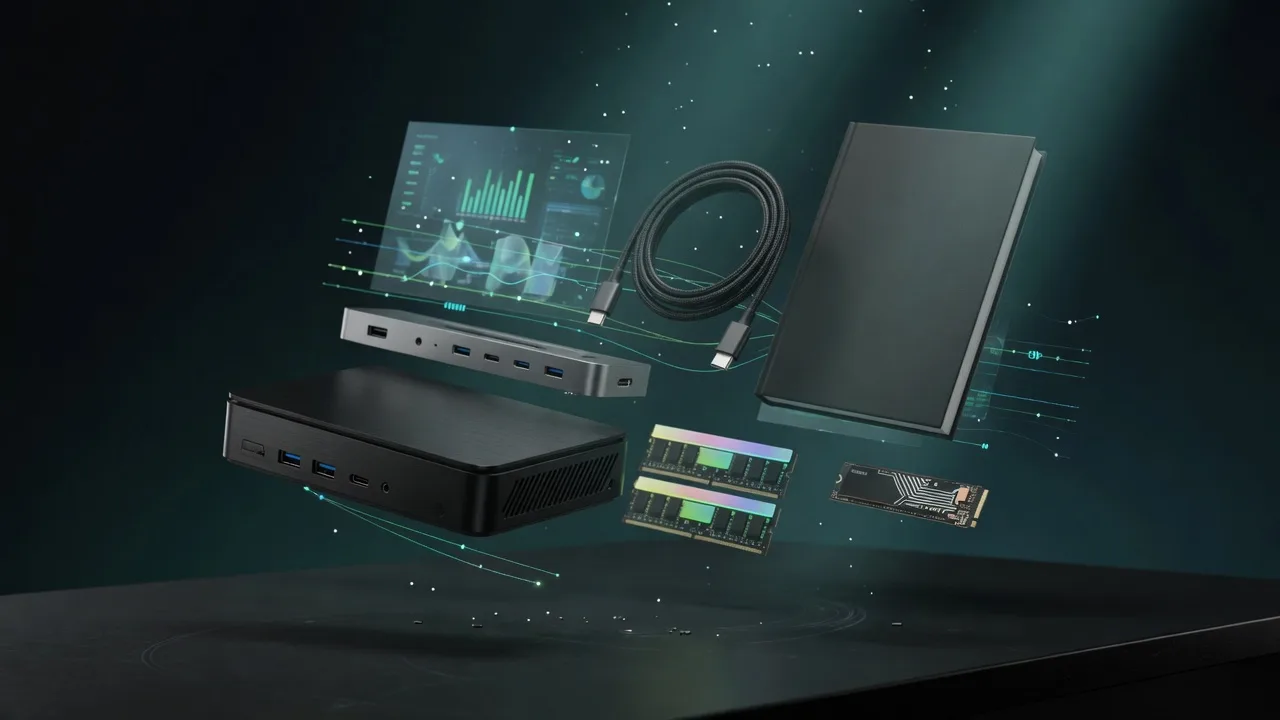
Also in Our Store
Docks, fast storage, cables, and a UPS sized for a local AI machine.
Rent this class of GPU by the hour before you buy. Live prices from RunPod and Vast.ai.
Find the break-even between buying this hardware and paying for a cloud API.
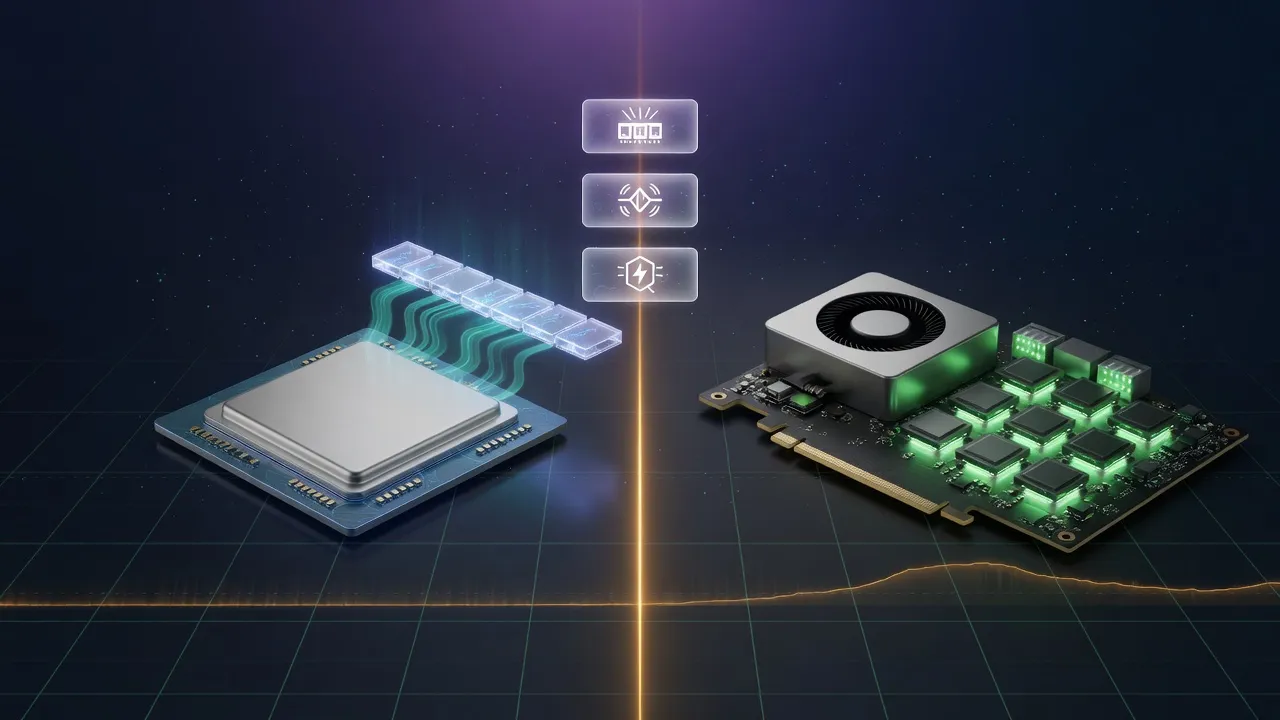
Mac vs NVIDIA for local inference, if you are still choosing a platform.
