- Services
Advertising disclosure: we earn commissions when you shop through the links below.
ASUS announced the UGen300 USB AI Accelerator, an edge AI device built around the Hailo-10H processor. It delivers 40 TOPS (INT4) or 20 TOPS (INT8) for generative AI and vision workloads, with 8GB of dedicated LPDDR4 memory. The USB-C device consumes 2.5 watts typical and supports Windows, Linux, and Android. It goes on sale October 16, 2026, priced at 49,800 yen in Japan.
8 GB will run a 7B Q4 quant and most embedding models, but the KV cache budget is tight. Better as a stepping stone than a long-term home for AI work.
Generated from this product’s spec sheet. Editor reviews refine it over time.
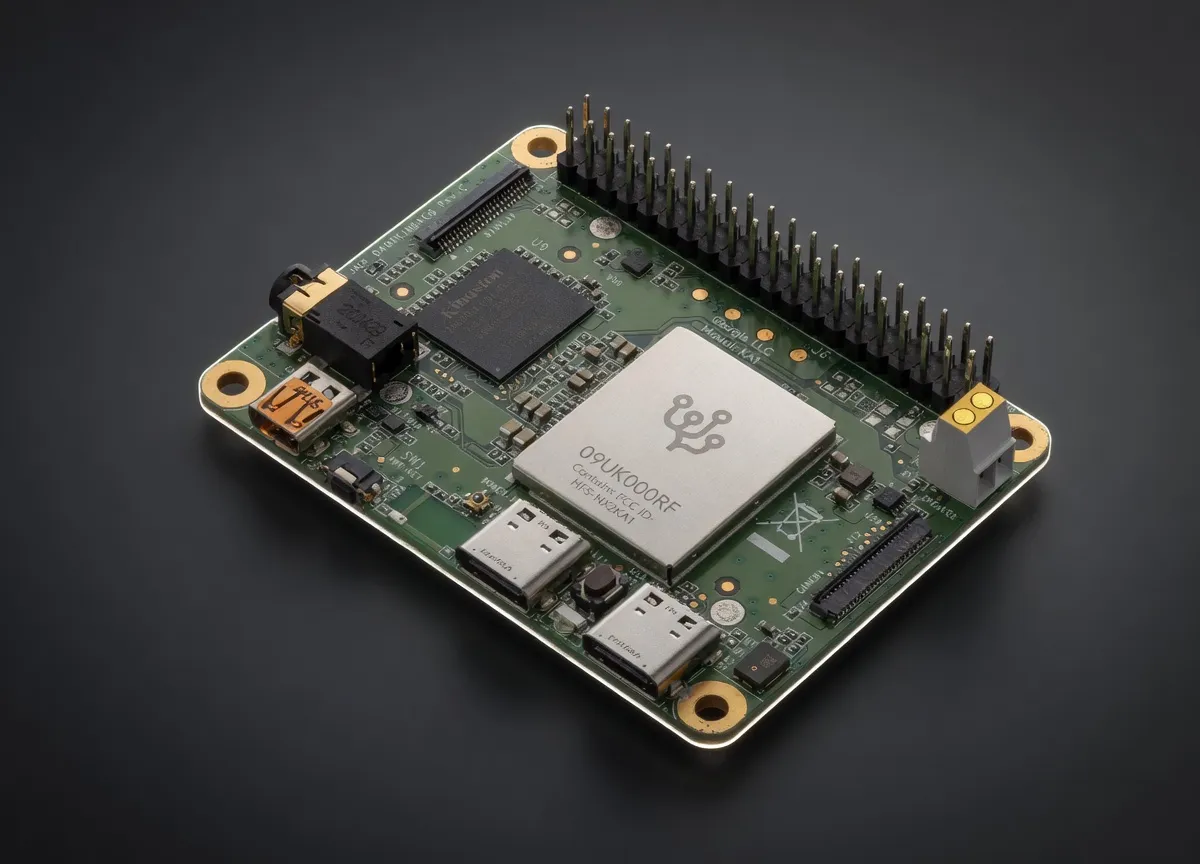
The ASUS UGen300 USB AI Accelerator 8GB is a plug-and-play edge accelerator built around the Hailo-10H neural processing unit. Packaged as an external USB 3.2 Gen2 Type-C device, it bridges a distinct gap in edge computing: bringing dedicated generative AI and computer vision acceleration to host machines without requiring PCIe expansion slots, custom carrier boards, or heavy power supplies. Drawing just 2.5 watts typical, the unit delivers up to 40 TOPS of INT4 compute and 20 TOPS of INT8 compute, backed by 8GB of integrated LPDDR4 memory.
Historically, external AI accelerators like the Google Coral USB stick targeted lightweight convolutional neural networks for classification and detection. The UGen300 shifts focus toward local Small Language Models (SLMs) and multimodal inference at the extreme edge. Even when indexed in experimental pipelines or categorized alongside unknown hardware for AI development, the UGen300 stands out because of its dedicated on-device memory architecture. It targets developers, industrial integrators, and robotics engineers looking for the best AI chip for local deployment where power, space, and physical interface constraints prevent adding an internal accelerator.
For developers evaluating the ASUS UGen300 USB AI Accelerator 8GB for AI workflows, its primary role is offloading continuous, low-latency background inference. Whether connected to an x86 industrial box, an ARM-based single-board computer, or a field laptop, it acts as an auxiliary inference engine capable of running text generation, vision-language processing, and speech recognition locally without consuming host system RAM or heating up the host CPU.
Understanding the ASUS UGen300 USB AI Accelerator 8GB AI inference performance requires looking closely at how the Hailo-10H processor handles memory and compute. Edge generative AI is fundamentally memory-bound during token generation and compute-bound during the prefill phase. The UGen300 resolves the edge memory bottleneck by soldering 8GB of dedicated LPDDR4 memory directly onto the accelerator board, running at 4266 MT/s.
Because memory is located on the device rather than across the USB bus, model weights reside locally on the accelerator. The USB 3.2 Gen2 Type-C interface (10Gbps) handles host communication, context passing, and token streaming, while the Hailo-10H accesses weights over its internal memory bus. This architecture avoids choking inference performance on USB transfer overhead.
Key technical specifications include:
Operating at an ultra-low 2.5W thermal footprint, the UGen300 delivers exceptional energy efficiency per unit of compute. While it cannot rival a discrete desktop GPU running at 150W to 300W, its compute density makes it a serious candidate among edge engineers looking for the best hardware for local AI agents 2026 within strictly power-constrained environments.
When evaluating the ASUS UGen300 USB AI Accelerator 8GB VRAM for large language models, practitioners must align their expectations with the 8GB memory ceiling and INT4/INT8 precision targets. This device is not hardware for running 70B parameter models; 70B architectures demand upwards of 40GB of VRAM even at INT4 quantization. Instead, the UGen300 is optimized for SLMs in the 1B to 3B parameter range, speech-to-text models, and vision networks.
Using INT4 quantization, modern SLMs consume under 2GB to 3GB of memory, leaving ample space inside the 8GB pool for KV cache and runtime overhead:
These ASUS UGen300 USB AI Accelerator 8GB tokens per second figures demonstrate that while the throughput is modest compared to a full-sized 8GB GPU for AI, it is more than fast enough for interactive reading speeds, automated agent decision steps, and conversational speech agents.
Beyond text generation, the accelerator handles specialized vision-language and audio models via Hailo's optimized model zoo:
The sweet spot for the UGen300 is INT4-quantized generative models and INT8-quantized vision backbones (such as YOLOv8 or ResNet variants). INT4 maximizes throughput and minimizes memory bandwidth pressure, keeping token latency predictable.
The UGen300 serves distinct niches where developers need to run AI locally without altering core system hardware:
This accelerator is strictly designed for inference. Model training, fine-tuning, and large-batch offline processing are out of scope and should remain on dedicated workstation or cloud infrastructure.
To decide if this device fits your stack, compare the ASUS UGen300 USB AI Accelerator 8GB vs alternative edge acceleration methods.
The Google Coral USB Accelerator is limited to Edge TPU technology delivering 4 TOPS (INT8) at 2W, with minimal internal memory. The Coral was built exclusively for legacy CNNs and shallow vision tasks; it cannot execute modern generative LLMs or large transformers. The UGen300 offers 40 TOPS INT4 (20 TOPS INT8) and 8GB of dedicated LPDDR4, placing it in an entirely different operational class that enables genuine generative AI, Whisper transcription, and vision-language models over USB.
The NVIDIA Jetson Orin Nano 8GB is a standalone system-on-module that delivers 40 TOPS (sparse INT8) at 7W to 15W. The Jetson platform benefits from the broader CUDA ecosystem, higher memory bandwidth, and higher raw throughput for larger models up to 7B or 8B parameters. However, the Orin Nano requires a dedicated carrier board, active cooling, complex integration, and significantly higher power. The UGen300 consumes a fraction of the power (2.5W typical) and attaches to existing hardware via a standard USB port, making it much easier to deploy on deployed machinery.
If you need a turnkey system for 7B-8B parameter models, dedicated hardware like an Orin Nano or an entry-level discrete GPU remains necessary. If your architecture demands an ultra-low-power, plug-and-play coprocessor to handle 1B-3B models, transcription, and edge vision on existing systems, the ASUS UGen300 is one of the most flexible hardware options available.
The top models this device can run at 4-bit, ranked by fit and speed.
Specs not available for scoring. This product is missing VRAM or memory bandwidth data.
Also in Our Store
Docks, fast storage, cables, and a UPS sized for a local AI machine.

Rent this class of GPU by the hour before you buy. Live prices from RunPod and Vast.ai.

Find the break-even between buying this hardware and paying for a cloud API.
Mac vs NVIDIA for local inference, if you are still choosing a platform.