- Services
Advertising disclosure: we earn commissions when you shop through the links below.
ASUS builds the ProArt P16 (H7607), a 16 inch creator notebook built around the NVIDIA RTX Spark N1X platform with an Arm CPU architecture and NVIDIA Blackwell graphics. Models carry up to 128GB of unified memory. ASUS plans to launch it on October 8, 2026. Full technical specifications and US pricing have not been published yet.
Sized for production serving of 70B–200B class models at full or lightly-quantized precision. Overkill for a homelab; right call when the workload pays for itself in token volume.
Generated from this product’s spec sheet. Editor reviews refine it over time.
The ASUS ProArt P16 (H7607) is a 16-inch creator notebook that happens to be one of the more interesting local AI machines announced for 2026. It is built on the NVIDIA RTX Spark N1X platform, which pairs an Arm-based NVIDIA Grace CPU with 20 cores against a Blackwell RTX GPU with 6,144 CUDA cores, all sharing up to 128GB of LPDDR5X unified memory. ASUS has it slated for an October 8, 2026 launch. Full US pricing and several key specifications, including memory bandwidth, are still unpublished.
That unified memory figure is the headline for anyone running models locally. 128GB of coherent memory accessible by both CPU and GPU puts this machine in a tier that discrete-GPU laptops cannot reach. A consumer RTX 5090 laptop tops out at 24GB of VRAM, which caps you at aggressively quantized 30B-class models. The ProArt P16 removes that ceiling entirely, and it does so in a 12.9mm chassis weighing 1.77kg. This is not a data center part and it is not a workstation replacement in the traditional sense. It is a prosumer laptop aimed at creators and developers who want serious local inference without a desktop tower or a cloud bill.
For AI practitioners specifically, the value proposition is straightforward: a portable machine that can hold a 70B or even 120B parameter model in memory at usable quantization, run agentic workflows with long context windows, and still drive a 4K OLED panel for the creative work that pays the bills. ASUS explicitly markets it as "optimized for agentic AI locally," claiming support for models up to 120B parameters and a 1-million-token context window.
The top models this device can run at 4-bit, ranked by fit and speed.
Specs not available for scoring. This product is missing VRAM or memory bandwidth data.
Also in Our Store
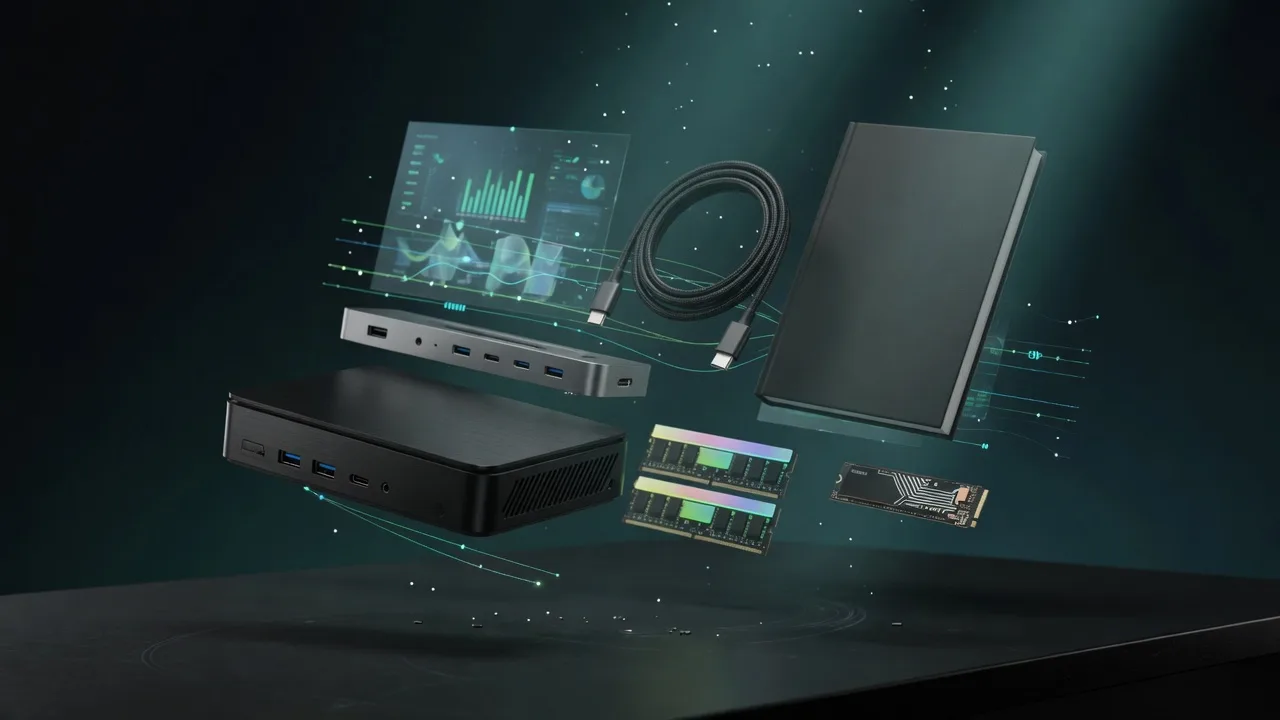
Docks, fast storage, cables, and a UPS sized for a local AI machine.
The specs that matter for inference, in order of importance:
Memory capacity determines what you can load. Memory bandwidth determines how fast it generates tokens. ASUS has not published bandwidth figures for the N1X, but LPDDR5X on a platform of this class typically lands in the 250-275 GB/s range. That is the single most important number for anyone asking about ASUS ProArt P16 (H7607) tokens per second, and it is the number you should chase down before ordering. Token generation on a dense transformer is almost purely bandwidth-bound, so a 70B model at 4-bit precision (roughly 40GB of weights) will read that entire 40GB from memory for every token produced. At 270 GB/s, the theoretical ceiling is around 6-7 tokens per second, and real-world throughput will land somewhat below that.
The 1 petaflop FP4 figure is a prefill and compute-bound number. It matters for prompt processing, image generation, and fine-tuning runs, not for steady-state token streaming. Do not let it set expectations for chat latency.
With 128GB of unified memory, you realistically have 100-115GB available for weights, KV cache, and framework overhead after the OS and display buffers take their share. That opens up a lot.
Comfortable at full or near-full precision:
The sweet spot for large models:
Out of reach:
Multimodal models are viable. Llama 3.2 Vision 11B and Qwen 2.5-VL 7B or 32B all fit comfortably, and the Blackwell GPU has the tensor throughput to handle vision encoding without stalling the text pipeline. Long-context work is where the 128GB really pays off: you can run a 70B model at Q4 and still allocate 50GB or more to KV cache, which supports very large context windows before you need to reach for aggressive quantization or paging.
Expect roughly 5-7 tokens per second on 70B Q4 and 30-40 tokens per second on 8B Q4. These are projections based on typical LPDDR5X bandwidth for this platform class, not measured figures.
Local chatbot and assistant users. If you want a private, always-available assistant running a 70B-class model, this is one of the few laptops that does it without compromise. The 1-million-token context claim matters here for document-heavy workflows.
Developers building agentic applications. ASUS is targeting this machine at personal agents specifically. Running multi-step agent loops with tool calls locally, against a 70B model with a large context window, is exactly what the memory configuration is designed for. For anyone searching for the best hardware for local AI agents in 2026, this belongs on the shortlist alongside the NVIDIA DGX Spark.
Creative professionals using AI in the pipeline. The 4K OLED panel, Delta E under 1 color accuracy, and PANTONE validation are real, and CUDA acceleration covers the 1,000+ accelerated creative applications. If your work is generative image or video plus local LLM assistance, the combination is coherent.
Not for training. This is an inference machine. Fine-tuning small models with LoRA is feasible. Full fine-tunes of anything substantial are not, and neither is multi-GPU scaling.
NVIDIA DGX Spark. The closest analogue. Same 128GB unified memory, same 1 petaflop FP4 class of compute, similar Grace-plus-Blackwell architecture. The DGX Spark is a desktop box with a mature software stack and NVIDIA's full support apparatus. The ProArt P16 gives you a screen, a battery, and portability. If you need a fixed inference node and maximum software maturity, take the Spark. If you need to carry your models with you, take the P16.
Apple MacBook Pro M4 Max (128GB). Also 128GB unified memory, also Arm, also bandwidth-limited for token generation. Apple's advantage is a far more mature local inference ecosystem (MLX, llama.cpp Metal backends) and better power efficiency. The ProArt P16's advantage is CUDA: native acceleration across the entire PyTorch, TensorRT, and vLLM toolchain, which matters enormously if you are developing rather than just consuming models. Pick the Mac for battery life and ecosystem polish. Pick the P16 for CUDA compatibility and Blackwell-class compute.
The decision hinges on one unpublished number: memory bandwidth. If the N1X lands at 270 GB/s or above, the ProArt P16 is a compelling portable inference machine. If it lands lower, token generation on 70B models becomes painful and the machine is better suited to smaller models and compute-heavy creative work. Verify that figure before you commit.