- Services
Advertising disclosure: we earn commissions when you shop through the links below.
GIGABYTE's AI TOP 100 B850 is a deskside workstation for on-premise AI work including LLM inference, generative AI, fine-tuning and agentic AI workflows. It combines a 16-core, 32-thread AMD Ryzen 9 9950X with 128 GB DDR5 memory, a 2 TB PCIe 4.0 SSD and a 1600W 80 PLUS Platinum power supply on an AMD B850 platform. Two graphics options are offered: a single NVIDIA GeForce RTX 5090, or two AMD Radeon AI PRO R9700 cards with 64 GB of total video memory. GIGABYTE rates the dual-card version for inference on models up to 235B parameters and fine-tuning up to 110B parameters, while the RTX 5090 version reaches up to 64.9 tokens per second on a 32B model.
The first tier where 70B-class models stop feeling cramped. Headroom for KV cache means 32K+ context on Q4 quants without falling off the GPU.
Generated from this product’s spec sheet. Editor reviews refine it over time.
GIGABYTE's AI TOP 100 B850 is a deskside AI workstation built on the AMD B850 platform with a 16-core, 32-thread Ryzen 9 9950X, 128 GB of DDR5, a 2 TB PCIe 4.0 SSD, and a 1600W 80 PLUS Platinum power supply. It is a prosumer and small-team machine, not a data center appliance: it sits below GIGABYTE's TRX50-based AI TOP 500 tier and above the consumer ATOM line, and it targets people who want to run LLM inference, fine-tuning, and agentic workflows on hardware they own rather than on metered cloud APIs.
The defining decision is the GPU configuration, because GIGABYTE ships two versions with very different memory ceilings. The first pairs the system with a single NVIDIA GeForce RTX 5090. The second installs two AMD Radeon AI PRO R9700 cards for 64 GB of total video memory. GIGABYTE rates the dual-AMD version for inference on models up to 235B parameters and fine-tuning up to 110B parameters, and quotes up to 64.9 tokens per second on a 32B model for the RTX 5090 configuration. Those two numbers describe different machines with different tradeoffs, and picking between them is the whole purchase decision.
Availability is announced rather than shipping, and no MSRP is listed, so budget planning should assume a build-it-yourself comparison: the components are all standard AM5 parts.
VRAM determines which models you can load at all, before speed enters the picture. The two configurations split cleanly:
System memory and GPU memory are separate budgets. The 128 GB of DDR5 does not become 128 GB of VRAM, but it does matter for CPU offload, dataset staging, and the host-side work in fine-tuning pipelines. 128 GB is generous for a single-socket desktop and lets you keep large tokenized datasets resident while the GPUs work.
The Ryzen 9 9950X handles tokenization, prompt processing coordination, data loading, and the CPU-side portions of agent frameworks. With 16 cores and 32 threads, it will not bottleneck a single-GPU inference loop, and it gives you real headroom for running quantized models partly on CPU when a model exceeds VRAM.
The 64.9 tokens per second figure on a 32B model is a single-stream, RTX 5090 number. That is comfortable interactive territory, roughly 2x to 3x reading speed. Expect batch throughput to scale better than single-stream latency, which is what matters if you are serving multiple concurrent agent requests rather than chatting with one model. GIGABYTE publishes no equivalent throughput figure for the dual-R9700 configuration, so treat the 235B rating as a capacity claim, not a speed claim. Multi-GPU tensor parallelism also adds communication overhead, so two cards do not deliver 2x the tokens per second of one.
The 1600W 80 PLUS Platinum unit is sized for two high-draw accelerators plus a 16-core CPU under sustained load, with margin. That is the correct way to read it: not as a marketing number, but as evidence the platform was specced for continuous inference rather than bursty gaming. Two PCIe 5.0 x16 slots, dual 10GbE LAN, and Wi-Fi 7 round out the platform. The dual 10GbE is the more interesting inclusion for teams, since it makes the machine viable as a shared inference node on a local network rather than a single-user desktop.
For both configurations, Q4_K_M is the best quality-to-speed tradeoff. Below 4-bit, perplexity climbs noticeably on smaller models; above 5-bit, you are spending VRAM for marginal gains. On the dual-card build, Q5_K_M and Q6_K become practical for 70B models and are worth the extra memory if you have it.
Multimodal work (vision-language models like Qwen2.5-VL or Llama 3.2 Vision) is fine at 7B to 32B scale on either configuration. Long-context tasks are where VRAM pressure shows up first: a 128K context on a 32B model can consume more memory in KV cache than the weights themselves, so plan context length against your quantization choice.
This is not a training platform. If pre-training or full fine-tuning is your workload, the AI TOP 100 B850 is the wrong tier.
Versus a DIY AM5 build with an RTX 5090. The core components are standard parts, and a self-built equivalent will typically cost less. You are paying GIGABYTE for validation, the AI TOP Utility software layer, thermal design, and a single warranty. If you are comfortable assembling and debugging a workstation, the DIY route is defensible.
Versus Apple's Mac Studio with M3 Ultra. Apple's unified memory lets you load far larger models (up to 512 GB) at lower power draw, which makes it attractive for running 200B-plus models at low quantization. It loses on raw compute density, CUDA compatibility, and fine-tuning flexibility. Pick the Mac for maximum model size at minimum noise; pick the AI TOP 100 B850 for throughput and framework compatibility.
Versus the dual-R9700 configuration itself. If your priority is running 70B models at Q4 or larger MoE models, the 64 GB AMD version is the more capable machine despite lower per-card ecosystem maturity. If your priority is fast, well-supported inference on models up to 32B, the RTX 5090 version wins on every practical metric.
For anyone searching for hardware to run 235B parameter models locally, or the best hardware for local AI agents in 2026, this machine's value proposition is straightforward: 64 GB of pooled VRAM and a 1600W platform in a deskside form factor, with the caveat that the AMD path demands you check software support before you buy.
The top models this device can run at 4-bit, ranked by fit and speed.
Specs not available for scoring. This product is missing VRAM or memory bandwidth data.
Also in Our Store
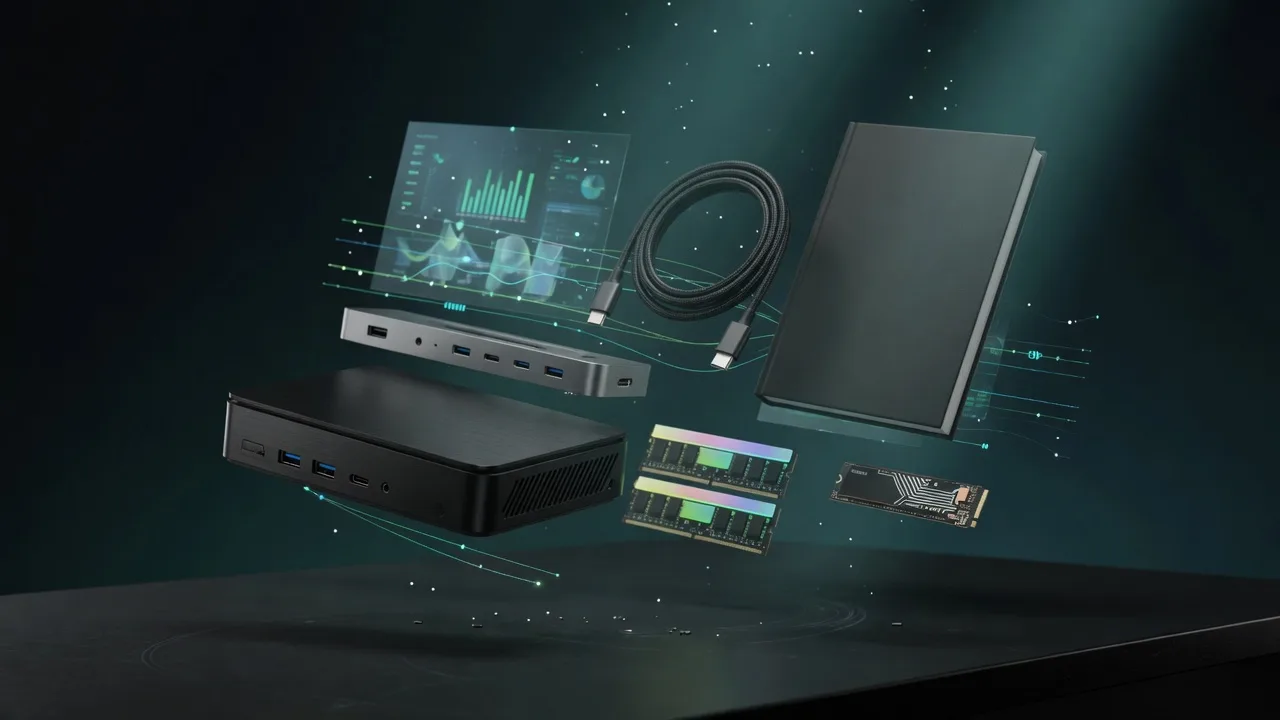
Docks, fast storage, cables, and a UPS sized for a local AI machine.

Rent this class of GPU by the hour before you buy. Live prices from RunPod and Vast.ai.
Find the break-even between buying this hardware and paying for a cloud API.
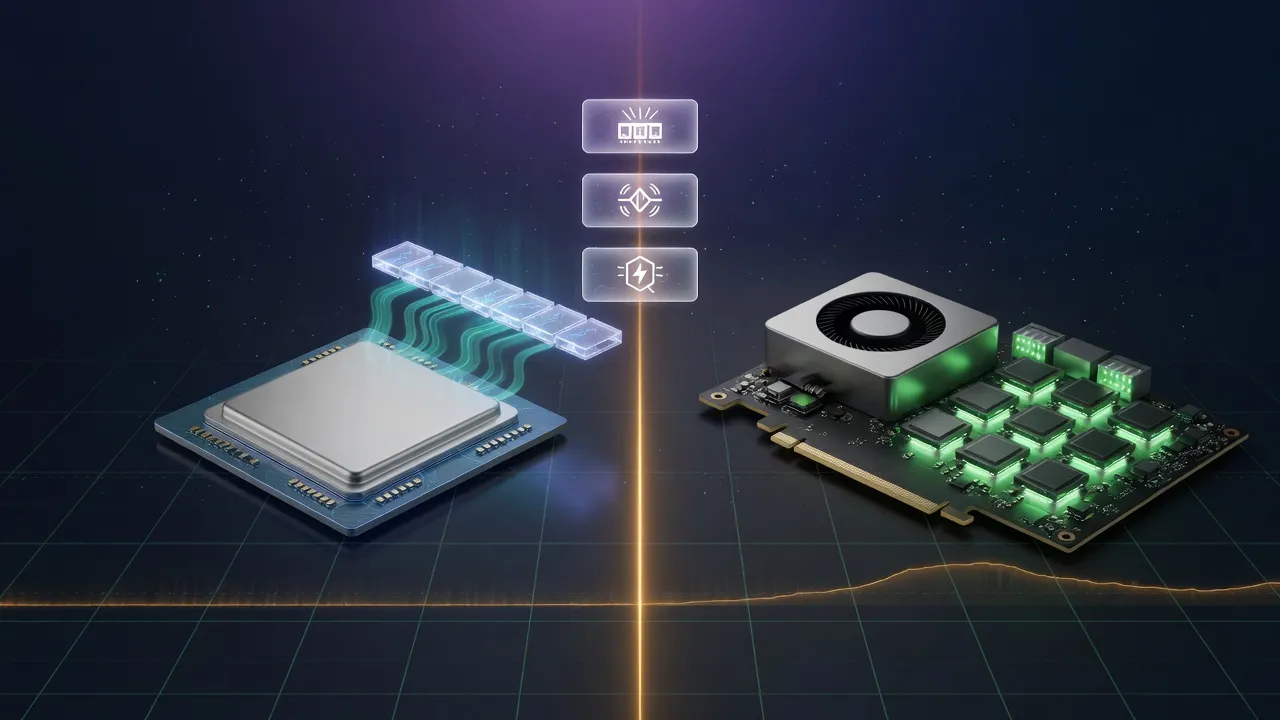
Mac vs NVIDIA for local inference, if you are still choosing a platform.