
- Services
Advertising disclosure: we earn commissions when you shop through the links below.
GMKtec EVO-X2 is a mini PC from GMKtec built around the AMD Ryzen AI Max+ 395 APU, with 16 Zen 5 cores, 32 threads and a Radeon 8060S integrated GPU. It comes with 128GB of LPDDR5X-8000 shared memory and a 2TB PCIe 4.0 SSD, and GMKtec demonstrated local inference on a 235B parameter model at Computex 2025. The XDNA 2 NPU is rated at 50 TOPS and combined CPU, GPU and NPU throughput is listed at 126 TOPS, with up to 140W peak power draw. It is sold through GMKtec and Amazon, and the 128GB plus 2TB configuration launched in China at 14,999 yuan.
Sized for production serving of 70B–200B class models at full or lightly-quantized precision. Overkill for a homelab; right call when the workload pays for itself in token volume.
Generated from this product’s spec sheet. Editor reviews refine it over time.
The GMKtec EVO-X2 represents a distinct shift in compact computing for machine learning practitioners, packaging workstation-class unified memory into a mini PC chassis. Powered by the AMD Ryzen AI Max+ 395 processor (part of AMD's Strix Halo family), this system addresses the single biggest bottleneck in local AI deployment: addressable VRAM. While standard desktop hardware forces developers into multi-GPU setups or costly enterprise accelerators to load high-parameter models, the EVO-X2 pairs 16 Zen 5 CPU cores and a Radeon 8060S GPU with 128GB of high-speed unified LPDDR5X memory.
Positioned in the prosumer and developer desktop tier, the device bridges the divide between standard consumer mini PCs and dedicated AI workstations. For developers evaluating Unknown hardware for AI development and looking for the best hardware for running AI models locally, the EVO-X2 offers an efficient alternative to power-hungry multi-card rigs. With the capacity to allocate up to 96GB of system memory strictly to graphics and compute tasks, it enables local deployment of architectures that previously required distributed nodes or cloud endpoints.
Operating at a peak power envelope of 140W, the system delivers high parameter density per watt. It provides researchers, autonomous agent architects, and software engineers with a quiet, dedicated inference engine capable of running advanced open-weight models locally without incurring recurring API fees or exposing proprietary data to third-party endpoints.
The GMKtec EVO-X2 for AI builds on AMD's integrated Strix Halo APU architecture. Compute is distributed across three specialized engines: the 16-core, 32-thread Zen 5 CPU boosting up to 5.1GHz with 80MB of onboard cache, the integrated Radeon 8060S GPU with 40 RDNA 3.5 compute units, and the XDNA 2 Neural Processing Unit (NPU) rated at 50 TOPS. Across CPU, GPU, and NPU, the platform delivers a combined INT8 compute throughput of 126 TOPS.
The standout specification for deep learning workloads is the memory subsystem. The EVO-X2 features 128GB of LPDDR5X-8000 memory operating over an eight-channel bus. Because the memory is unified, up to 96GB can be dedicated directly to the Radeon 8060S compute engine. In practice, this gives local inference pipelines what effectively behaves as a 96GB GPU for AI within a mini PC form factor.
While discrete high-end GPUs like the RTX 4090 offer higher peak memory bandwidth, they are hard-capped at 24GB of VRAM per card. The EVO-X2 sidesteps PCIe bus communication overhead entirely by housing massive model weights in a single, contiguous 96GB pool. The memory bandwidth of the eight-channel LPDDR5X-8000 configuration provides the sustained throughput needed to feed the 40 compute units during autoregressive generation.
Key technical specifications include:
Thermal management is handled by an Arctic vapor chamber paired with dual turbine fans. Under sustained heavy inference loads, the system manages the 140W TDP effectively, preventing thermal throttling during long prompt evaluation and token generation sessions.
GMKtec EVO-X2 VRAM for large language models makes it a specialized tool for loading high-parameter weights without CPU offloading penalties. When evaluating GMKtec EVO-X2 AI inference performance, the 96GB allocation threshold determines model viability across distinct parameter tiers:
Models such as Llama 3.1 8B, Mistral 7B, and Qwen 2.5 14B fit completely into memory at unquantized FP16 or high-fidelity Q8_0 quantization. In this tier, GMKtec EVO-X2 tokens per second remain exceptionally high, delivering rapid interactive streaming suitable for low-latency coding assistants, document parsing, and real-time voice agents.
This range represents the optimal operational tier for the machine. A model like Llama 3.3 70B or Qwen 2.5 32B runs cleanly inside the 96GB limit:
The EVO-X2 is practical hardware for running 235B parameter models locally. GMKtec demonstrated local inference on a 235B parameter model at Computex 2025. Running models of this scale requires aggressive quantization, such as 2-bit (IQ2_XXS or Q2_K) or low-bit Mixture of Experts (MoE) execution. While generation speeds at 235B are lower (typically 2 to 5 tokens per second), the fact that it loads and executes fully on a 140W mini PC without multi-node clusters makes it a unique platform for large-weight testing.
The massive VRAM pool allows the EVO-X2 to excel at vision-language tasks (such as Qwen2-VL and LLaVA 1.6) and massive context tasks. A 32B model can run with a 128k context window without offloading the KV cache to system RAM, avoiding the steep speed drop associated with CPU context swapping.
The EVO-X2 serves specific operational requirements across engineering and development workflows:
llama.cpp, Ollama, or ROCm-accelerated stacks benefit from a self-contained, low-noise environment that handles both coding models and long-context documentation queries.Understanding where the EVO-X2 fits requires comparing it against the two standard local AI alternatives: unified Mac hardware and discrete desktop rigs.
Apple silicon provides higher raw memory bandwidth through its 384-bit and 512-bit unified buses, giving the Mac Studio higher tokens-per-second throughput on dense 70B models. However, the EVO-X2 runs on native x86_64 architecture with open ROCm and Linux support, avoiding the architectural translation layers or proprietary Metal optimizations often needed for bleeding-edge frameworks. It also provides open storage upgradeability via dual PCIe 4.0 M.2 slots at a substantially lower price per gigabyte of VRAM.
A custom workstation equipped with two RTX 4090 GPUs provides 48GB of aggregate VRAM across dual cards and offers unmatched raw compute and CUDA software support. However, dual-4090 rigs draw 850W to 1000W under load, generate substantial heat, occupy full mid-tower cases, and cost significantly more. The EVO-X2 offers double the addressable VRAM (96GB vs. 48GB) within a 140W mini PC footprint, making it the better choice for loading models larger than 70B where memory capacity takes precedence over raw compute throughput.
For practitioners looking for the best AI chip for local deployment where VRAM capacity, compact footprint, and power efficiency are the primary design constraints, the GMKtec EVO-X2 delivers a targeted, cost-effective platform for running advanced local LLM architectures.
The top models this device can run at 4-bit, ranked by fit and speed.
Specs not available for scoring. This product is missing VRAM or memory bandwidth data.
Also in Our Store
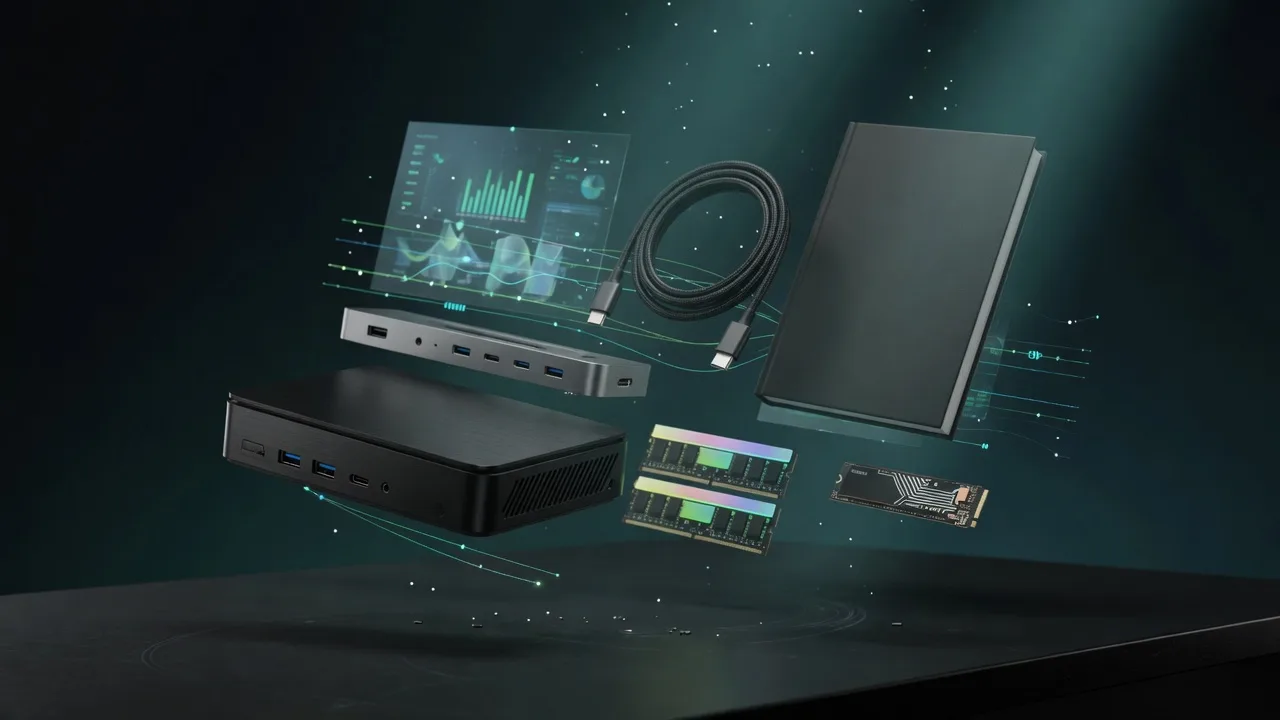
Docks, fast storage, cables, and a UPS sized for a local AI machine.

Rent this class of GPU by the hour before you buy. Live prices from RunPod and Vast.ai.

Find the break-even between buying this hardware and paying for a cloud API.
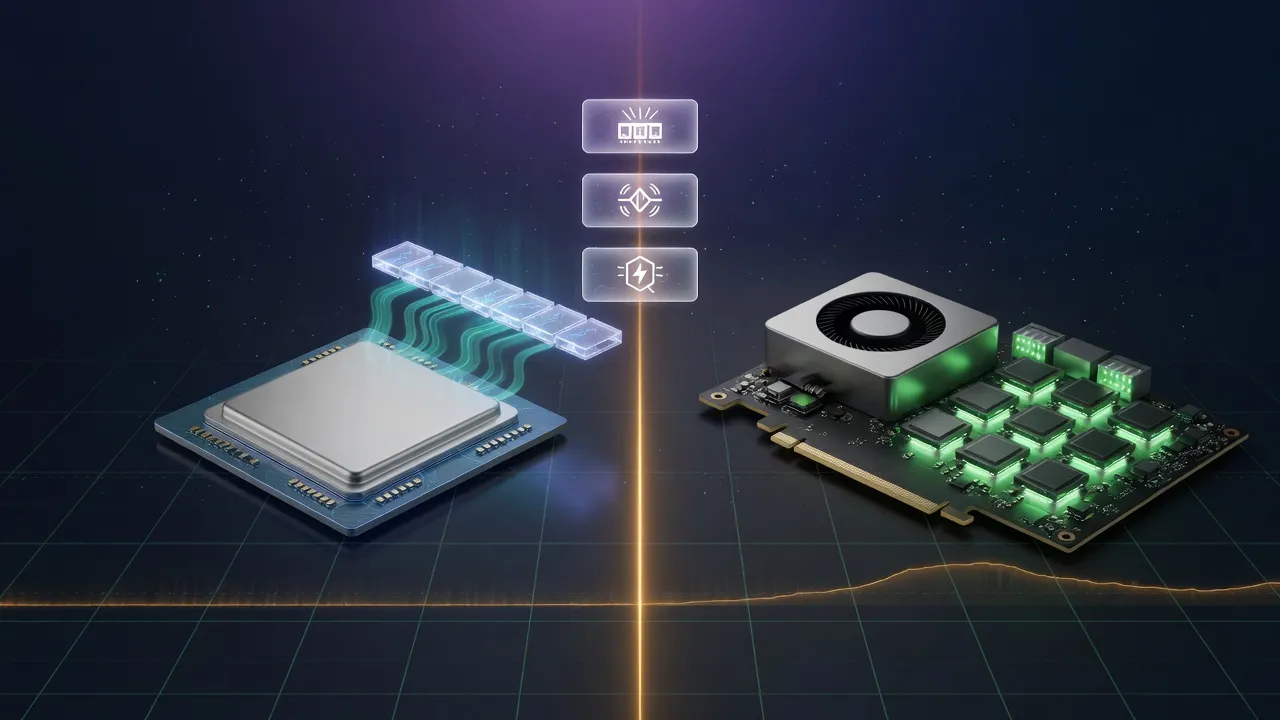
Mac vs NVIDIA for local inference, if you are still choosing a platform.
