- Services
Advertising disclosure: we earn commissions when you shop through the links below.
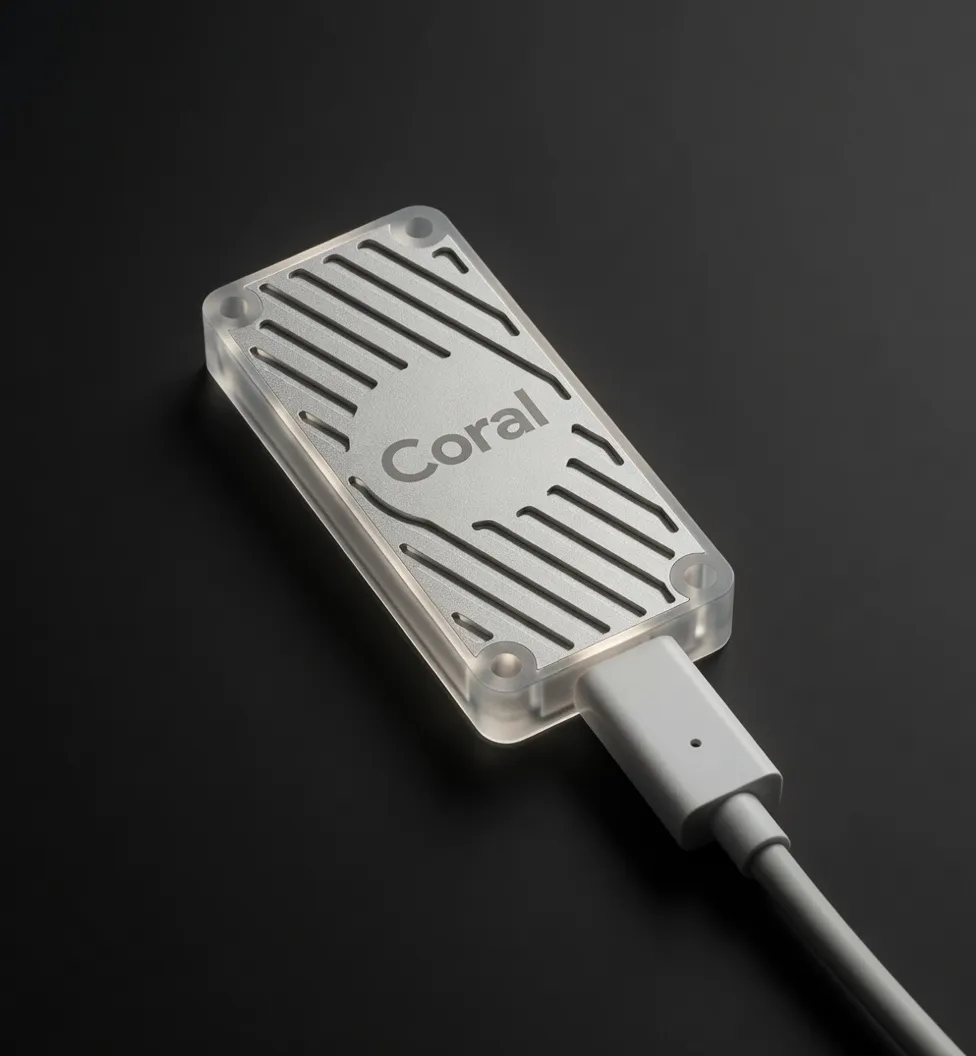
Compact USB-C Edge TPU dongle delivering 4 TOPS at just 2W for fast TensorFlow Lite inference. Plug-and-play ML acceleration for Raspberry Pi, Linux, macOS, and Windows systems.
Manufacturer's suggested retail price. Current prices can be higher or lower. This is not a live price.
The Google Coral USB Accelerator is a purpose-built hardware plug-in designed to offload machine learning inference from a host CPU to a dedicated tensor processing unit. Manufactured by Google, this device brings the Edge TPU (Tensor Processing Unit) to any system with a USB port, making it a staple in the ecosystem of Google edge devices for AI development. It occupies a specific niche: high-speed, low-power execution of quantized computer vision models.
In the landscape of best edge devices for running AI models locally, the Coral USB Accelerator is a "specialist" tool. It is not a general-purpose GPU like an NVIDIA Jetson, nor is it a high-VRAM workstation card. Instead, it is a budget-friendly ($60 MSRP) accelerator optimized for TensorFlow Lite workloads. For practitioners building autonomous workflows or real-time monitoring systems, it offers a way to add 4 TOPS of INT8 performance to hardware as constrained as a Raspberry Pi 3B+ or an aging laptop without a discrete GPU.
The core of the Google Coral USB Accelerator is the Edge TPU, an ASIC designed by Google specifically to accelerate the linear algebra required for deep neural networks.
When evaluating Google Coral USB Accelerator AI inference performance, the key metric is latency for INT8 quantized models. Because the device is optimized for 8-bit integer math, it achieves massive throughput on vision tasks. For example, it can run MobileNet V2 at approximately 400 FPS.
Unlike standard GPUs, the Edge TPU does not have "VRAM" in the traditional sense that a user can load a 7B parameter model into. Instead, it utilizes an on-chip SRAM cache for model weights and activations. This architectural choice is why the device is restricted to MobileNet/Inception-class vision models and other small-footprint architectures. If a model exceeds the on-chip memory, the compiler will "map" parts of the model back to the host CPU, significantly degrading performance.
Practitioners must understand that the Google Coral is a specialized inference engine. It is not built for the current wave of Large Language Models (LLMs) that require gigabytes of VRAM.
The "sweet spot" for this hardware is MobileNet, Inception, and SSDLite architectures. It is arguably the best AI chip for local deployment of real-time object detection, face recognition, and image classification.
A common inquiry is the Google Coral USB Accelerator local LLM capability. To be direct: the Coral USB Accelerator is not suitable for running modern LLMs like Llama 3.1, Mistral 7B, or Qwen 2.5. These models require FP16 or high-bit quantization (4-bit/8-bit) and massive memory bandwidth that the Edge TPU's architecture does not support.
If you are looking for Google Coral USB Accelerator VRAM for large language models, you will find it lacks the capacity for the billions of parameters these models demand. For LLM workloads, practitioners should look toward NVIDIA’s Jetson Orin series or Apple Silicon (M2/M3/M4) for unified memory architectures.
The Edge TPU requires models to be in the .tflite format and fully quantized to INT8. You cannot run FP32 or FP16 models directly on the TPU; they must be converted using the Edge TPU Compiler. This process ensures the best quality-to-speed tradeoff for edge deployment but requires an extra step in the development pipeline.
The Google Coral USB Accelerator is a foundational component for local AI agents in 2025 that rely on "sight" rather than just text processing.
When choosing the best hardware for local AI agents, it is important to compare the Coral with its closest competitors: the Intel Movidius Neural Compute Stick 2 (NCS2) and the Hailo-8L.
The Intel NCS2 was the primary competitor for years. However, the Google Coral generally outperforms the NCS2 in raw throughput for TensorFlow-based models. Furthermore, the NCS2 has been largely deprecated by Intel in favor of the OpenVINO toolkit on integrated GPUs, whereas Google continues to support the Coral ecosystem.
The Hailo-8 is a more modern competitor, offering up to 26 TOPS compared to the Coral’s 4 TOPS. However, the Hailo-8 is significantly more expensive and often requires an M.2 slot. The Coral USB Accelerator remains the preferred choice for budget-friendly projects and systems that lack M.2 expansion, relying instead on the ubiquity of USB 3.0.
You should choose the Google Coral if your workload involves TensorFlow Lite, requires less than 2W of power, and focuses on vision-based inference. If your goal is to run a local chatbot (Llama 3, DeepSeek-R1) or perform model training, this is not the correct hardware; for those tasks, prioritize high-VRAM NVIDIA hardware or Mac Studio configurations.
For engineers building the "eyes" of an autonomous system, the Google Coral USB Accelerator remains a top-tier choice for its reliability, ease of integration, and unmatched efficiency in its class.
The top models this device can run at 4-bit, ranked by fit and speed.
Specs not available for scoring. This product is missing VRAM or memory bandwidth data.
Also in Our Store
Docks, fast storage, cables, and a UPS sized for a local AI machine.
Rent this class of GPU by the hour before you buy. Live prices from RunPod and Vast.ai.
Find the break-even between buying this hardware and paying for a cloud API.
Mac vs NVIDIA for local inference, if you are still choosing a platform.