- Services
Advertising disclosure: we earn commissions when you shop through the links below.
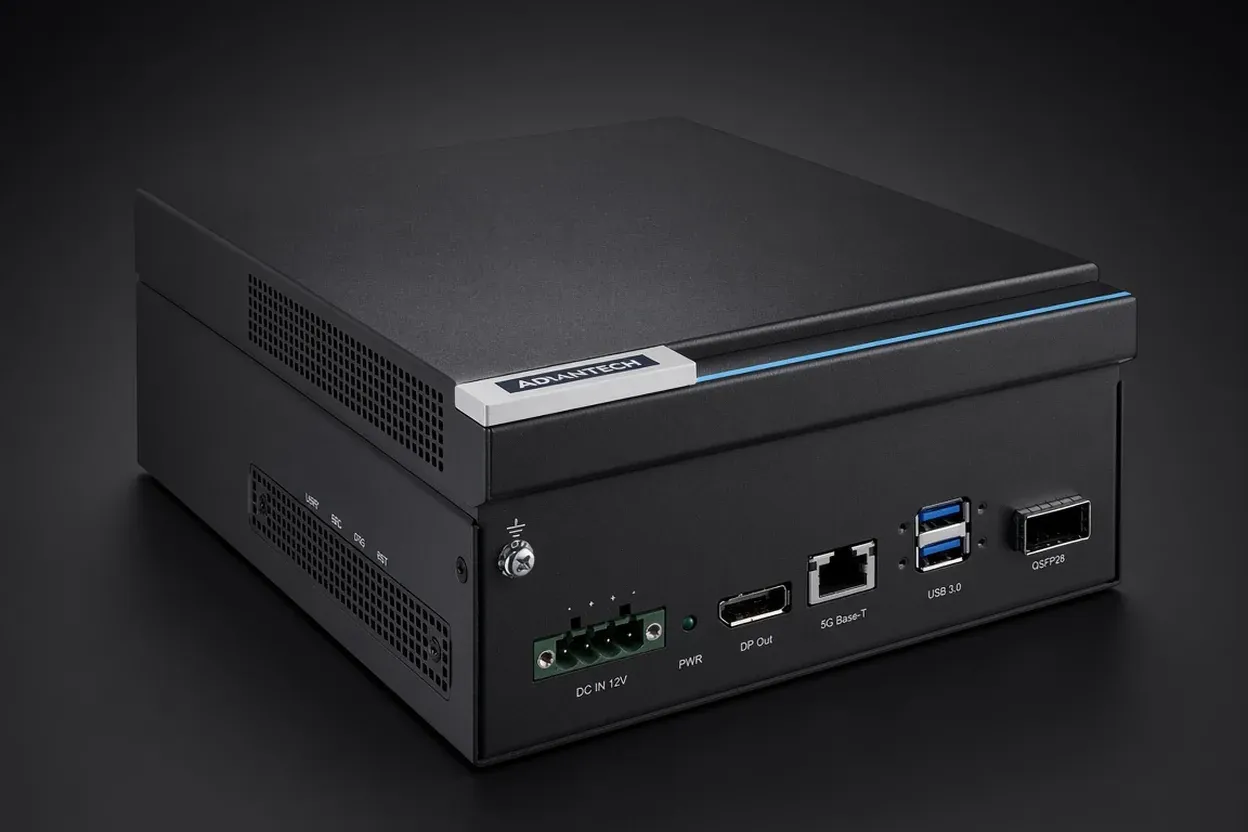
The MIO-5380 is Advantech's 3.5-inch single board computer built on AMD Ryzen AI Embedded P100 series processors, with up to 12 cores, 24 threads and a 50 TOPS NPU for edge AI workloads. It takes dual-channel DDR5-5600 memory up to 128GB with sideband ECC and drives four independent displays through eDP, two HDMI 2.0b ports and USB Type-C DP Alt Mode. Industrial connectivity includes 2x LAN (1GbE and 2.5GbE), USB4, 4x COM, 2x CAN-FD and four M.2 slots, with EdgeBMC out-of-band management and extended temperature SKUs from -40C to 85C. Price and license terms were not stated.
The MIO-5380 is a 3.5-inch single-board computer (SBC) built on AMD Ryzen AI Embedded P100 series processors, designed to bring localized machine learning inference directly to edge industrial environments. Engineered by Advantech and categorized under Unknown hardware for AI development, the board integrates Zen 5 x86 CPU architecture, RDNA 3.5 integrated graphics, and an XDNA 2 neural processing unit (NPU) delivering up to 50 TOPS of INT8 compute. With support for up to 128GB of dual-channel DDR5-5600 memory with sideband ECC, the platform solves one of the most critical bottlenecks in edge compute: memory capacity for local weights.
Operating at a base thermal design power of 28W, the MIO-5380 targets embedded deployments where physical footprint, thermal dissipation, and industrial reliability dictate hardware selection. Unlike consumer-tier mini PCs, this board features extended operating temperature tolerance (-40°C to 85°C on industrial SKUs), EdgeBMC for out-of-band management, dual high-speed Ethernet (1GbE and 2.5GbE), CAN-FD interfaces, and four dedicated M.2 expansion slots. For engineers building autonomous systems, smart surveillance gateways, or ruggedized edge appliances, the board bridges the gap between low-power micro-controllers and bulky, power-hungry rackmount servers.
Evaluating the MIO-5380 for AI deployment requires looking past pure desktop compute metrics. The platform is designed for environments where failure is not an option and network latency or data sovereignty requirements prevent cloud offloading. By delivering 50 TOPS of dedicated NPU compute alongside extensive standard system memory, the MIO-5380 establishes itself as an intriguing option for teams evaluating the best hardware for local AI agents 2026 demands in industrial automation.
At the core of the MIO-5380 is the AMD Ryzen AI Embedded P100 platform, scaling up to the flagship P185/P185i configuration featuring 12 cores, 24 threads, and boost clocks up to 5.1 GHz. The integrated NPU provides up to 50 TOPS of dedicated INT8 performance, targeting lightweight vision transformers, audio transcription models, and embedding generation without loading the x86 CPU cores.
1Processor Options: AMD Ryzen AI Embedded P100 Series (up to P185/P185i, 12C/24T, 28W TDP)2NPU Throughput: Up to 50 TOPS INT8 (XDNA 2 architecture)3System Memory: Up to 128GB Dual-Channel DDR5-5600 (2x SODIMM, Sideband ECC)4Memory Bandwidth: ~89.6 GB/s theoretical peak5I/O & Expansion: 1x USB4, 1x USB 3.2 Gen 2, 4x COM, 2x CAN-FD, 8-bit GPIO, MCIO PCIe Gen4 x46Network: 1x Intel i210 (1GbE), 1x Intel i226 (2.5GbE), optional PoE via MIOe-PSE7Storage: 2x M.2 M-Key 2280 (NVMe PCIe Gen4 x4), 1x M.2 B-Key 3052, 1x M.2 E-Key 22308Power Input: 12V to 24V DC-in9Operating Temp: 0°C to 60°C (Standard) / -40°C to 85°C (Extended Temp SKUs)
For large language models and generative workloads, token generation is predominantly bound by memory bandwidth rather than raw TOPS. The MIO-5380 utilizes standard DDR5-5600 SODIMMs, achieving a theoretical maximum bandwidth of 89.6 GB/s across its dual 64-bit channels. While lower than unified memory architectures found on mobile-derived SoCs, this interface delivers substantial system stability via sideband ECC support, preventing memory corruption during long-running inference jobs.
Because the system relies on unified system RAM allocation for the integrated GPU and CPU execution pipelines, MIO-5380 VRAM for large language models can be configured to exceed 64GB or even 96GB depending on OS and BIOS allocations. This makes the board rare among edge devices: a compact single-board computer that avoids the 16GB or 32GB soldered memory limits typical of small form-factor hardware.
The MIO-5380 AI inference performance profile splits across two distinct runtime paradigms: low-latency INT8/FP16 vision pipelines running on the 50 TOPS NPU, and autoregressive text generation running across the Zen 5 CPU and RDNA 3.5 graphics compute units via frameworks such as llama.cpp, ONNX Runtime, or ROCm.
The combination of up to 128GB RAM makes the MIO-5380 viable hardware for running 70B parameter models at the edge, provided your application can tolerate lower generation throughput:
For multimodal models like LLaVA-1.6 or Qwen2-VL 7B, the MIO-5380 handles combined visual-text pipelines reliably. The 50 TOPS NPU can be leveraged to accelerate base vision backbones (such as CLIP or YOLOv8/v10 for pre-filtering) while the CPU processes conversational decoders. This heterogeneous execution prevents the host CPU from choking during high-frame-rate image acquisition over the dual Intel Ethernet ports or USB3 feeds.
The MIO-5380 is not aimed at desktop hobbyists looking for a quick playground rig; consumer mini PCs provide higher clock speeds at lower costs. Instead, this SBC serves teams that require an industrial-grade MIO-5380 local LLM appliance capable of surviving harsh thermal, electrical, and physical environments:
When evaluating the best AI chip for local deployment, practitioners typically weigh the MIO-5380 against dedicated edge AI platforms and consumer silicon.
The NVIDIA Jetson AGX Orin remains the reference standard for edge AI compute, delivering up to 275 TOPS of INT8 sparse performance and significantly higher memory bandwidth (up to 204.8 GB/s on the 64GB SKU). For pure deep learning throughput, the Jetson AGX Orin easily outperforms the MIO-5380, hitting three to four times the token generation speed on identical model weights.
However, the MIO-5380 provides native x86 binary compatibility, eliminating the ARM cross-compilation hurdles common to complex enterprise stacks. Furthermore, the MIO-5380 supports up to 128GB of off-the-shelf, replaceable DDR5 memory with sideband ECC, whereas Jetson modules feature non-upgradable soldered memory capped at 64GB. The MIO-5380 also brings standard industrial PC I/O, including native USB4, PCIe Gen4 expansion via MCIO, and dual CAN-FD, without requiring complex carrier board design.
Consumer mini PCs powered by AMD's Strix Point (such as the Ryzen AI 9 HX 370) share architectural similarities with the embedded P100 series, including the 50 TOPS XDNA 2 NPU. Many consumer mini PCs utilize faster LPDDR5x-7500 memory, yielding higher initial token throughput for small models.
The tradeoff comes down to reliability and limits: consumer mini PCs typically solder their RAM (often capped at 32GB or 64GB), support standard commercial temperatures (0°C to 35°C ambient), and lack out-of-band management. The MIO-5380 is built for continuous 24/7/365 uptime, handles -40°C to 85°C swings, supports modular RAM expansion to 128GB, and incorporates EdgeBMC.
If your deployment targets an air-conditioned office or lab bench, standard consumer hardware remains the best hardware for running AI models locally on a tight budget. If your deployment lives inside a field cabinet, autonomous vehicle, or industrial control enclosure, the MIO-5380 provides the necessary durability, memory headroom, and compute balance to run local intelligence reliably.
The top models this device can run at 4-bit, ranked by fit and speed.
Specs not available for scoring. This product is missing VRAM or memory bandwidth data.
Also in Our Store
Docks, fast storage, cables, and a UPS sized for a local AI machine.
Rent this class of GPU by the hour before you buy. Live prices from RunPod and Vast.ai.
Find the break-even between buying this hardware and paying for a cloud API.
Mac vs NVIDIA for local inference, if you are still choosing a platform.