- Services
Advertising disclosure: we earn commissions when you shop through the links below.
CyberPowerPC's AI Workstation ASRock AI BOX-A395 is a compact desktop for running AI models locally. It pairs a 16-core AMD Ryzen AI Max+ 395 processor, boosting up to 5.1 GHz, with integrated AMD Radeon 8060S graphics and 128 GB of onboard LPDDR5X memory rated up to 8000 MT/s. Storage starts at a 1 TB PCIe NVMe SSD with two M.2 Gen4 x4 slots, and connectivity includes USB4, Wi-Fi 7, 10 Gb Ethernet and 2.5 Gb Ethernet. It ships with Windows 11 Home and is listed at $4,579 in stock.
Manufacturer's suggested retail price. Current prices can be higher or lower. This is not a live price.
The AI Workstation ASRock AI BOX-A395 is a compact desktop engineered specifically to address the memory constraints of modern local AI inference. Powered by AMD's Ryzen AI Max+ 395 processor (codenamed Strix Halo) and featuring 128 GB of unified onboard LPDDR5X memory, this machine carves out a distinct position in the prosumer and edge AI hardware landscape. Rather than relying on power-hungry, multi-GPU desktop towers or cloud APIs, it delivers massive memory pools in a 200 x 100 x 232 mm aluminum chassis weighing just 2.8 kg.
Distributed through integrators like CyberPowerPC and manufactured using ASRock Industrial's edge computing platform, this system is aimed squarely at developers, ML engineers, and infrastructure teams deploying local agentic loops. At an MSRP of $4,579, it bridges the gap between consumer mini PCs and dedicated enterprise accelerators, offering an always-on inference node with native 10 Gb Ethernet and dual USB4 expansion.
For practitioners looking for the best hardware for running AI models locally, the AI BOX-A395 shifts the economics of running 70B parameter models. Because integrated Radeon 8060S graphics share the 128 GB memory pool dynamically via unified addressing, users can allocate upwards of 96 GB to 112 GB directly to graphics memory (VRAM). This avoids the steep price premiums and strict PCIe lane limitations typical of discrete consumer GPU setups.
Evaluating hardware for local AI tasks comes down to memory capacity, memory bandwidth, compute density, and thermal endurance. The AI Workstation ASRock AI BOX-A395 balances these factors effectively for memory-bound generative workloads.
Local LLM inference speed during token generation is fundamentally memory-bandwidth bound. The ASRock AI BOX-A395 packs 128 GB of soldered LPDDR5X running at 8000 MT/s across a wide 256-bit bus interface, producing theoretical memory bandwidth up to 256 GB/s.
Because memory is unified between the 16 Zen 5 CPU cores and the Radeon 8060S integrated GPU (40 RDNA 3.5 Compute Units), the graphics pipeline accesses model weights directly without transferring data back and forth across a PCIe bus. While 256 GB/s does not match the bandwidth of high-end discrete GPUs running GDDR6X or HBM (such as an NVIDIA RTX 4090 at 1,008 GB/s or an Apple M-series Max chip reaching 400 GB/s), it easily outpaces standard dual-channel DDR5 desktop systems, which top out around 80-90 GB/s.
Most mini PCs using mobile silicon throttle under extended load. ASRock Industrial mitigated this by outfitting the AI BOX-A395 with a standing aluminum micro-tower chassis and an internal 400W power supply (using standard C13 AC input). The integrated Radeon 8060S graphics core (gfx1151) and the 16-core, 32-thread CPU can sustain continuous power envelopes without the aggressive thermal throttling typical of ultra-compact enclosures.
Key architectural specifications:
With up to 112 GB of addressable VRAM allocated to the GPU runtime in ROCm or Vulkan, the AI Workstation ASRock AI BOX-A395 runs large language models that simply fail to load on high-end consumer cards with 16 GB or 24 GB of VRAM.
Given the ~256 GB/s memory bandwidth ceiling, token generation throughput follows clean mathematical limits determined by memory access rates:
The sweet spot for daily development on this machine is running 32B models at Q5_K_M or 70B models at Q4_K_M. At these levels, response latency remains conversational while retaining strong reasoning capabilities. Multimodal models, such as Qwen2.5-VL and large vision-language models, execute with plenty of headroom for image and video feature embeddings.
The AI Workstation ASRock AI BOX-A395 targets distinct deployment needs where traditional towers or cloud setups fall short:
Understanding where the AI BOX-A395 fits against alternative hardware setups helps clarify whether its integrated design matches your workflow.
A common path for local LLMs is building a custom desktop with used RTX 3090s (yielding 48 GB total VRAM) or multiple 16 GB cards. A dual RTX 3090 setup delivers much higher memory bandwidth (~936 GB/s per card), resulting in significantly faster 70B generation speeds (15-20 tokens per second).
However, dual 3090 rigs consume 750W-1000W under load, require a massive chassis, run loud, generate significant heat, and top out at 48 GB of VRAM unless you step up to enterprise workstations. The AI BOX-A395 consumes a fraction of the power, fits on a desk shelf, and provides 128 GB of continuous memory, allowing you to load models and context sizes that would crash a 48 GB setup.
Apple's unified memory hardware is the closest direct competitor to Strix Halo systems. A Mac Studio with 128 GB or 192 GB of RAM offers higher memory bandwidth (up to 400-800 GB/s on Ultra chips), yielding faster token generation.
The AI BOX-A395, however, runs standard x86-64 architecture, supporting native Windows 11 Home alongside standard Linux distributions (Ubuntu, Fedora). This avoids macOS-specific build quirks in certain containerized pipelines, ROCm-compatible toolchains, and edge deployment software stacks. Furthermore, the inclusion of integrated 10 GbE plus 2.5 GbE ports out of the box makes it a purpose-built headless network appliance for engineers standardizing on x86 container images.
The top models this device can run at 4-bit, ranked by fit and speed.
Specs not available for scoring. This product is missing VRAM or memory bandwidth data.
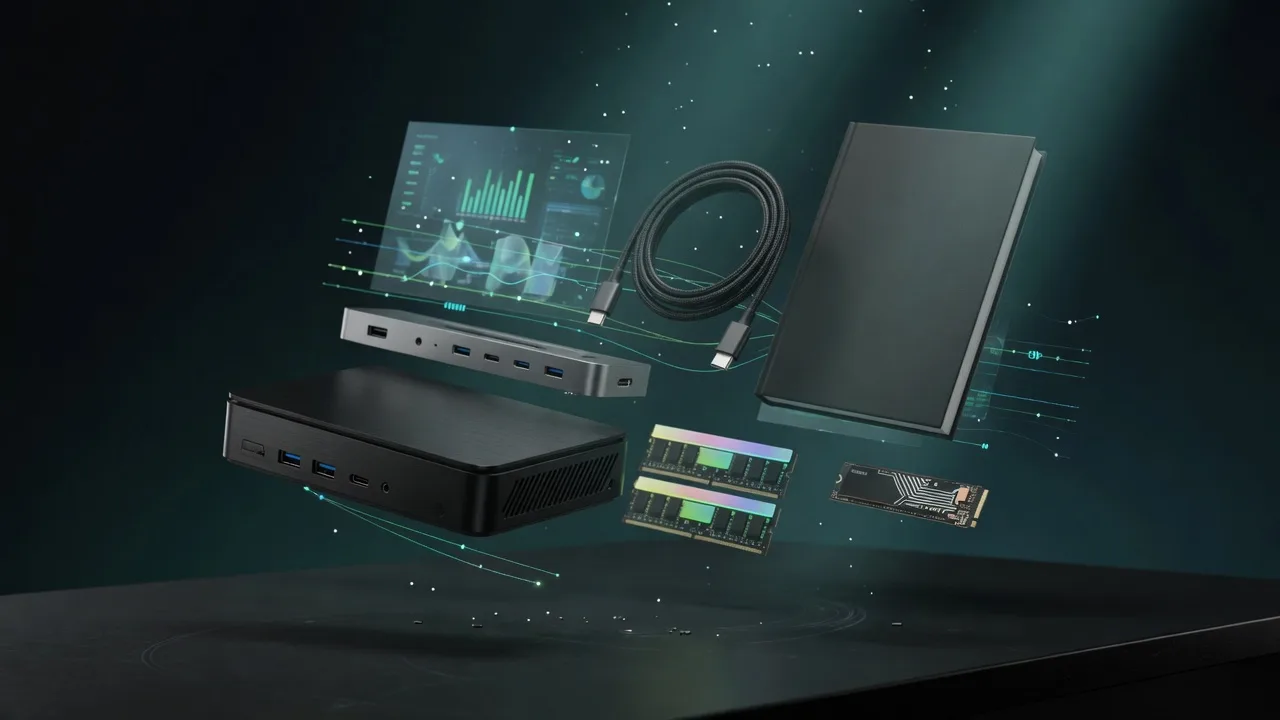
Also in Our Store
Docks, fast storage, cables, and a UPS sized for a local AI machine.

Rent this class of GPU by the hour before you buy. Live prices from RunPod and Vast.ai.
Find the break-even between buying this hardware and paying for a cloud API.
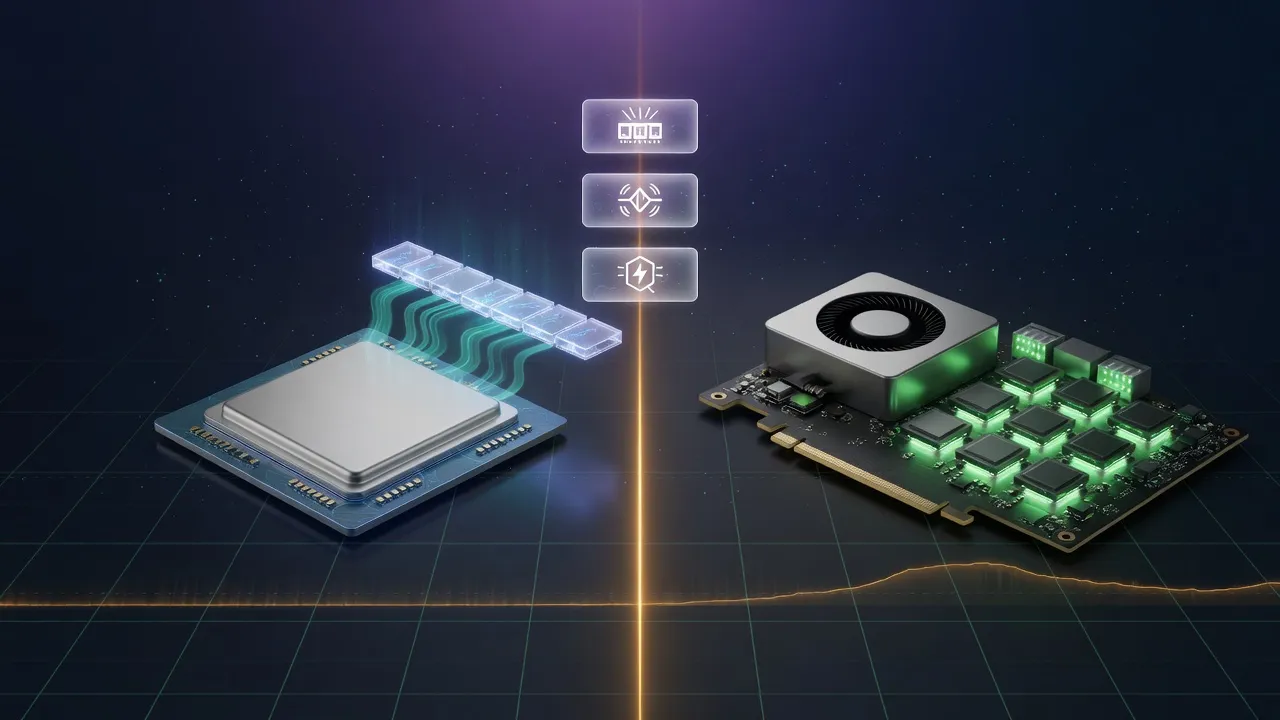
Mac vs NVIDIA for local inference, if you are still choosing a platform.