- Services
Advertising disclosure: we earn commissions when you shop through the links below.
HP's 16-inch OmniBook Ultra 16 is a Windows laptop built on NVIDIA's RTX Spark Arm platform. The base configuration pairs an 18-core CPU and a 5120-core GPU with 32GB of LPDDR5x-9400 unified memory and a 1TB PCIe Gen 5 SSD, plus a 16-inch 3K OLED display. HP briefly listed it at $3,199.99 in a US store leak, while a higher configuration with a 20-core CPU, 6144-core GPU, 64GB memory and 2TB SSD was listed at $4,999.99. UK pre-orders are open for delivery from 19 November 2026.
Manufacturer's suggested retail price. Current prices can be higher or lower. This is not a live price.
A 70B Q4 quant fits with usable context budget left over. Sweet spot if you want a single card that handles every open model worth running locally today.
Generated from this product’s spec sheet. Editor reviews refine it over time.
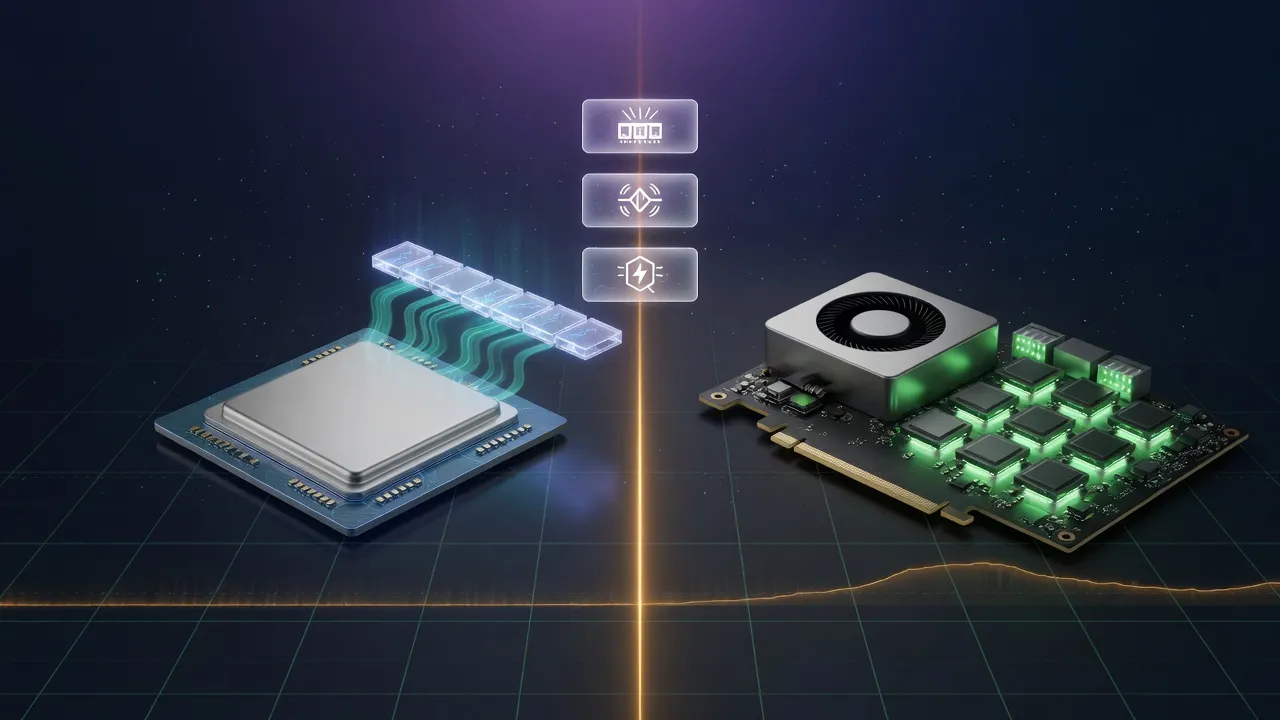
The HP OmniBook Ultra 16 represents an architectural pivot for mobile local AI compute, shifting away from power-hungry x86 processors tethered to discrete GPUs over a PCIe bus. Built on NVIDIA's RTX Spark platform (internally designated as the N1X), the machine fuses an 18-core Arm CPU with a 5120-core Blackwell-generation GPU into a cohesive system-on-chip. By pairing this architecture with 32GB of LPDDR5x-9400 unified memory on the base configuration, the laptop circumvents the traditional VRAM bottlenecks that have historically limited laptop-based machine learning workflows.
Positioned in the prosumer and mobile workstation bracket at an MSRP of $3,199.99, the OmniBook Ultra 16 targets practitioners who need a standalone development environment for running local LLMs, prototyping autonomous pipelines, and deploying agentic workflows on the road. Rather than relying on cloud APIs with associated latency and data sovereignty concerns, this system allows engineers to run private, low-latency models directly on the client. It enters the market as a direct competitor to Apple's unified-memory silicon, but with the distinct advantage of native CUDA execution under Windows on Arm.
For developers seeking the best hardware for running AI models locally in a portable format, this machine bridges a longstanding divide: it provides the memory headroom of unified memory architectures alongside the software compatibility of the NVIDIA acceleration stack. Whether evaluated against standard enterprise rigs or tracked as Unknown hardware for AI development during its rollout, the OmniBook Ultra 16 delivers a credible mobile alternative to dedicated inference servers.
Evaluating the HP OmniBook Ultra 16 for AI requires looking past traditional CPU clock speeds and focusing on memory bandwidth, unified capacity, and mixed-precision tensor throughput.
The primary advantage of the HP OmniBook Ultra 16 VRAM for large language models is the ability to bypass the 8GB, 12GB, or 16GB limits common to x86 laptops. With roughly 26GB to 28GB of addressable VRAM for inference, the system opens up distinct capability tiers:
These architectures run without compromise. At FP16, an 8B model takes roughly 16GB of VRAM, fitting easily into memory with space for extensive context buffers. When running at 4-bit (Q4_K_M) or 8-bit (Q8_0) quantization, memory consumption drops below 8GB.
This tier represents the system's operational sweet spot.
Achieving viable inference on hardware for running 70B parameter models typically demands 40GB or more of VRAM. On this 32GB base unit, loading Llama 3.1 70B or DeepSeek-R1-Distill-Llama-70B requires aggressive quantization, such as IQ2_XXS or 2.5-bit formats (occupying 22GB to 24GB). While technically runnable, generation drops to 6 to 10 tokens per second, and context windows must remain constrained. Practitioners dedicated to sustained 70B models should look to the upgraded 64GB or 128GB configurations of this platform.
Vision-language models like Pixtral 12B, Llama 3.2 Vision 11B, and Qwen 2-VL run natively with fast visual encoding. Furthermore, the memory capacity comfortably hosts embedding models (such as BGE-M3) and rerankers side-by-side with a primary 8B model, allowing local Retrieval-Augmented Generation (RAG) pipelines to operate entirely in memory.
The HP OmniBook Ultra 16 fits specific developer requirements across several areas:
The MacBook Pro has long set the standard for unified-memory inference on laptops, offering massive bandwidth and configurations past 36GB. However, Apple Silicon relies on the Metal Performance Shaders (MPS) framework and MLX. While efficient, the wider AI research ecosystem still treats CUDA as the primary tier-one runtime. The OmniBook Ultra 16 provides the unified memory advantage while keeping developers within the native NVIDIA ecosystem. For teams using TensorRT, vLLM, or proprietary CUDA libraries, the HP removes translation and porting friction.
Traditional high-end gaming and workstation laptops pairing an Intel or AMD CPU with an NVIDIA mobile discrete GPU yield higher raw FP32 TFLOPS. However, they hit a hard physical memory ceiling: mobile RTX 4080 and 4090 chips top out at 12GB and 16GB of dedicated VRAM, respectively. Once a model exceeds that ceiling, an x86 machine drops performance off a cliff as it offloads to system RAM across the PCIe bus. The OmniBook Ultra 16 sacrifices high-wattage desktop-replacement compute to deliver an effective 28GB pool for model weights, running 32B models that refuse to fit on standard 16GB graphics cards.
For AI engineers, researchers, and technical practitioners prioritizing large context windows, native CUDA workflows, and freedom from cloud dependencies, the HP OmniBook Ultra 16 is a balanced, highly capable platform for local model execution.
The top models this device can run at 4-bit, ranked by fit and speed.
Specs not available for scoring. This product is missing VRAM or memory bandwidth data.
Also in Our Store
Docks, fast storage, cables, and a UPS sized for a local AI machine.
Rent this class of GPU by the hour before you buy. Live prices from RunPod and Vast.ai.
Find the break-even between buying this hardware and paying for a cloud API.
Mac vs NVIDIA for local inference, if you are still choosing a platform.