- Services
Advertising disclosure: we earn commissions when you shop through the links below.
HP announced the OmniBook X 14 on 2026-10-07 as a 14-inch AI PC laptop built around an NVIDIA RTX Spark processor. It targets on-device AI work and everyday productivity in a 1.34 kg chassis. HP has not published pricing or a full spec sheet for this NVIDIA-based configuration yet.
The HP OmniBook X 14 represents an intriguing shift in ultraportable AI client hardware. Announced on October 7, 2026, this 1.34 kg laptop integrates an NVIDIA RTX Spark processor, diverging from the Qualcomm Snapdragon silicon found in earlier iterations of the OmniBook X series. Paired with a 14-inch 2.2K (2240 x 1400) IPS touchscreen and high-bandwidth LPDDR5x-8448 memory, the machine targets mobile engineers and developers who need dedicated local acceleration in a compact form factor.
Positioned in the prosumer and developer sub-tier of mobile computing, the HP OmniBook X 14 for AI provides a portable environment for evaluating small language models, debugging autonomous agents, and running client-side pipelines. While early supply chain trackers cataloged this configuration under generic or unknown hardware for AI development prior to HP's official reveal, the inclusion of an NVIDIA compute core establishes it as a serious entry among thin-and-light systems designed to execute code locally rather than relying exclusively on cloud APIs.
For engineers selecting the best hardware for running AI models locally, physical portability must be balanced against memory bandwidth and VRAM constraints. The OmniBook X 14 achieves an ultra-low carry weight while delivering the software ecosystem advantages inherent to NVIDIA architectures, making it a distinct option in the compact laptop landscape.
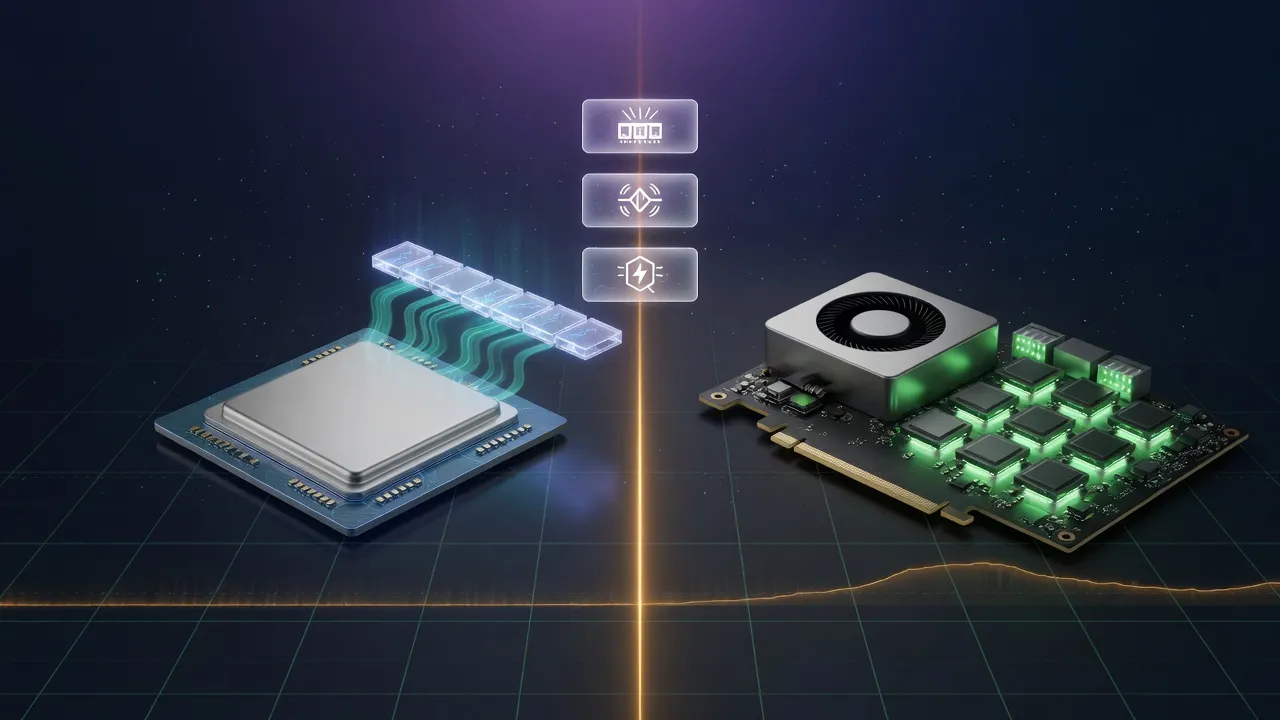
The centerpiece of this OmniBook configuration is the NVIDIA RTX Spark processor. While complete low-level architectural whitepapers remain pending from HP, integrating an NVIDIA-designed processing block directly impacts developer workflows. Unlike standalone NPUs that often require proprietary toolchains and runtime translation layers, NVIDIA silicon offers direct access to mature acceleration frameworks like CUDA, TensorRT, and TensorRT-LLM.
1HP OmniBook X 14 Specifications2-----------------------------------------------------------------3Processor: NVIDIA RTX Spark4Memory: 16 GB LPDDR5x-8448 MT/s (onboard)5Storage: 512 GB PCIe NVMe M.2 SSD6Display: 14-inch 2.2K (2240 x 1400) IPS, 300 nits, 100% sRGB7Battery: 3-cell 59 Wh Li-ion polymer (Fast charge: 50% in 30 min)8Weight: 1.34 kg9Connectivity: Wi-Fi 6E (2x2), Bluetooth 5.310Operating System: Windows 11 Home
Memory architecture is the primary determinant of LLM execution speed. The OmniBook X 14 features 16 GB of onboard LPDDR5x operating at 8448 MT/s. In unified or tightly coupled memory layouts, this high transfer rate yields substantial memory bandwidth, typically exceeding 130 GB/s across a 128-bit bus. Because autoregressive token generation is memory-bandwidth bound, this elevated transfer rate directly enhances generative throughput compared to systems utilizing standard DDR5 or lower-clocked LPDDR5 modules.
Storage is configured at 512 GB PCIe NVMe M.2 SSD. While sufficient for standard system operations and several quantized weights, practitioners testing multiple large model checkpoints will find that modern model repositories fill 512 GB quickly. Upgrading or supplementing with external storage will be necessary for extensive local model libraries.
Power management centers on a 3-cell 59 Wh battery with fast-charge capability reaching 50% in 30 minutes. In an ultraportable chassis weighing 1.34 kg, thermal design power (TDP) constraints will inevitably govern sustained compute throughput. Extended batch processing or continuous training loops will hit thermal throttling boundaries faster than dedicated workstation hardware, positioning this machine primarily for bursty, interactive inference workloads.
When evaluating HP OmniBook X 14 VRAM for large language models, the total pool of 16 GB system memory dictates the hard operational ceiling. Because Windows 11 Home and active background tasks claim roughly 3 GB to 4 GB of RAM, the usable pool for model weights, context buffers, and runtime overhead hovers around 10 GB to 12 GB.
Practitioners searching for hardware for running 70B parameter models must look elsewhere. Even at aggressive 4-bit quantization (Q4_K_M), a 70-billion-parameter architecture requires roughly 38 GB to 40 GB of addressable memory before accounting for the KV cache. Attempting to run a 70B model on a 16 GB machine forces aggressive paging to disk, resulting in unusable generation speeds measured in seconds per token rather than tokens per second.
1Model Compatibility Matrix (Estimated Usable Memory: ~11 GB)2-----------------------------------------------------------------------------------------3Model Quantization Weight Footprint Context Window Execution4-----------------------------------------------------------------------------------------5Llama 3.1 8B Q4_K_M ~4.9 GB 16k tokens Optimal6Llama 3.1 8B Q8_0 ~8.5 GB 4k-8k tokens Functional7Mistral 7B v0.3 Q5_K_M ~5.1 GB 16k tokens Optimal8Qwen 2.5 7B Q4_K_M ~4.7 GB 16k-32k tokens Optimal9DeepSeek-R1-Distill-7B Q4_K_M ~4.7 GB 8k-16k tokens Optimal10DeepSeek-R1-Distill-14B Q4_K_M ~8.9 GB 4k tokens Tight fit11Phi-3.5-Vision (4.2B) FP16 ~8.4 GB 4k tokens Functional12Llama 3.1 70B Any >35 GB N/A Unsupported
The ideal operational baseline for this machine is the 7B to 8B parameter tier. Models such as Llama 3.1 8B, Qwen 2.5 7B, and Mistral 7B at Q4_K_M or Q5_K_M quantization easily reside within the available memory envelope. These configurations consume between 4.7 GB and 5.5 GB of RAM, leaving ample headroom for extended context windows and agent operational memory.
Using optimized runtimes like llama.cpp, Ollama, or TensorRT-LLM, HP OmniBook X 14 AI inference performance on an 8B Q4 model can be expected to hit responsive interaction rates. Driven by the LPDDR5x-8448 memory pipeline, estimated HP OmniBook X 14 tokens per second should sit in the range of 20 to 30 tokens per second for prompt evaluations and interactive output generation, which is well above standard human reading speeds.
Compact reasoning architectures, such as the distilled DeepSeek-R1-Distill-Qwen-7B or 8B variants, operate comfortably within these limits at 4-bit precision. Multimodal vision-language models like Phi-3.5-Vision or Moondream2 also run smoothly, allowing the device to process mixed visual and text inputs locally without saturating system RAM.
For users seeking the highest quality output on this hardware, 5-bit quantization (Q5_K_M) serves as the sweet spot for 7B and 8B models. It recaptures virtually all the perplexity loss associated with 4-bit compression while maintaining a compact memory footprint of roughly 5.5 GB to 6.0 GB.
The HP OmniBook X 14 serves targeted development scenarios rather than high-density production demands:
This device is not an inference server or a training platform. Full-parameter fine-tuning is out of the question due to memory constraints, and even Parameter-Efficient Fine-Tuning (PEFT/LoRA) on 8B models will be tightly limited by the 16 GB combined memory architecture. It is strictly an edge inference and development laptop.
The most relevant comparison for the OmniBook X 14 is the HP OmniBook X 14 vs Snapdragon X Elite configuration (14-fe0023dx). The Snapdragon model features a Qualcomm Hexagon NPU rated at 45 TOPS and delivers exceptional battery endurance, often exceeding 20 hours of light usage. However, the Snapdragon platform relies on Windows on Arm and depends on fragmented toolchain support for popular machine learning packages. The RTX Spark configuration of the OmniBook X provides direct compatibility with standard x86 and NVIDIA CUDA software pipelines, removing the translation friction frequently encountered with Python data science stacks on Arm.
When stacked against the Apple MacBook Air M3 (16 GB unified memory), the MacBook Air provides superior memory bandwidth scaling and sustained thermal efficiency in a fanless chassis. However, Apple's Metal Performance Shaders (MPS) framework, while capable, requires framework-specific adaptations. For developers whose production environments target NVIDIA data centers, running an RTX Spark processor locally allows closer parity with upstream deployment targets.
If your requirements involve local models exceeding 14B parameters, a heavier mobile workstation featuring 32 GB to 64 GB of RAM or a dedicated desktop GPU is non-negotiable. But for developers prioritizing mobility (1.34 kg) and requiring native NVIDIA software support for 7B-8B model inference, the HP OmniBook X 14 presents a specialized, highly portable option.
The top models this device can run at 4-bit, ranked by fit and speed.
Specs not available for scoring. This product is missing VRAM or memory bandwidth data.
Also in Our Store
Docks, fast storage, cables, and a UPS sized for a local AI machine.
Rent this class of GPU by the hour before you buy. Live prices from RunPod and Vast.ai.
Find the break-even between buying this hardware and paying for a cloud API.
Mac vs NVIDIA for local inference, if you are still choosing a platform.