- Services
Advertising disclosure: we earn commissions when you shop through the links below.
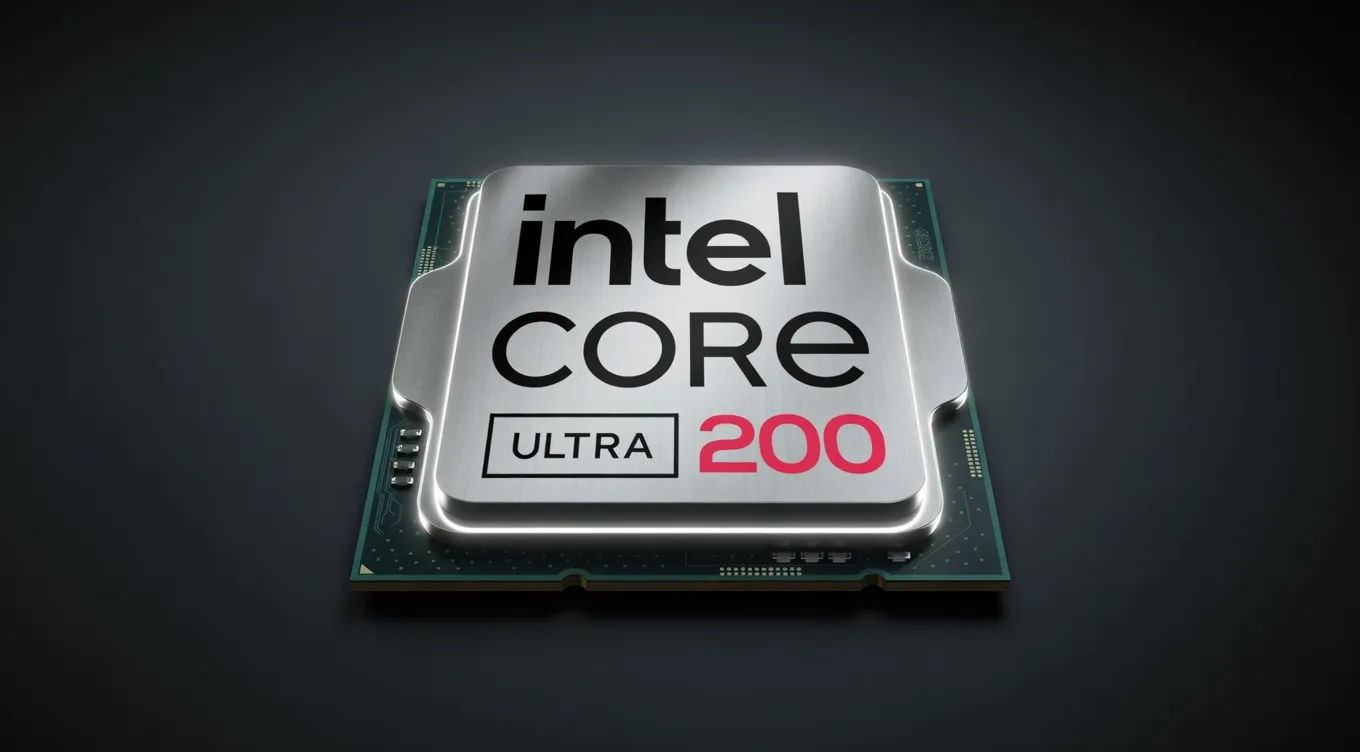
Intel's latest desktop processor with integrated NPU for AI acceleration. Features new Lion Cove P-cores and Skymont E-cores on Intel 20A process with up to 24 cores.
The Intel Core Ultra 200S (Arrow Lake Desktop) marks a strategic shift in Intel’s desktop roadmap, prioritizing architectural efficiency and dedicated AI silicon over raw clock speed. Built on a disaggregated tile design utilizing the Intel 20A and TSMC N3B nodes, the Core Ultra 200S is the first enthusiast-class desktop processor from Intel to integrate a dedicated Neural Processing Unit (NPU). For engineers and researchers, this means the CPU is no longer just a host for a GPU; it is now a heterogeneous compute platform capable of offloading persistent AI background tasks to dedicated hardware.
Positioned as a high-end consumer and prosumer chip, the Core Ultra 200S competes directly with AMD’s Ryzen 9000 series. While previous generations relied on the CPU cores or an integrated GPU (iGPU) for inference, the Arrow Lake architecture introduces NPU 3, delivering 13 TOPS of INT8 performance. This makes it a viable candidate for developers building agentic workflows where low-power, "always-on" inference is required without saturating the primary discrete GPU (dGPU).
When evaluating the Intel Core Ultra 200S (Arrow Lake Desktop) for AI, the focus shifts from traditional gaming benchmarks to tensor throughput and memory bottlenecks. The flagship Core Ultra 9 285K features 24 cores (8 Lion Cove P-cores and 16 Skymont E-cores), providing significant multi-threaded performance for CPU-bound preprocessing and data augmentation tasks.
The total AI compute on the SoC is distributed across three engines:
For local LLMs, memory bandwidth is the primary governor of tokens per second. The Core Ultra 200S supports DDR5-5600 in a dual-channel configuration. While the platform supports high-capacity modules (allowing for large system RAM pools up to 192GB), the bandwidth is significantly lower than the HBM3 found in data center chips or the unified memory architecture of Apple’s M-series. This means that while you can fit very large models into system RAM, the Intel Core Ultra 200S (Arrow Lake Desktop) VRAM for large language models is essentially shared system memory, leading to slower "prompt processing" and "token generation" compared to dedicated VRAM on an RTX 4090.
With a base TDP of 125W and a Maximum Turbo Power of 250W, the 200S is more efficient than the outgoing 14th Gen chips. For practitioners running 24/7 inference servers or local agents, the improved performance-per-watt reduces thermal throttling during long-running batch jobs.
The Intel Core Ultra 200S (Arrow Lake Desktop) AI inference performance is best utilized through the OpenVINO toolkit, which allows for heterogenous execution across the NPU, iGPU, and CPU.
Because the NPU and iGPU share system memory, the size of the model you can run is limited only by your installed DDR5 RAM. However, for usable performance, practitioners should look at the following:
The Arrow Lake architecture excels at vision tasks. Running Stable Diffusion XL or Flux.1 (Schnell) via OpenVINO is highly optimized on Intel hardware. The NPU can handle background image upscaling or feature extraction (CLIP) while the P-cores handle the orchestration of an agentic pipeline.
The Intel Core Ultra 200S is not a replacement for an H100 or even a mid-range RTX 40-series GPU for heavy training. Instead, it is the best Intel hardware for AI development at the workstation level where the goal is local prototyping and deployment of agentic software.
When choosing the best hardware for local AI agents 2025, the Core Ultra 200S sits in a unique position between the AMD Ryzen 9000 series and Apple’s Silicon.
The Ryzen 9950X offers superior raw multi-core performance for CPU-based tasks and has an NPU (Ryzen AI) with slightly higher rated TOPS (16 vs 13). However, Intel’s OpenVINO ecosystem is currently more mature than AMD’s ROCm/Ryzen AI software stack for Windows-based AI development. If your workflow relies on standardized libraries and easy quantization paths, the Intel platform is often easier to configure for local inference.
Apple’s unified memory architecture provides significantly higher memory bandwidth (up to 400 GB/s), which makes it superior for running large models like Llama 3 70B at high token-per-second rates. However, the Intel Core Ultra 200S offers the flexibility of the LGA 1851 socket, allowing you to pair the CPU with a dedicated NVIDIA GPU (via PCIe 5.0) to get the best of both worlds: high-speed CUDA-based inference on the GPU and NPU-assisted background tasks on the CPU.
For practitioners looking for the best AI chip for local deployment within a standard desktop environment, the Intel Core Ultra 200S provides a balanced, future-proof foundation. It is particularly effective for those who need a high-performance general-purpose workstation that can also handle the specific demands of NPU-assisted inference parameter models.
The top models this device can run at 4-bit, ranked by fit and speed.
Specs not available for scoring. This product is missing VRAM or memory bandwidth data.
Also in Our Store
Docks, fast storage, cables, and a UPS sized for a local AI machine.

Rent this class of GPU by the hour before you buy. Live prices from RunPod and Vast.ai.

Find the break-even between buying this hardware and paying for a cloud API.
Mac vs NVIDIA for local inference, if you are still choosing a platform.