- Services
Advertising disclosure: we earn commissions when you shop through the links below.
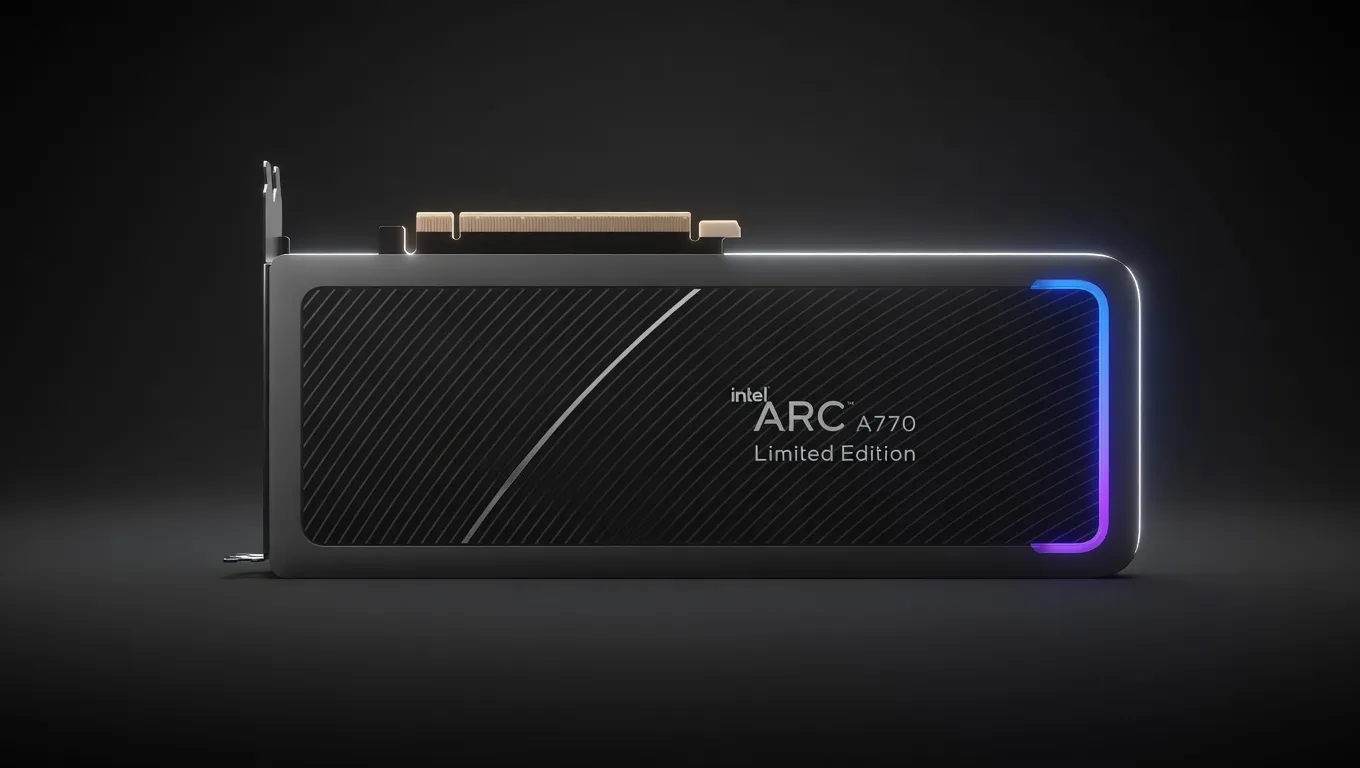
Intel's previous-gen flagship discrete GPU with 16GB GDDR6. First-gen Alchemist architecture with XMX AI cores. Budget option for 1080p/1440p gaming and basic AI experimentation.
Good balance for indie developers running local copilots and chat. 30B+ models are reachable but only with aggressive quantization and short context.
Generated from this product’s spec sheet. Editor reviews refine it over time.
The Intel Arc A770 16GB occupies a unique position in the hardware landscape as one of the most cost-effective entries into the 16GB VRAM tier. While Intel is a newcomer to the discrete GPU market compared to NVIDIA, the Alchemist architecture (Xe-HPG) was designed with a heavy emphasis on matrix math. This is evidenced by the inclusion of 512 XMX (Xe Matrix Extensions) Engines, which are dedicated hardware accelerators for AI workloads, functionally similar to NVIDIA's Tensor Cores.
For practitioners and developers, the A770 16GB represents a strategic "budget-first" choice. It is primarily a consumer-grade card that competes directly with the NVIDIA RTX 4060 Ti 16GB and the AMD Radeon RX 7600 XT. However, for Intel hardware for AI development, the A770 is the current flagship of the discrete consumer line, offering a significant memory buffer that is rarely found at its $349 MSRP. This makes it a compelling candidate for those looking to explore local LLM inference and stable diffusion without the "NVIDIA tax."
When evaluating the Intel Arc A770 16GB for AI, the most critical specification is the 16GB of GDDR6 memory. In the realm of local inference, VRAM is the primary bottleneck; if a model does not fit in the GPU memory, performance drops by orders of magnitude as the system falls back to system RAM.
The A770 features a 256-bit memory bus providing 560 GB/s of memory bandwidth. This is a standout spec for a budget card, significantly outperforming the RTX 4060 Ti 16GB (288 GB/s). Since LLM token generation is a memory-bandwidth-bound task, this high throughput allows the A770 to maintain competitive tokens per second during autoregressive decoding.
The 512 XMX engines are capable of handling INT8, FP16, and BF16 operations efficiently. While the raw TFLOPS are impressive for the price, the actual Intel Arc A770 16GB AI inference performance is heavily dependent on software optimization. To get the most out of this hardware, developers should utilize the Intel OpenVINO toolkit or the IPEX (Intel Extension for PyTorch). These libraries are essential for translating standard models into a format that can fully leverage the Xe-HPG architecture.
The primary appeal of a 16GB GPU for AI is the ability to run 7B and 14B parameter models entirely on-device with high-precision quantization.
The Intel Arc A770 16GB local LLM experience is optimized for models in the 7B to 14B range. Using tools like llama.cpp (via the SYCL backend) or Intel’s own BigDL-LLM (now part of IPEX-LLM), you can expect the following:
The A770 16GB is surprisingly capable for Stable Diffusion. Using the OpenVINO backend, the card can generate 512x512 images in seconds. The 16GB VRAM is particularly useful for Stable Diffusion XL (SDXL), which requires more memory for its larger base model and refiner. It can also handle vision-language models (VLMs) like Llava 1.5 7B, enabling local image description and analysis.
The Intel Arc A770 16GB is not a "fire and forget" solution like an NVIDIA card; it requires a practitioner who is comfortable with environment configuration.
For those looking for the best hardware for local AI agents 2025 on a strict budget, the A770 is a top contender. It provides the VRAM necessary to run an agentic loop (where one model plans and another executes) without hitting OOM (Out of Memory) errors.
If you are developing applications intended for the Intel ecosystem, such as AI features for Windows laptops using Core Ultra processors, the A770 is the ideal development target. It allows you to profile and optimize your code using the same architecture (Xe) that your end-users will utilize.
The A770 can serve as a capable inference node for small teams. While it isn't a data center chip, its 16GB buffer allows it to host a quantized 7B at Q4 parameter model for internal API use, handling multiple concurrent requests better than 8GB or 12GB alternatives.
Deciding on the best AI chip for local deployment at the $300-$400 price point usually comes down to three options:
The RTX 4060 Ti is the primary competitor. NVIDIA has the advantage of the CUDA ecosystem, which is the industry standard. Most AI repositories "just work" on NVIDIA. However, the A770 has nearly double the memory bandwidth (560 GB/s vs 288 GB/s). If you are using frameworks that support OpenVINO or SYCL, the A770 can actually outperform the 4060 Ti in raw token generation speed for larger models. Choose the A770 if you are price-conscious and comfortable with non-CUDA workflows.
AMD’s ROCm support has improved, but Intel’s OpenVINO and IPEX-LLM libraries are currently more mature for Windows-based AI development. The A770 generally offers better matrix math performance thanks to the XMX engines, whereas the 7600 XT relies on standard shaders. The A770 is typically the stronger choice for AI specifically, while the 7600 XT is often preferred for pure gaming.
The Intel Arc A770 16GB is the best Intel hardware for running AI models locally for those who cannot justify the cost of an RTX 3090 or 4090. It provides a massive sandbox (16GB VRAM) for a fraction of the price, making it an essential tool for the democratized AI era. If your workflow involves Python, PyTorch, and a willingness to use Intel’s specialized libraries, the A770 offers the highest VRAM-per-dollar ratio currently available in the new market.
The top models this device can run at 4-bit, ranked by fit and speed.
| Model | Grade | Speed | VRAM |
|---|---|---|---|
| AliceAI-Foundation-80B-A3B-Baseyandex | SS | 52.8 tok/s | 8.5 GB |
| Mixtral 8x7B InstructMistral AI | SS | 39.7 tok/s | 11.4 GB |
| DiffusionGemma 26B-A4BGoogle | SS | 43.0 tok/s | 10.5 GB |
| Gemma 4 26B-A4B ITGoogle | SS | 40.9 tok/s | 11.0 GB |
| Xing4.0-29B-A4BChina Telecom AI | SS | 40.2 tok/s | 11.2 GB |
Among 4 similar devices, the Intel Arc A770 16GB ranks #3 for memory and #3 for memory bandwidth.
Also in Our Store
Docks, fast storage, cables, and a UPS sized for a local AI machine.

Rent this class of GPU by the hour before you buy. Live prices from RunPod and Vast.ai.

Find the break-even between buying this hardware and paying for a cloud API.
Mac vs NVIDIA for local inference, if you are still choosing a platform.