- Services
Advertising disclosure: we earn commissions when you shop through the links below.
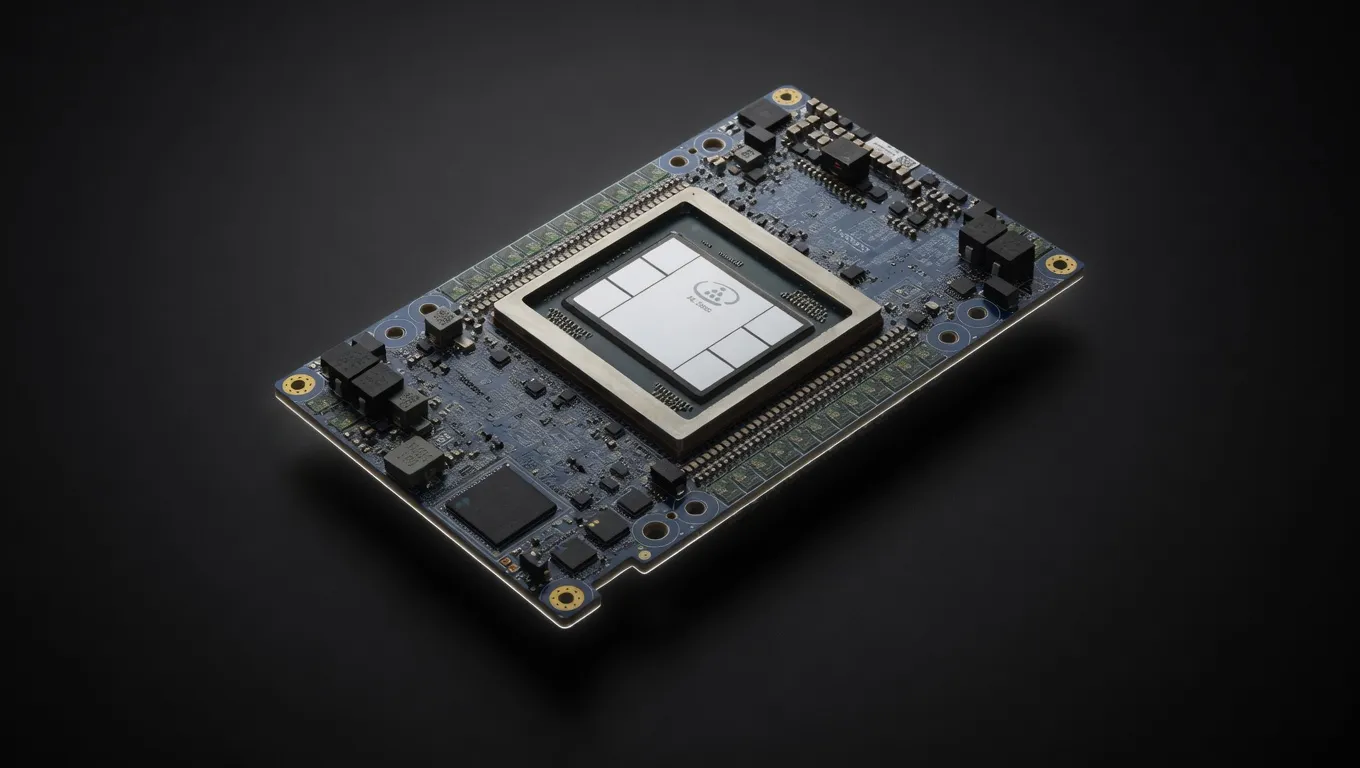
Second-generation Intel AI training accelerator with 96GB HBM2e. Competitive alternative to NVIDIA A100 for transformer training with an open software stack and integrated networking.
Sized for production serving of 70B–200B class models at full or lightly-quantized precision. Overkill for a homelab; right call when the workload pays for itself in token volume. High TDP — plan for adequate cooling and a beefy PSU; not the right pick for compact desktops.
Generated from this product’s spec sheet. Editor reviews refine it over time.
The Intel Gaudi 2 AI Accelerator is a purpose-built deep learning processor designed to challenge the dominance of NVIDIA’s data center offerings. Manufactured by Intel (via Habana Labs), the Gaudi 2 is a second-generation architecture engineered specifically to bridge the gap between high-end consumer GPUs and ultra-expensive enterprise silicon. While it is categorized as a data center-grade accelerator, its availability in PCIe form factors and its inclusion in various cloud developer programs make it a critical piece of Intel hardware for AI development and local enterprise deployments.
In the current market, the Intel Gaudi 2 AI Accelerator for AI workloads positions itself as a direct competitor to the NVIDIA A100 80GB. By offering 96GB of HBM2e memory, a 20% increase over the A100, Intel has targeted the primary bottleneck in modern AI: VRAM capacity. This is not a general-purpose GPU; it is a dedicated Tensor Processor Core (TPC) array optimized for the matrix multiplication operations that define transformer-based architectures. For teams looking for the best intel hardware for running AI models locally or in a private cloud, Gaudi 2 provides a high-bandwidth, high-capacity alternative that avoids the "NVIDIA tax."
When evaluating the Intel Gaudi 2 AI Accelerator AI inference performance, the conversation starts and ends with memory throughput and compute density. The Gaudi 2 architecture utilizes 24 programmable Tensor Processor Cores (TPC) and a dedicated GEMM (General Matrix Multiply) engine.
The 96GB GPU for AI category is sparse, making the Gaudi 2’s memory configuration its most compelling feature. With 96GB of HBM2e, it provides enough headroom to load massive parameter counts without immediate resort to aggressive quantization.
The Gaudi 2 is optimized for lower-precision formats which are now the standard for efficient AI.
Compared to the NVIDIA A100 (312 TFLOPS BF16), the Gaudi 2 offers significantly higher raw throughput on paper for training and inference. However, achieving this performance requires utilizing the Intel Gaudi SDK (SynapseAI), which integrates natively with PyTorch and TensorFlow.
A standout feature for those building clusters is the 24 integrated 100Gb Ethernet ports (RoCE v2). This allows for Large models via multi-card scaling without the need for expensive external InfiniBand switches, making it an efficient choice for hardware for running Large models via multi-card parameter setups.
The Intel Gaudi 2 AI Accelerator VRAM for large language models allows it to handle the most demanding open-weights models currently available. Because it features 96GB of VRAM, practitioners can move beyond the limitations of standard 24GB or 48GB consumer cards.
While the Gaudi 2 supports FP8, which offers a 2x speedup over BF16 with negligible accuracy loss, practitioners should focus on BF16 for development and FP8 for production inference. The 96GB buffer means you rarely need to drop down to 4-bit GPTQ or AWQ unless you are attempting to fit 100B+ parameter models on a single unit.
The Intel Gaudi 2 is not a consumer "plug-and-play" gaming card; it is a specialized tool for best hardware for local AI agents 2025 and enterprise-grade development.
For developers building AI agents that require low-latency reasoning and large context windows, the Gaudi 2 is a powerhouse. Its ability to handle multiple concurrent model streams makes it suitable for agentic loops where a "planner" model and "executor" model must run simultaneously.
If your organization has data privacy requirements that forbid hitting OpenAI or Anthropic APIs, the Gaudi 2 is a premier choice for an on-premise inference server. It provides the VRAM necessary to run "GPT-4 class" open-weights models like the larger Llama or DeepSeek variants without the latency of a distributed cluster.
With 96GB of VRAM, this is a top-tier card for Parameter-Efficient Fine-Tuning (PEFT) and LoRA. You can fine-tune 70B parameter models on a single card, a task that would require 2-3 consumer GPUs (and suffer from P2P bottlenecks).
The Gaudi 2 generally outperforms the A100 in price-to-performance for transformer workloads. With 16GB more VRAM and higher BF16 TFLOPS, the Gaudi 2 is the superior choice for pure LLM training and inference. However, the A100 has a more mature software ecosystem (CUDA). If your workflow is strictly PyTorch-based, the transition to Gaudi 2 is seamless; if you rely on niche CUDA kernels, the A100 may be easier to implement.
The H100 (Hopper) is faster in raw FP8 compute and has the Transformer Engine advantage. However, the Gaudi 2 remains competitive due to its 96GB capacity. For models that are memory-capacity limited rather than compute-limited, the Gaudi 2 can actually outperform an H100 in terms of maximum model size per card.
Choose the Intel Gaudi 2 if you need a local LLM powerhouse with maximum VRAM and are looking to scale via Ethernet rather than proprietary interconnects. It is currently one of the most cost-effective ways to access nearly 100GB of high-speed HBM2e memory for enterprise AI workloads.
The top models this device can run at 4-bit, ranked by fit and speed.
| Model | Grade | Speed | VRAM |
|---|---|---|---|
| Qwen3.5-397B-A17BAlibaba | SS | 42.9 tok/s | 46.0 GB |
| Llama 3 70B InstructMeta | SS | 43.2 tok/s | 45.7 GB |
| Qwen 3.5 OmniAlibaba | SS | 43.7 tok/s | 45.2 GB |
| Mixtral 8x22B InstructMistral AI | SS | 45.3 tok/s | 43.6 GB |
| Apertus 70BEPFL, ETH Zurich, CSCS | SS | 45.5 tok/s | 43.4 GB |
Among 4 similar devices, the Intel Gaudi 2 AI Accelerator ranks #2 for memory and #2 for memory bandwidth.
Also in Our Store
Docks, fast storage, cables, and a UPS sized for a local AI machine.

Rent this class of GPU by the hour before you buy. Live prices from RunPod and Vast.ai.

Find the break-even between buying this hardware and paying for a cloud API.
Mac vs NVIDIA for local inference, if you are still choosing a platform.