
- Services
Advertising disclosure: we earn commissions when you shop through the links below.
Lenovo's Yoga 9n 2-in-1 is a 16-inch convertible laptop built on Nvidia's RTX Spark platform, pairing a Grace CPU with up to 20 cores and an integrated Blackwell RTX GPU with up to 6,144 cores. It has a 2880 x 1800 OLED touchscreen, up to 64GB of unified LPDDR5x-9400 memory and up to 2TB of PCIe Gen 4 QLC storage, and runs Windows 11. US pricing starts at $2,999.99 for an 18-core CPU, 5,120-core GPU, 32GB memory and 512GB storage configuration, and reaches $3,999.99 for 20 cores, 64GB memory and 1TB storage.
Manufacturer's suggested retail price. Current prices can be higher or lower. This is not a live price.
The Lenovo Yoga 9n 2-in-1 (16-inch, 11) brings Nvidia's RTX Spark architecture to a 360-degree convertible form factor, pairing an ARM-based Grace CPU with up to 20 cores alongside an integrated Blackwell RTX GPU featuring up to 6,144 CUDA cores. Unlike traditional mobile workstations that divide memory pools between host system RAM and a discrete GPU buffer, the Yoga 9n implements up to 64GB of unified LPDDR5x-9400 memory. This design gives the Blackwell graphics engine direct, low-latency access to the entire memory space under Windows 11.
For practitioners looking for the best hardware for running AI models locally, this machine represents a critical shift. Historically, mobile developers were constrained by the 8GB to 16GB VRAM ceilings found on standard mobile GPUs. Running modern open weights required offloading to quantized system RAM over PCIe lanes, crippling token throughput. By unifying high-speed memory across Grace and Blackwell on a 70W platform, the Yoga 9n provides mobile practitioners with desktop-class model footprint capacities in a portable 1.94 kg chassis.
Listed in our directory under Unknown hardware for AI development, the Yoga 9n occupies an unusual but potent niche. It targets AI engineers, technical researchers, and developers who require native CUDA support on Windows without being tethered to a server rack or locked into macOS hardware. With an MSRP starting at $2,999.99 for the 18-core/32GB tier and scaling to $3,999.99 for the 20-core/64GB model, it bridges high-end consumer hardware and dedicated mobile AI development platforms.
Evaluating the Lenovo Yoga 9n 2-in-1 (16-inch, 11) for AI requires looking past traditional clock speeds and focusing on memory bandwidth, architecture, and thermal dissipation.
The defining metric for local inference is memory availability and bandwidth. The Lenovo Yoga 9n 2-in-1 (16-inch, 11) VRAM for large language models is not carved out as a static, isolated partition. Instead, the unified LPDDR5x-9400 bus allows the Blackwell GPU to address upwards of 52GB to 56GB of the total 64GB capacity after accounting for operating system overhead.
The integrated Blackwell GPU features 6,144 CUDA cores accompanied by dedicated Tensor Cores optimized for FP16, FP8, and INT4 matrix operations. This architecture allows the laptop to maintain high compute density while operating within a compact 70W envelope. Lenovo's X Power thermal system, which uses a 4-heat-pipe layout and a mesh baseplate, prevents thermal throttling during extended inference runs without generating distracting high-frequency fan whine. For developers seeking the best AI chip for local deployment in a mobile form factor, the Grace-Blackwell pairing avoids the latency and software translation overhead seen when compiling CUDA workflows for non-Nvidia architectures.
With a 64GB unified memory ceiling, the Yoga 9n changes what is achievable on a portable machine, turning it into capable hardware for running 70B parameter models directly on your desk.
Small language models such as Llama 3.1 8B, Mistral 7B, and Qwen 2.5 14B fit entirely into memory unquantized in full 16-bit precision. At 4-bit or 8-bit precision, these models consume negligible memory (around 6GB to 12GB), leaving massive headroom for large context windows (128k tokens) or concurrent background tasks. Expect Lenovo Yoga 9n 2-in-1 (16-inch, 11) tokens per second to exceed 65 to 80 tokens/sec on 8B models using optimized runtimes like TensorRT-LLM or llama.cpp.
Mid-tier architectures, including Qwen 2.5 32B and Command R subsets, find their sweet spot on this configuration. A Q8 quantized 32B model takes roughly 34GB of memory, fitting cleanly within the 64GB boundary while leaving room for an 8k to 16k context window. Generation speeds reliably fall within the 25 to 40 tokens/sec range, providing an optimal balance between reasoning accuracy and generation speed.
The Yoga 9n handles 70B variants, including Llama 3.1 70B and Qwen 2.5 72B, using 4-bit quantization (such as Q4_K_M or AWQ). A 4-bit 70B model requires approximately 38GB to 42GB of memory. With roughly 54GB of dynamically allocatable VRAM on the 64GB SKU, the Yoga 9n runs these architectures entirely on the Blackwell GPU cores without offloading to slower CPU memory tiers. Under TensorRT-LLM or quantized CUDA execution, the Lenovo Yoga 9n 2-in-1 (16-inch, 11) AI inference performance delivers sustained speeds between 11 and 16 tokens/sec for 70B parameter models.
Architectures like Mixtral 8x7B (requiring ~26GB to 32GB depending on quantization) run with exceptional efficiency because only a subset of active parameters are calculated per token. Vision-language models such as Pixtral, LLaVA, and Qwen-VL can be hosted simultaneously with their image encoders, allowing multimodal local processing on the 16-inch PureSight Pro OLED display.
The Yoga 9n is engineered for specific development environments rather than general casual computing:
Evaluating the Lenovo Yoga 9n 2-in-1 (16-inch, 11) vs HP OmniBook Ultra 16 highlights clear design trade-offs. Both machines share the underlying Nvidia RTX Spark platform with the 20-core Grace CPU and 6,144-core Blackwell GPU. However, the OmniBook Ultra 16 utilizes a rigid clamshell chassis tuned for higher sustained thermal targets, giving it a slight edge in raw token generation during hours-long batch processing. In contrast, the Yoga 9n prioritizes versatility. Its 360-degree hinge, pen-enabled haptic Force Pad, and PureSight Pro OLED provide a tablet canvas for visual workflows, storyboard generation, and interactive local model interaction, all while running quieter under full load.
When compared against traditional x86 laptops like the Razer Blade 16 or mobile workstation alternatives equipped with standalone mobile RTX GPUs, the difference comes down to addressable memory. Traditional laptops feature fast discrete GPUs, but mobile RTX 4080 or 4090 chips are capped at 12GB to 16GB of VRAM. Those machines cannot load a 70B parameter model into GPU memory, forcing aggressive CPU fallback that drops generation speeds to 1-2 tokens per second. The Yoga 9n bypasses this bottleneck entirely through its 64GB unified memory bus, making it far superior for hosting large-parameter local language models on the road.
The top models this device can run at 4-bit, ranked by fit and speed.
Specs not available for scoring. This product is missing VRAM or memory bandwidth data.
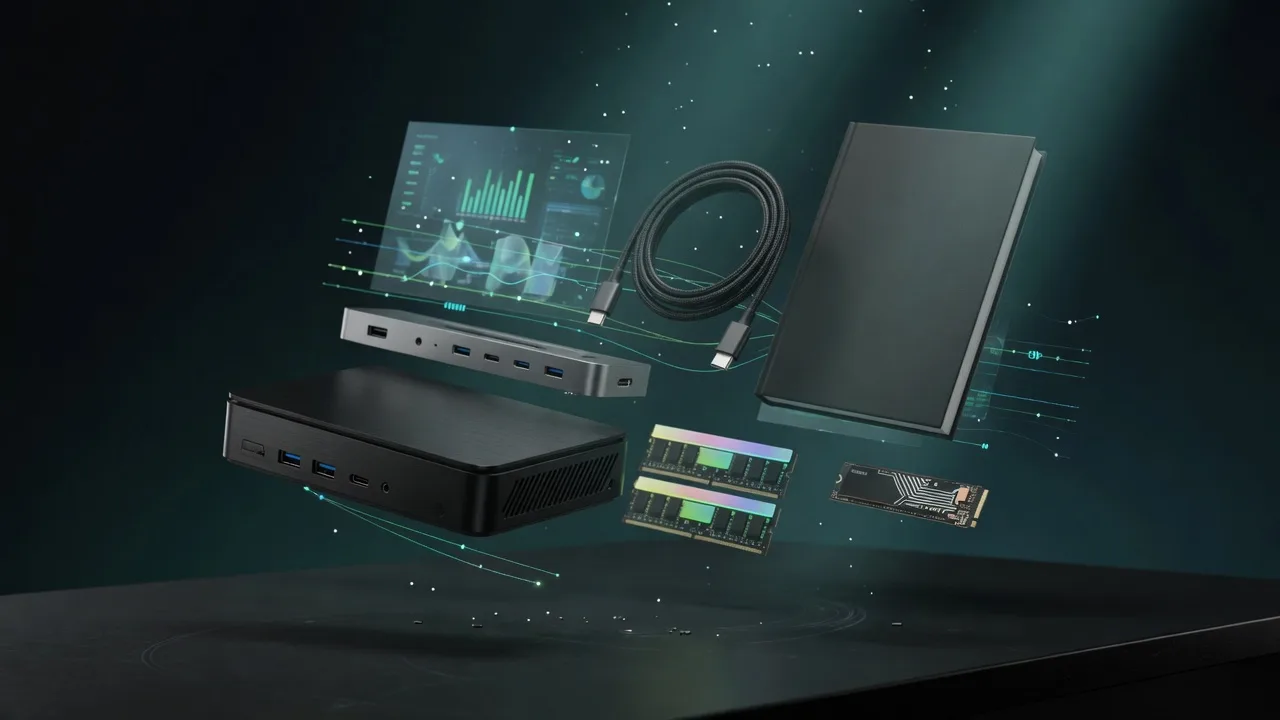
Also in Our Store
Docks, fast storage, cables, and a UPS sized for a local AI machine.

Rent this class of GPU by the hour before you buy. Live prices from RunPod and Vast.ai.
Find the break-even between buying this hardware and paying for a cloud API.
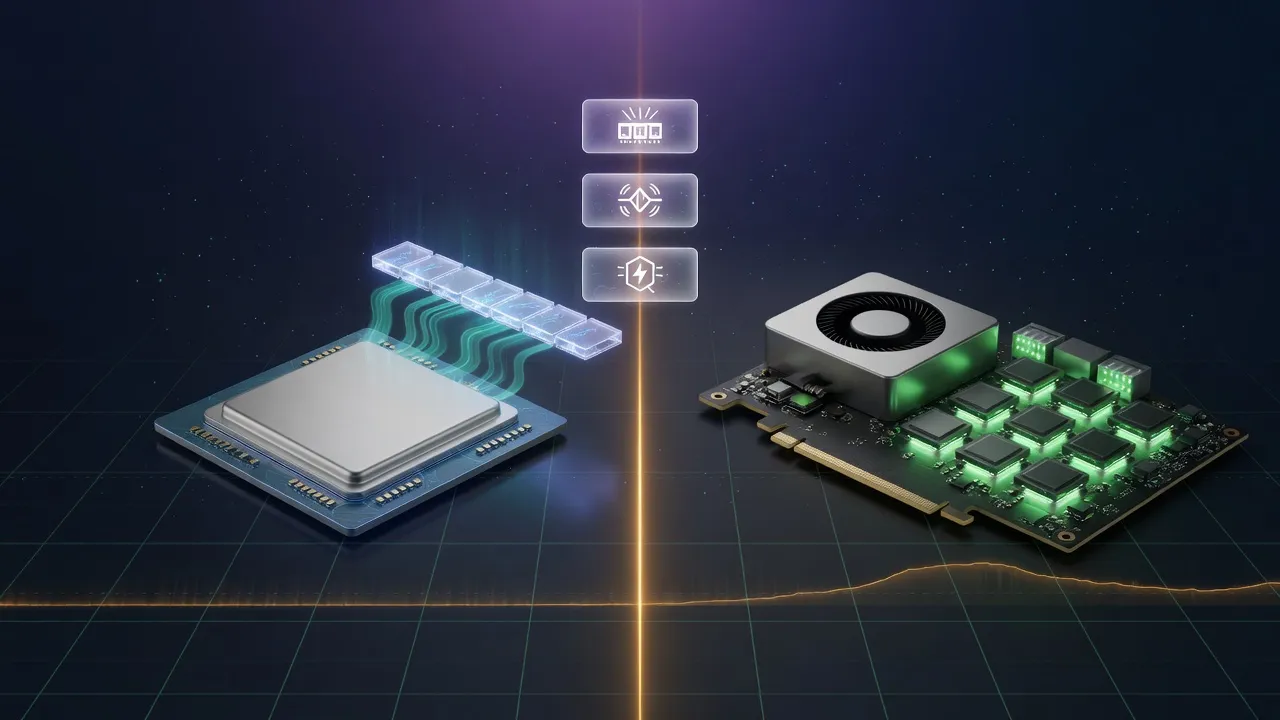
Mac vs NVIDIA for local inference, if you are still choosing a platform.
