- Services
Advertising disclosure: we earn commissions when you shop through the links below.
ASUS ProArt P14 (H7407) is a 14-inch Windows laptop built on the NVIDIA RTX Spark platform, pairing an N1X chip with a 20-core CPU and a 6144-core Blackwell RTX GPU with up to 128GB of unified LPDDR5X memory. ASUS quotes up to 1 petaflop of AI performance and positions the machine for local agentic AI and creator work. It has a 3K 120Hz OLED touch display, up to 1TB PCIe 4.0 SSD, Wi-Fi 7 and a 90Wh battery, and runs Windows 11 Pro or Home. ASUS opened preorders on 2026-10-07 and has not announced a price.
Sized for production serving of 70B–200B class models at full or lightly-quantized precision. Overkill for a homelab; right call when the workload pays for itself in token volume.
Generated from this product’s spec sheet. Editor reviews refine it over time.
The ProArt P14 (H7407) represents an architectural shift for mobile AI workstations. Powered by the NVIDIA RTX Spark N1X superchip, this 14-inch laptop combines a 20-core CPU with a 6144-core Blackwell RTX GPU and up to 128GB of unified LPDDR5X memory. By consolidating CPU and GPU compute onto a single unified memory bus, the P14 bypasses the traditional bottleneck that has constrained mobile AI development: the strict VRAM ceilings of discrete laptop GPUs. At just 1.48 kg, it delivers data-center-style model capacity in an ultralight footprint.
For machine learning engineers, local agent developers, and researchers, the ProArt P14 (H7407) for AI workloads fills a critical gap between high-power desktop rigs and underpowered consumer laptops. While conventional mobile workstations max out at 16GB or 24GB of discrete VRAM, the top-tier configuration of the P14 provides a contiguous 128GB pool accessible directly by Blackwell Tensor Cores. This design enables practitioners to run complex, multi-step agentic pipelines, large language models, and multimodal pipelines entirely on device without cloud dependencies.
Historically, working with large local models on mobile hardware forced developers to compromise on software ecosystems, often defaulting to Apple Silicon unified memory to fit parameters while sacrificing native CUDA support. The ProArt P14 eliminates that compromise. It pairs massive unified memory with native NVIDIA software optimization, making it one of the best hardware for running AI models locally while maintaining native compatibility with CUDA, TensorRT-LLM, and standard Python machine learning tooling.
At the heart of the ProArt P14 (H7407) AI inference performance is the NVIDIA RTX Spark N1X platform. Built on the Blackwell architecture, the integrated GPU features 6144 CUDA cores and hardware acceleration for FP4, FP8, and FP16 precision.
In local LLM inference, memory bandwidth dictates token generation speed during the autoregressive phase, while compute power dictates prefill and prompt evaluation throughput. Having a 128GB GPU for AI in a portable chassis means memory allocations for parameters and KV caches are limited only by the unified pool, fundamentally changing how long-context tasks run on mobile hardware.
The standout metric for evaluating the ProArt P14 (H7407) local LLM capabilities is addressable parameter capacity. With 128GB of unified memory, developers can run models that previously required multiple discrete desktop cards or dedicated server nodes.
The P14 serves as premier hardware for running 70B parameter models locally. Models like Llama 3.1 70B and Qwen 2.5 72B require roughly 40GB to 45GB of memory at 4-bit quantization (Q4_K_M). On standard mobile GPUs with 16GB VRAM, these models cannot even load. On the P14:
The 128GB capacity unlocks architectures such as Mixtral 8x22B (active parameter routing) and dense models up to 120B parameters at Q4 quantization. While compute requirements scale with active parameter counts, the unified memory pool allows these sprawling weight matrices to reside permanently in memory without disk swapping.
Distilled reasoning models like DeepSeek-R1-Distill-Qwen-32B or Llama-3.3-70B run without friction. For massive reasoning models, context length is critical. The P14 can host a 32B model at Q8 precision while holding a 128k-token KV cache entirely in RAM, enabling complex chains of thought that saturate typical GPU allocations.
The sweet spot for daily engineering on the P14 is running a quantized 32B or 70B instruction-tuned model alongside local visual encoders (such as CLIP or SigLIP), an embedding model (like BGE-M3), and a local vector store. This concurrent execution makes the machine an ideal foundation for local AI agents in 2026, allowing multi-agent swarms to reason, parse documents, and execute code simultaneously on device.
The ProArt P14 targets technical practitioners who prioritize local control, security, and portable compute:
The Apple MacBook Pro has long been the default portable machine for large local models due to Apple Silicon unified memory. However, macOS lacks native CUDA support. Developers on Apple Silicon must rely on Metal Performance Shaders (MPS) or MLX. While MLX is efficient, many cutting-edge research repositories, vLLM optimizations, and custom CUDA kernels do not run natively on Apple hardware. The ProArt P14 matches Apple's 128GB unified memory ceiling while offering the complete NVIDIA CUDA, TensorRT, and Triton ecosystem. For engineers running specialized inference backends, the P14 eliminates code translation layers.
A workstation with dual RTX 4090 GPUs provides higher memory bandwidth (over 1000 GB/s per card) and faster raw token generation, but it caps total usable VRAM at 48GB (24GB per card split across PCIe) unless using expensive NVLink-era setups or running slower pipeline parallelism. The dual-desktop setup consumes 900W+ from the wall and is confined to an office. The ProArt P14 provides more contiguous memory (128GB) than dual RTX 4090s at a fraction of the power footprint in a 1.48 kg chassis, making it the superior option for parameter capacity and mobile deployment, even if raw generation speeds on smaller models are lower than full-power desktop silicon.
For practitioners looking for the best AI chip for local deployment across mobile form factors, the ProArt P14 (H7407) establishes a new baseline for what is possible outside of a server rack.
The top models this device can run at 4-bit, ranked by fit and speed.
Specs not available for scoring. This product is missing VRAM or memory bandwidth data.
Also in Our Store
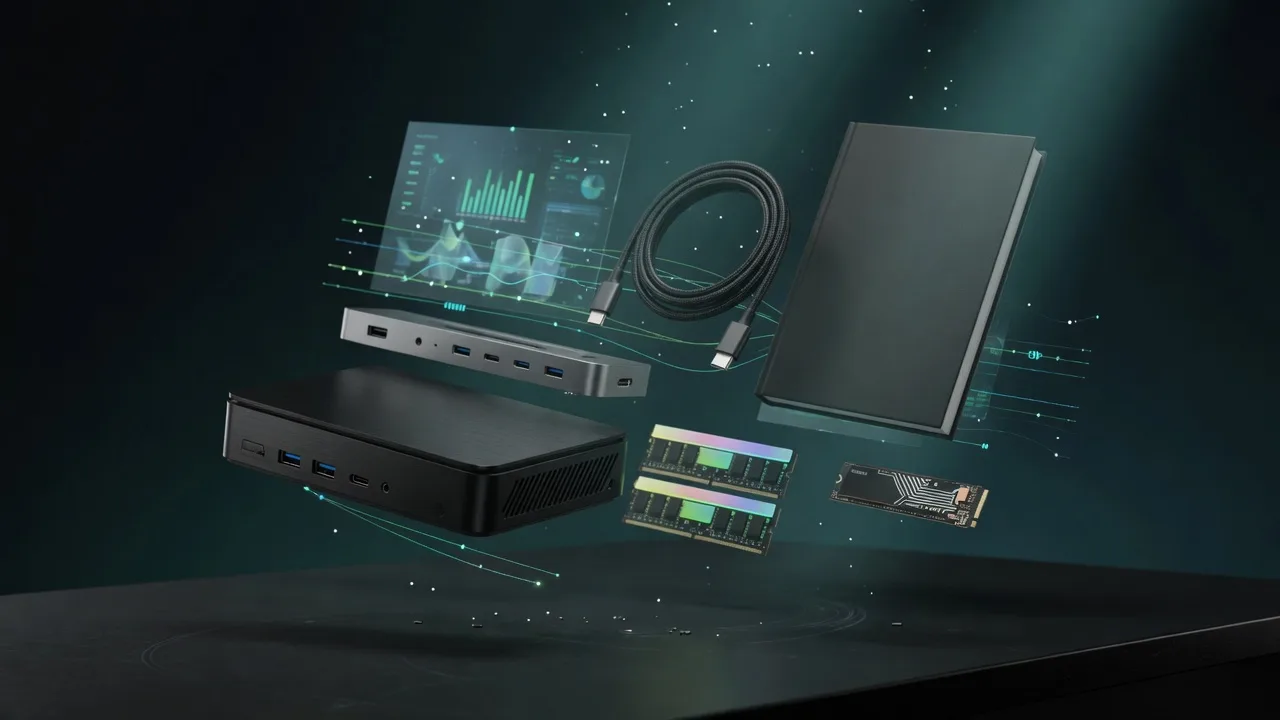
Docks, fast storage, cables, and a UPS sized for a local AI machine.

Rent this class of GPU by the hour before you buy. Live prices from RunPod and Vast.ai.
Find the break-even between buying this hardware and paying for a cloud API.
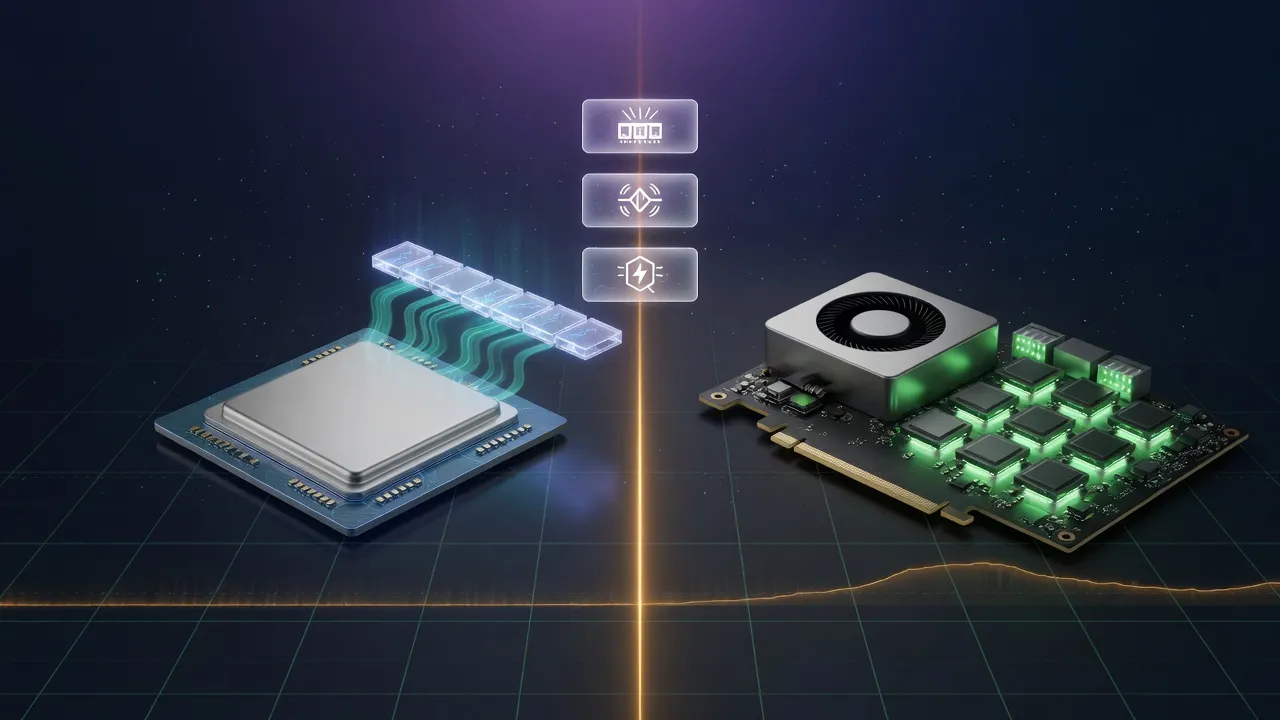
Mac vs NVIDIA for local inference, if you are still choosing a platform.