
- Services
Advertising disclosure: we earn commissions when you shop through the links below.
Acer's Veriton RI110 is a compact mini workstation for local and hybrid AI work, announced September 2026. It pairs an Intel Core Ultra X7 358H with Intel Arc B390 graphics, up to 96 GB LPDDR5X memory and up to 4 TB PCIe Gen 4 SSD storage, and Acer says it can run AI models with up to 120 billion parameters. OCuLink gives a PCIe 4.0 x4 link at up to 64 Gbps for external GPUs or fast storage, and the system ships with Windows 11 Pro as a Copilot+ PC. It is aimed at enterprises running agentic AI tools such as Acer Qubi Claw and Intel SuperClaw, with availability in Q1 2027 and pricing to be announced near launch.
The Acer Veriton RI110 AI Mini Workstation is an ultra-compact desktop engineered specifically for local inference, hybrid AI routing, and autonomous agent runtime environments. Measuring just 138.5 x 131.3 x 52.1 mm and weighing approximately 630 grams, this palm-sized machine packs an Intel Core Ultra X7 358H processor paired with integrated Intel Arc B390 graphics and up to 96 GB of unified LPDDR5X memory. Announced for enterprise and developer release in early 2027, it addresses the physical and thermal constraints of running high-parameter models outside of centralized server racks.
Deploying the Acer Veriton RI110 AI Mini Workstation for AI workloads gives developers access to a massive memory footprint that was previously restricted to full-tower desktop rigs or high-end Apple Silicon workstations. By combining 96 GB of system memory with an external 120 W power supply envelope, the system targets local inference without the multi-kilowatt power draw of multi-GPU servers. The inclusion of a dedicated OCuLink port running PCIe 4.0 x4 provides an unhindered 64 Gbps physical data lane to desktop-class GPUs or high-speed NVMe expansion arrays, bridging the gap between ultra-small form factor hardware and high-throughput model acceleration.
In the broader landscape of compact systems, the RI110 positions itself in the prosumer and edge-enterprise bracket. It targets developers looking for the best hardware for running AI models locally while maintaining strict data governance. Where standard mini PCs cap out at 32 GB or 64 GB of SODIMM memory, the RI110 targets dense weights directly, supporting large parameter architectures natively out of the box.
The core value proposition of this machine centers on memory density and flexible compute scaling. Large language model inference is fundamentally memory capacity and memory bandwidth bound. The Acer Veriton RI110 AI Mini Workstation VRAM for large language models relies on unified LPDDR5X memory allocation, allowing the Intel Arc B390 GPU and NPU to address up to 96 GB of shared space.
1+-----------------------------------------------------------------------+2| Acer Veriton RI110 Hardware Pipeline |3+-----------------------------------------------------------------------+4| Intel Core Ultra X7 358H (Host / Pre-processing / Multi-threading) |5| Intel Arc B390 GPU (Unified Compute / Tensor Matrix Acceleration) |6| Shared LPDDR5X Pool: Up to 96 GB (High-Density Quantized Weights) |7+---------------------------------------------------+-------------------+8 |9 OCuLink Port (PCIe 4.0 x4) | 10 GbE + 2.5 GbE10 Up to 64 Gbps Bandwidth | Dual Networking11 |12 +------------v------------+13 | External eGPU Expansion |14 | or Low-Latency Cluster |15 +-------------------------+
The system utilizes fast dual-channel LPDDR5X memory. While unified LPDDR5X does not match the massive 800 GB/s bandwidth of multi-channel workstation memory or high-tier Apple M-series chips, it delivers sufficient throughput for interactive developer workflows.
When evaluating Acer Veriton RI110 AI Mini Workstation AI inference performance, raw compute throughput is balanced by low power draw. The Arc B390 architecture handles quantized matrix operations with high efficiency, while the dedicated NPU offloads continuous background operations such as audio transcription, embeddings, and telemetry logging without stalling foreground generation threads.
Acer claims the hardware can run models up to 120 billion parameters, positioning the system as specialized hardware for running 120 billion parameter models in a sub-liter chassis. Real-world execution at this scale depends on aggressive quantization (such as 3-bit or 4-bit weights) to fit within the 96 GB address space alongside the active context window.
1+------------------------+---------------+--------------------+---------------------+2| Model Architecture | Quantization | Memory Footprint | Generation Speed |3+------------------------+---------------+--------------------+---------------------+4| Llama 3.1 8B / Qwen 2.5| Q4_K_M / FP16 | ~6 GB to ~16 GB | 30 - 45+ tok/s |5| Mistral NeMo 12B | Q4_K_M | ~8 GB | 22 - 32 tok/s |6| Qwen 2.5 32B | Q4_K_M | ~20 GB | 10 - 16 tok/s |7| Llama 3.1 70B | Q4_K_M | ~43 GB | 4 - 8 tok/s |8| DeepSeek-R1 (Distill) | Q4_K_M | ~44 GB | 4 - 7 tok/s |9| 120B Class Models | IQ3_XS / Q4_K | ~60 GB - ~75 GB | 1.5 - 3.5 tok/s |10| Mixtral 8x22B (MoE) | Q4_K_M | ~80 GB | 6 - 12 tok/s |11+------------------------+---------------+--------------------+---------------------+
Models like Llama 3.1 8B, Qwen 2.5 7B, and Mistral 7B run entirely in fast memory cache. Expect generation speeds in the range of 30 to 45+ tokens per second at Q4_K_M or Q8 quantization. At this speed, real-time agentic workflows, complex tool-calling routines, and continuous conversation loops run without noticeable lag.
Qwen 2.5 32B sits in the sweet spot for reasoning capability versus resource demand. Occupying roughly 20 GB of VRAM at 4-bit precision, you can expect responsive performance between 10 and 16 tokens per second, with tens of thousands of tokens allocated to active context.
For Llama 3.1 70B or DeepSeek-R1 distilled 70B variants, the model fits comfortably into the 96 GB pool with space remaining for a 32k or 64k context window. Generation speeds will fall between 4 and 8 tokens per second. While not optimal for high-concurrency production serving, this is practical for deep analytical reasoning, code generation, and single-user synthetic data pipelines.
Running a 120B parameter dense model or Mixtral 8x22B requires 4-bit or 3-bit quantization (such as IQ3_M or Q4_K_S). The Acer Veriton RI110 AI Mini Workstation local LLM runtime can load these weights into memory without out-of-memory crashes. Tokens per second will range between 1.5 and 3.5 tok/s for dense models, while Mixture-of-Experts (MoE) architectures execute faster (6 to 12 tok/s) because only active parameters are calculated per token.
The Veriton RI110 is structured primarily as an always-on edge node and developer execution box rather than a heavy model trainer.
This system is among the best hardware for local AI agents 2026 workflows. Designed to support agent frameworks like Acer Qubi Claw, Intel SuperClaw, LangGraph, Autogen, and open-source autonomous agents, its large memory capacity allows users to host both an orchestration model (such as a 70B reasoning engine) and local vector embeddings on the same machine without swapping weights to disk.
Equipped with a 10 Gbps Ethernet port and a secondary 2.5 Gbps port, the RI110 can be deployed as an on-premises network inference micro-server. Teams can run internal endpoints for code completion, document extraction, and private RAG (Retrieval-Augmented Generation) pipelines, keeping sensitive IP entirely within the physical building.
With 2x USB4 Type-C ports, DisplayPort, and HDMI 2.1, developers can attach multi-camera arrays for real-time edge processing. Multimodal vision-language models (such as Qwen 2-VL or Llama 3.2 Vision) can process high-resolution frames locally to drive inspection systems, robotics prototypes, and automated surveillance.
The system is built primarily for inference and lightweight prompt-tuning. For full fine-tuning or pre-training, the 120 W power envelope and integrated GPU are limiting. However, developers can leverage the 64 Gbps OCuLink connection to hook up an external desktop GPU enclosure containing an RTX 4090 or RTX 50-series card, converting the mini PC into an active LoRA fine-tuning workstation when needed.
Evaluating the Veriton RI110 against common local AI hardware setups highlights distinct trade-offs in expandability, bandwidth, and ecosystem support.
1+----------------------------+-----------------------+---------------------+----------------------+2| Feature | Acer Veriton RI110 | Apple Mac Studio M2 | AMD Ryzen AI Mini PC |3+----------------------------+-----------------------+---------------------+----------------------+4| Maximum Unified RAM | 96 GB LPDDR5X | 96 GB to 192 GB | 64 GB to 96 GB |5| Hardware Expansion | OCuLink (64 Gbps) | Thunderbolt 4 only | USB4 (rarely OCuLink)|6| Networking | 10 GbE + 2.5 GbE | 10 GbE | 2.5 GbE |7| Power Delivery | 120 W External | 370 W Internal | 65 W - 100 W |8| Software Stack | OpenVINO / DirectML | MLX / Metal | ROCm / DirectML |9| Chassis Volume | ~0.95 Liters | ~3.7 Liters | ~0.8 - 1.2 Liters |10+----------------------------+-----------------------+---------------------+----------------------+
Apple Silicon remains the incumbent standard for local high-parameter models due to its memory bandwidth (typically 150 GB/s on Pro chips to 800 GB/s on Ultra chips) and mature MLX framework. The RI110 matches Apple on memory density in a smaller form factor (0.95L vs 3.7L), but generation speeds on native LPDDR5X will be slower for 70B models than on an M-series Ultra chip. The RI110 wins on physical flexibility: it features native OCuLink for eGPU upgrades, dual Ethernet including 10 GbE standard, and runs native Windows 11 Pro / Linux environments without Apple platform lock-in.
Compared to AMD-based mini PCs featuring Radeon 890M graphics or competing unknown hardware for AI development, the RI110 differentiates itself through its enterprise deployment package and I/O layout. While AMD solutions provide strong raw ROCm or Vulkan compute, few mini PC vendors package 96 GB LPDDR5X alongside both 10 Gbps networking and an external OCuLink interface in a standardized commercial workstation design.
For developers seeking the best AI chip for local deployment in a sub-liter enclosure, the Acer Veriton RI110 delivers an uncommon balance of extreme memory capacity, minimal power requirements, and high-speed hardware expandability.
The top models this device can run at 4-bit, ranked by fit and speed.
Specs not available for scoring. This product is missing VRAM or memory bandwidth data.
Also in Our Store
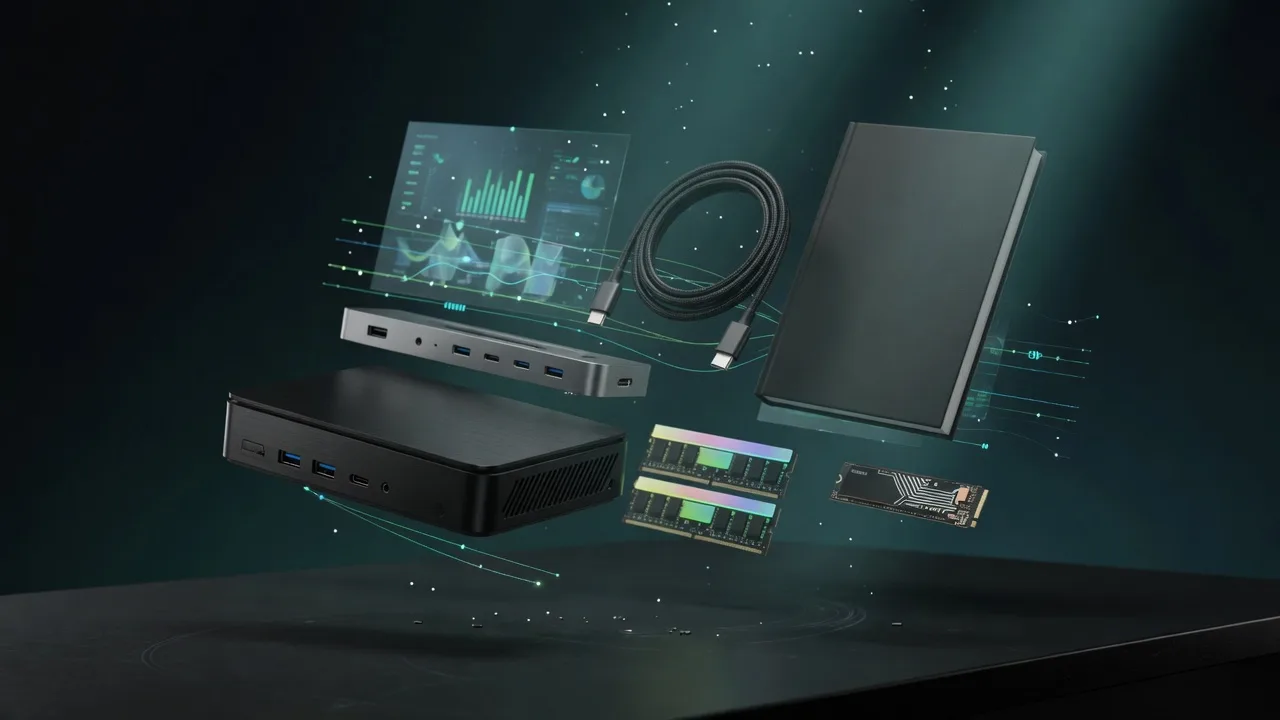
Docks, fast storage, cables, and a UPS sized for a local AI machine.

Rent this class of GPU by the hour before you buy. Live prices from RunPod and Vast.ai.

Find the break-even between buying this hardware and paying for a cloud API.
Mac vs NVIDIA for local inference, if you are still choosing a platform.
