- Services
Advertising disclosure: we earn commissions when you shop through the links below.
Mid-tier M4 chip with 14-core CPU, 20-core GPU, and up to 64GB unified memory at 273 GB/s. Excellent balance of AI performance and efficiency for professional Mac users.
The first tier where 70B-class models stop feeling cramped. Headroom for KV cache means 32K+ context on Q4 quants without falling off the GPU.
Generated from this product’s spec sheet. Editor reviews refine it over time.
The Apple M4 Pro (14-core CPU, 20-core GPU) represents the current "sweet spot" in the Apple Silicon lineup for engineers and researchers requiring high-density VRAM in a compact, power-efficient form factor. Built on TSMC’s second-generation 3nm process, this SoC bridges the gap between consumer-grade hardware and the high-end M4 Max. For the AI practitioner, the M4 Pro is defined by its 273 GB/s memory bandwidth and its ability to address up to 64GB of unified memory, a critical threshold for running large language models (LLMs) that typically require multi-GPU setups on x86 platforms.
In the 2025 landscape of local AI development, the M4 Pro is positioned as a primary workstation for building agentic workflows and testing local inference. While the M4 Max offers higher peak bandwidth, the M4 Pro provides sufficient throughput for real-time interaction with complex models while maintaining a significantly lower thermal profile (60W TDP). It competes directly with mid-to-high-tier mobile workstations and desktop setups featuring NVIDIA’s RTX 4080 (16GB), though it offers a distinct advantage in total addressable VRAM for large-scale model loading.
When evaluating the Apple M4 Pro (14-core CPU, 20-core GPU) for AI, the headline figure is the 64GB unified memory capacity. Unlike traditional PC architectures where VRAM is isolated on the GPU, Apple Silicon allows the 20-core GPU to access the entire pool of system memory. For AI inference performance, this means you can load models that would otherwise require an NVIDIA A6000 or dual-RTX 3090/4090 configurations.
The 273 GB/s memory bandwidth is the primary driver for token generation speed. In LLM inference, the bottleneck is almost always memory bandwidth rather than compute TFLOPS. At 273 GB/s, the M4 Pro delivers a responsive experience even when running high-parameter models that exceed the 16GB or 24GB limits of consumer GPUs. While it doesn't reach the 400+ GB/s of the Max series, it remains significantly faster than standard M4 or M3 configurations.
The chip features a 16-core Neural Engine rated at 38 TOPS (INT8). While the Neural Engine is optimized for CoreML tasks like image segmentation and on-device transcription, most local LLM practitioners will utilize the 20-core GPU via the Metal Performance Shaders (MPS) backend. The 14-core CPU (comprising 10 Performance cores and 4 Efficiency cores) handles the pre-processing and KV cache management efficiently, ensuring that the system remains responsive even during heavy inference loads.
With a TDP of approximately 60W, the M4 Pro is one of the most energy-efficient AI chips for local deployment. This makes it an ideal candidate for "always-on" local AI agents or edge inference servers where power consumption and heat dissipation are constraints.
The Apple M4 Pro (14-core CPU, 20-core GPU) VRAM for large language models is its greatest asset. With a 64GB configuration, you can realistically allocate ~48-52GB to the GPU (leaving overhead for the OS). This capacity changes the paradigm for what is possible on a single mobile or small-form-factor machine.
The hardware for running ~70B at Q4 with 64GB unified memory parameter models is exactly what the M4 Pro provides.
The 64GB VRAM allows for significant context extension. Developers working with RAG (Retrieval-Augmented Generation) can utilize 32k or even 64k context windows on 8B-30B parameter models without hitting out-of-memory (OOM) errors. It also handles multimodal models like LLaVA or Molmo with ease, providing enough headroom for both the vision encoder and the language backbone.
The M4 Pro occupies a specific niche for AI development where portability or power efficiency must meet high VRAM requirements.
This is the entry-level "production ready" chip for Apple Silicon for AI development. It allows engineers to prototype locally with the same models they will eventually deploy to the cloud (e.g., Llama 70B). The inclusion of Thunderbolt 5 support also enables high-speed data transfer for large dataset management, which is essential for fine-tuning preparation.
For those building local AI agents, the M4 Pro is arguably the best AI chip for local deployment in a workstation environment. It can run an embedding model, a vector database, and an LLM simultaneously without the latency spikes common in systems with less unified memory.
Hobbyists who want to explore the latest "frontier" models without spending $5,000+ on a Mac Studio or a multi-GPU PC build will find the M4 Pro (especially in the Mac Mini or MacBook Pro 14") to be the most cost-effective entry point into high-parameter (70B+) local inference.
To understand the M4 Pro's value, it must be compared against its siblings and its PC counterparts.
The M4 Max offers double the memory bandwidth (up to 546 GB/s) and more GPU cores. If your primary goal is the highest possible tokens per second (TPS) on 70B+ models, the Max is superior. However, the M4 Pro is significantly more affordable and runs cooler, making it better for sustained workloads in smaller chassis. For many, the jump from 273 GB/s to 546 GB/s is a luxury, whereas the jump from the base M4 to the M4 Pro is a necessity for serious AI work.
The RTX 4080 is faster for raw compute and benefits from the mature CUDA ecosystem. However, it is strictly limited by its 16GB of VRAM. While the 4080 will outperform the M4 Pro on a 7B or 14B parameter model in terms of raw speed, it cannot run a 70B model at any usable quantization. For the AI practitioner, 64GB of slower unified memory is almost always more valuable than 16GB of fast GDDR6X.
The M4 Pro sees a significant jump in memory bandwidth (from 150 GB/s in the M3 Pro to 273 GB/s) and a more capable Neural Engine. This makes the M4 Pro a much more viable "AI workstation" than its predecessor, which was often criticized for its narrowed memory bus.
In summary, the Apple M4 Pro (14-core CPU, 20-core GPU) with 64GB of unified memory is the best hardware for local AI agents 2025 for those who prioritize the ability to run large models locally without the power draw or complexity of a multi-GPU Linux build.
The top models this device can run at 4-bit, ranked by fit and speed.
| Model | Grade | Speed | VRAM |
|---|---|---|---|
| Qwen3-30B-A3BAlibaba | SS | 40.8 tok/s | 5.4 GB |
| Holo4-35B-A3BHcompany | AA | 94.0 tok/s | 2.3 GB |
| Llama 3 8B InstructMeta | AA | 38.8 tok/s | 5.7 GB |
| LFM2.5-8B-A1BLiquid AI | AA | 75.6 tok/s | 2.9 GB |
| LensVLM-9BApple | AA | 36.5 tok/s | 6.0 GB |
Among 6 similar devices, the Apple M4 Pro (14-core CPU, 20-core GPU) ranks #5 for memory and #6 for memory bandwidth.
Also in Our Store
Docks, fast storage, cables, and a UPS sized for a local AI machine.

Rent this class of GPU by the hour before you buy. Live prices from RunPod and Vast.ai.
Find the break-even between buying this hardware and paying for a cloud API.
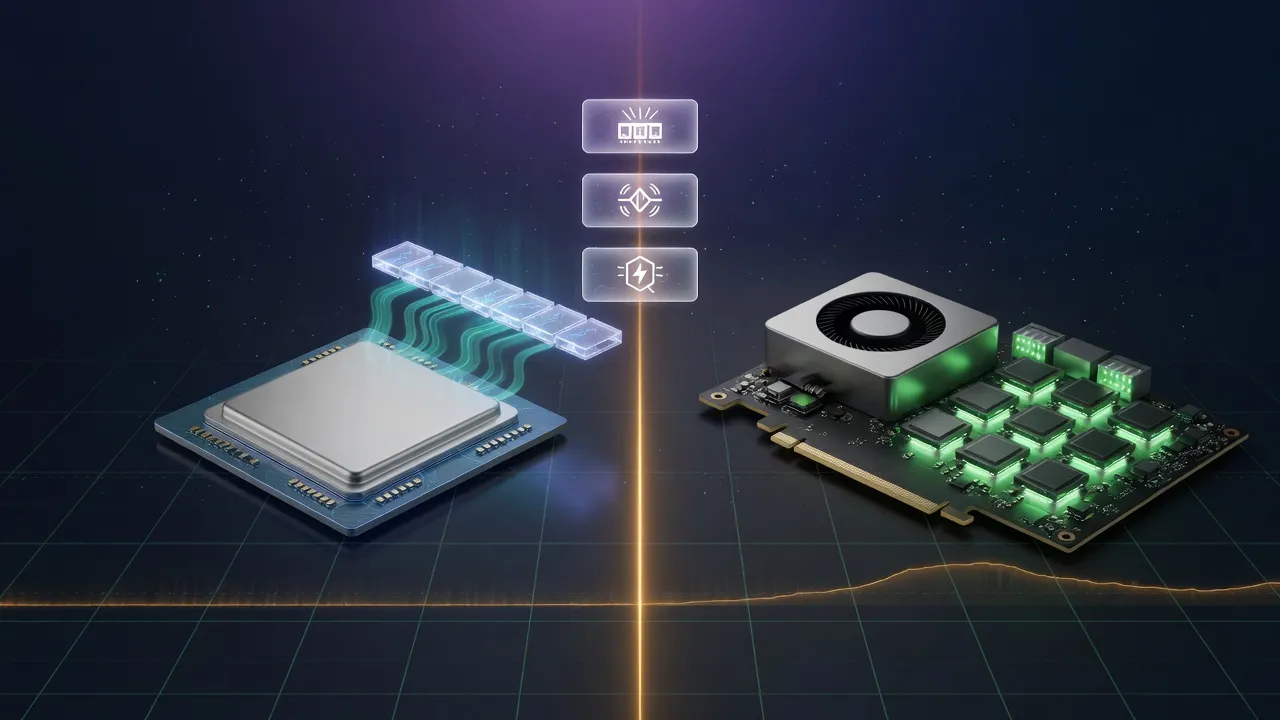
Mac vs NVIDIA for local inference, if you are still choosing a platform.