- Services
Advertising disclosure: we earn commissions when you shop through the links below.
Built with Apple's new Fusion Architecture connecting two 3nm dies. 18-core CPU (6 super + 12 performance), 20-core GPU with Neural Accelerators, up to 64GB unified memory at 307 GB/s.
The first tier where 70B-class models stop feeling cramped. Headroom for KV cache means 32K+ context on Q4 quants without falling off the GPU.
Generated from this product’s spec sheet. Editor reviews refine it over time.
The Apple M5 Pro (18-core CPU, 20-core GPU) represents a fundamental shift in how Apple designs mid-tier professional silicon. By moving to a "Fusion Architecture" that connects two 3nm dies, Apple has effectively created a high-bandwidth bridge that eliminates the traditional bottlenecks found in mobile SoCs. For AI engineers and researchers, this means the M5 Pro is no longer just a "laptop chip", it is a legitimate workstation-class piece of hardware for local LLM inference and agentic development.
Positioned between the entry-level M5 and the ultra-high-end M5 Max, this specific 18-core configuration is the price-to-performance "sweet spot" for 2025. It competes directly with mid-tier dedicated GPUs like the NVIDIA RTX 4070 Ti Super (16GB), but offers a massive advantage in addressable VRAM. While consumer GPUs are often capped at 16GB or 24GB, the M5 Pro’s 64GB of unified memory allows practitioners to run models that would otherwise require a dual-GPU setup or a significantly more expensive enterprise card.
The core of the Apple M5 Pro (18-core CPU, 20-core GPU) for AI is its memory architecture. Unlike traditional PC builds where the CPU and GPU have separate memory pools, the M5 Pro uses a unified LPDDR5X structure with 307 GB/s of bandwidth. In the context of local LLM inference, memory bandwidth is almost always the primary bottleneck for token generation speed. At 307 GB/s, the M5 Pro provides the throughput necessary to keep generation fluid even on larger-parameter models.
When evaluating the best hardware for local AI agents 2025, the M5 Pro is defined by its ability to handle "Large-Medium" models. The 64GB unified memory ceiling is the critical factor here. Because the macOS system requires a small portion of RAM, you effectively have ~48-54GB available for the weights and KV cache.
The Apple M5 Pro (18-core CPU, 20-core GPU) VRAM for large language models enables the following:
For the best quality-to-speed tradeoff, we recommend running 30B to 34B parameter models at Q5_K_M or Q6_K quantization. This provides near-FP16 intelligence levels while maintaining the high token throughput required for interactive AI agents.
The M5 Pro is production ready and specifically tuned for three primary personas:
If you are building an agentic workflow that requires a local "brain" to handle sensitive data, the M5 Pro is the best apple silicon for running AI models locally. The 307 GB/s bandwidth ensures that the "Thinking" phase of an agent doesn't create a bottleneck in your development loop.
With Thunderbolt 5 support and 14.5 GB/s SSD speeds, the M5 Pro is built for handling massive datasets. It is an ideal machine for fine-tuning smaller models (1B to 7B parameters) using MLX or LoRA adapters before deploying to the cloud.
For organizations that cannot send data to OpenAI or Anthropic, the M5 Pro offers enough VRAM to run high-quantization 70B models locally. It serves as a "private server in a laptop" for processing internal documents and codebases.
Given the 65W TDP, this is a premier AI chip for local deployment in edge environments where power is limited but high-parameter model support is required (e.g., mobile command centers or specialized industrial hardware).
When choosing Apple apple silicon for AI development, the M5 Pro sits in a unique competitive bracket.
For practitioners looking for a balance of portability, thermal efficiency, and the ability to run 70B class models, the Apple M5 Pro (18-core CPU, 20-core GPU) with 64GB of unified memory is currently the most capable mid-range AI workstation on the market.
The top models this device can run at 4-bit, ranked by fit and speed.
| Model | Grade | Speed | VRAM |
|---|---|---|---|
| Qwen3-30B-A3BAlibaba | SS | 45.9 tok/s | 5.4 GB |
| Holo4-35B-A3BHcompany | AA | 105.7 tok/s | 2.3 GB |
| LensVLM-9BApple | AA | 41.1 tok/s | 6.0 GB |
| Carnice-9b for Hermes agentkai-os | AA | 41.1 tok/s | 6.0 GB |
| Llama 3 8B InstructMeta | AA | 43.6 tok/s | 5.7 GB |
Among 6 similar devices, the Apple M5 Pro (18-core CPU, 20-core GPU) ranks #5 for memory and #5 for memory bandwidth.
Also in Our Store
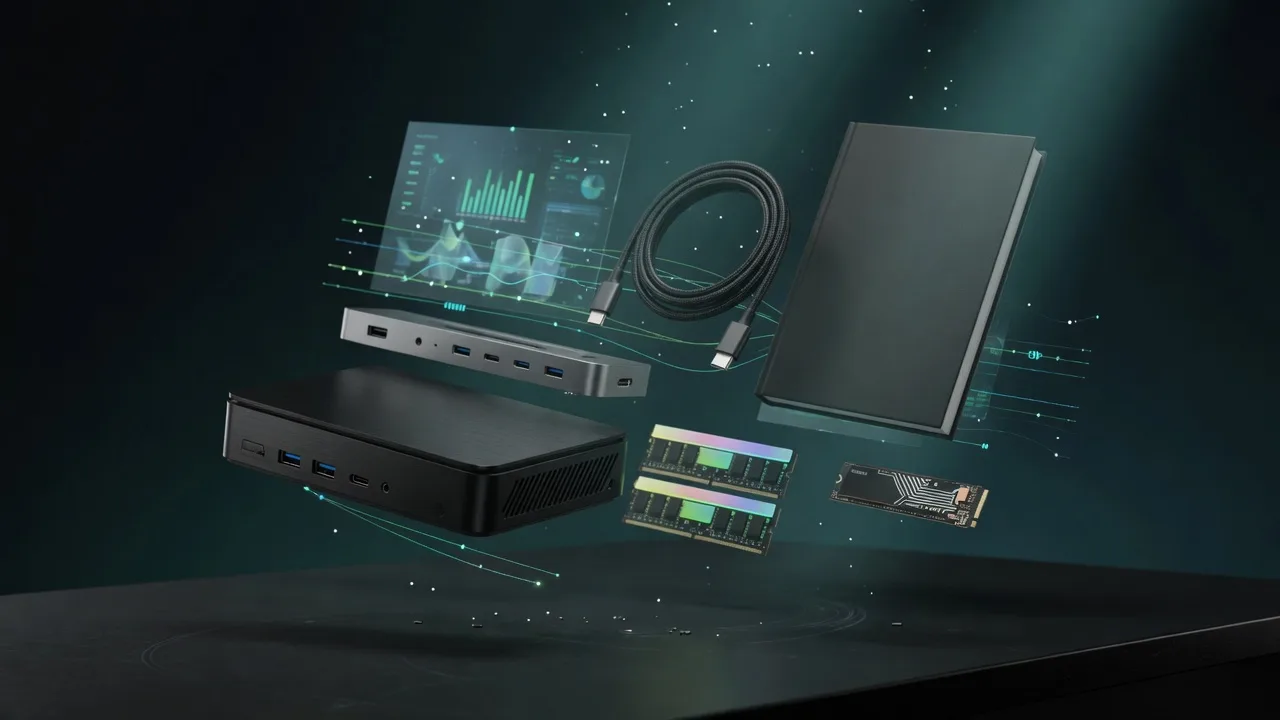
Docks, fast storage, cables, and a UPS sized for a local AI machine.

Rent this class of GPU by the hour before you buy. Live prices from RunPod and Vast.ai.

Find the break-even between buying this hardware and paying for a cloud API.
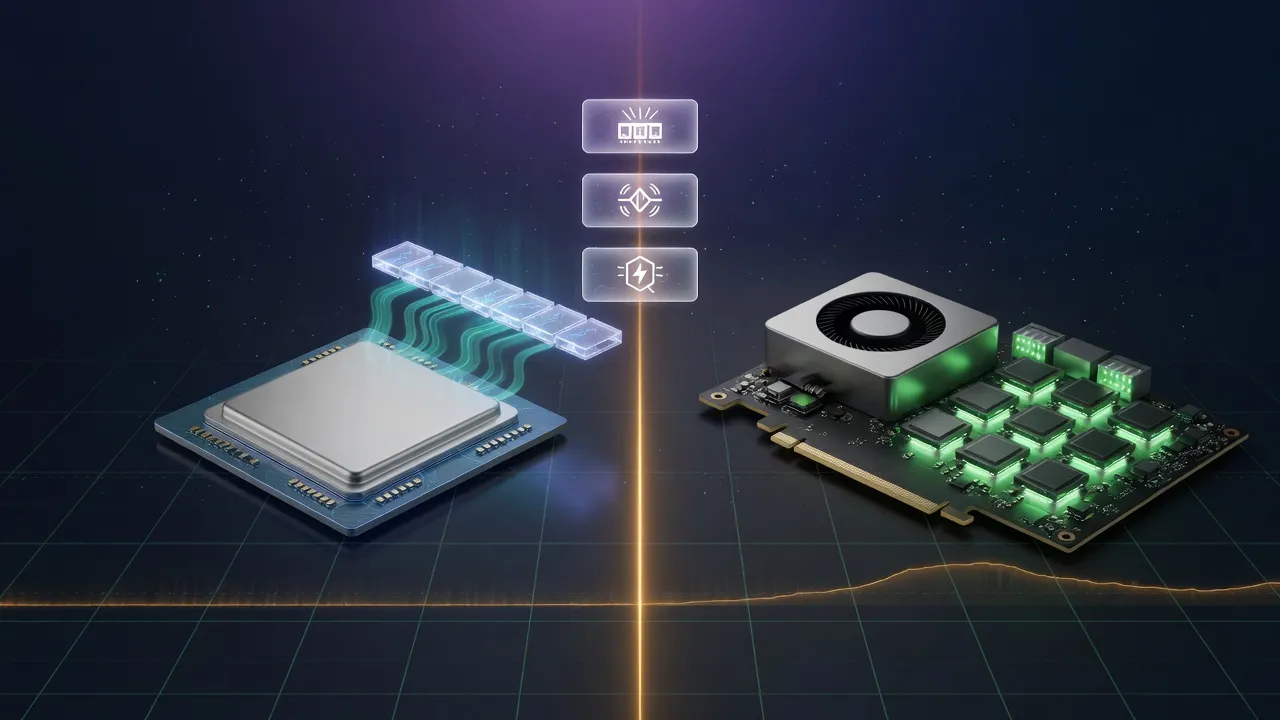
Mac vs NVIDIA for local inference, if you are still choosing a platform.