- Services
Advertising disclosure: we earn commissions when you shop through the links below.
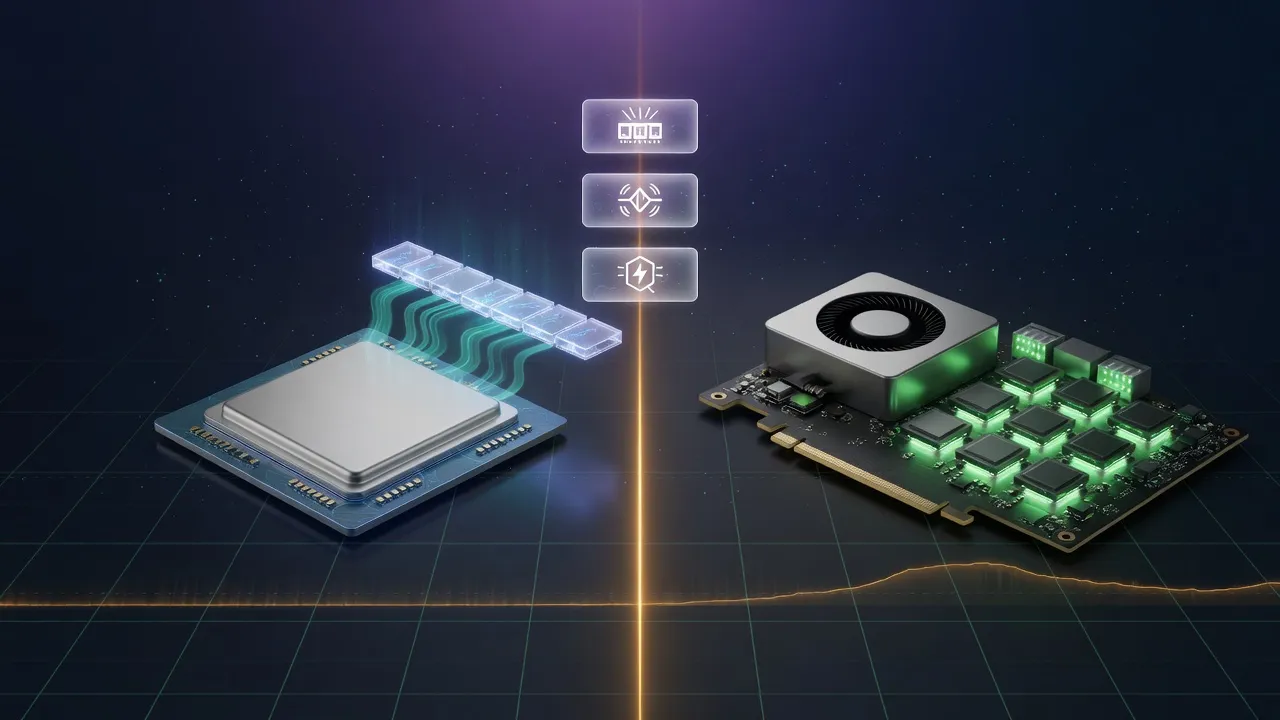
Data center AI accelerator card from Huawei, built on the Ascend 950PR processor and aimed at the prefill stage of inference and recommendation workloads. It delivers 1.56 PFLOPS of dense FP4 compute, 804 TFLOPS of FP8, 112 GB of in-house HiBL 1.0 memory at 1.4 TB/s and a 600 W TDP. Huawei claims 2.8 times the performance of Nvidia's H20. It went on sale in mainland China on 21 March 2026 and is not sold outside China; no price was published.
Sized for production serving of 70B–200B class models at full or lightly-quantized precision. Overkill for a homelab; right call when the workload pays for itself in token volume. Notably efficient for its compute class — strong perf-per-watt makes it a natural pick for always-on inference.
Generated from this product’s spec sheet. Editor reviews refine it over time.
The Atlas 350 is an enterprise-grade AI accelerator built on Huawei's Ascend 950PR processor, engineered specifically to handle high-throughput prefill and inference workloads in data centers. Positioned directly against tier-one enterprise accelerators like Nvidia's China-market H20, the Atlas 350 shifts architectural focus toward ultra-low-precision execution and memory subsystem optimization. Featuring Huawei's proprietary Da Vinci v3 architecture, this custom accelerator card aims to maximize compute density for large language model serving, vector-heavy search, and recommendation pipelines.
While technically listed under non-traditional channels as Unknown hardware for AI development on Western tracking platforms due to trade restrictions, the Atlas 350 is a production-grade machine learning platform launched in March 2026 for the mainland China enterprise ecosystem. It targets organizations seeking sovereign infrastructure that decouples their model deployment from US silicon supply chains. With hardware support for modern micro-scaling floating-point formats, it delivers substantial compute throughput for modern production inference stacks.
Evaluating the Atlas 350 for AI infrastructure requires understanding its role: this is not a desktop graphics card for hobbyist experimentation. It is a full-height, double-width, passively cooled 600 W accelerator designed for multi-card server enclosures. For teams running dedicated inference fleets or sovereign clusters, its hardware primitives provide an alternative deployment target capable of running modern 70B-parameter and MoE architectures.
Evaluating Atlas 350 AI inference performance centers on three pillars: low-precision matrix engines, memory capacity, and interconnect scaling. The Ascend 950PR silicon prioritizes the prefill phase of model evaluation, where dense matrix-matrix multiplication dominates compute time.
The Atlas 350 incorporates native support for next-generation micro-scaling formats, competing directly with modern Blackwell-era compute formats rather than older Hopper designs:
The inclusion of dense MXFP4 execution enables significant compute amplification during prompt ingestion. In typical transformer models, prefill is compute-bound while autoregressive token generation is memory-bandwidth bound. Providing 1.56 PFLOPS of 4-bit tensor performance allows the card to ingest massive prompt contexts at scale without stalling pipeline execution.
Memory bandwidth limits single-stream token generation latency. The Atlas 350 integrates 112 GB of in-house high-bandwidth memory, designated as HiBL 1.0:
Having a 112GB GPU for AI workloads places the Atlas 350 in an advantageous capacity bracket compared to standard 80 GB accelerators, reducing the number of nodes required to host large parameter pools.
Atlas 350 VRAM for large language models offers sufficient headroom to host large single-instance networks or split massive Mixture-of-Experts (MoE) architectures across fewer nodes.
The Atlas 350 tokens per second metrics depend heavily on which phase of generation is executing:
The operational requirements of the Atlas 350 dictate its ideal deployment environments:
To evaluate whether the Atlas 350 is the best AI chip for local deployment in data centers, it must be measured against its primary geopolitical and technical competitors: the Nvidia H20 and the Nvidia L40S.
The Nvidia H20 was designed to comply with US export control thresholds, retaining 96 GB of HBM3 at 4.0 TB/s memory bandwidth but heavily clamping raw compute down to 296 TFLOPS of FP8 / INT8 performance.
The Nvidia L40S is a PCIe data center card based on the Ada Lovelace architecture, relying on 48 GB of GDDR6 memory:
For enterprises operating within regional constraints that preclude access to top-tier Western silicon, the Atlas 350 stands as a performant accelerator for high-density AI inference, providing the raw compute and VRAM capacity necessary to sustain modern foundation models.
The top models this device can run at 4-bit, ranked by fit and speed.
| Model | Grade | Speed | VRAM |
|---|---|---|---|
| KolibriAleph Alpha | SS | 42.9 tok/s | 69.7 GB |
| Sarvam-105B-1711Sarvam AI | SS | 57.3 tok/s | 74.6 GB |
| Ling-3.2-airAnt Group | SS | 74.0 tok/s | 84.0 GB |
| AliceAI-Foundation-80B-A3B-Baseyandex | SS | 132.1 tok/s | 53.9 GB |
| Kolibri 1.1aleph-alpha | SS | 116.1 tok/s | 51.3 GB |
Also in Our Store
Docks, fast storage, cables, and a UPS sized for a local AI machine.

Rent this class of GPU by the hour before you buy. Live prices from RunPod and Vast.ai.

Find the break-even between buying this hardware and paying for a cloud API.
Mac vs NVIDIA for local inference, if you are still choosing a platform.