
- Services
Advertising disclosure: we earn commissions when you shop through the links below.
Minisforum's T5 Max-388 is a compact desktop built around AMD's Ryzen AI Max+ 388 APU with eight Zen 5 cores, 16 threads and a Radeon 8060S integrated GPU with 40 RDNA 3.5 compute units. It ships with 48GB of soldered LPDDR5-6400 unified memory and a 1TB SSD, and Minisforum lists it for local AI work with quantized models such as Qwen3.6-35B-A3B and Gemma-4-26B. The NPU is rated at 50 TOPS Int8, with up to 118 TOPS of total AI performance. It is listed at $1,559 in the US store, down from a $1,949 regular price, with shipping estimated for early December 2026.
Manufacturer's suggested retail price. Current prices can be higher or lower. This is not a live price.
The Minisforum T5 Max-388 represents a distinct shift in prosumer hardware for local artificial intelligence development. Built around AMD's Strix Halo architecture, this 6.2-liter compact desktop combines an 8-core, 16-thread Ryzen AI Max+ 388 processor with a high-compute Radeon 8060S integrated GPU. What sets this machine apart for machine learning practitioners is its 48GB of unified LPDDR5-6400 memory. Instead of routing model weights across a narrow PCIe bus to an expensive discrete GPU with limited VRAM, the T5 Max-388 treats its entire 48GB pool as a shared resource for both compute cores and graphics clusters.
At an entry pre-order price of $1,559 (down from an MSRP of $1,949), this system targets developers, AI researchers, and hobbyists searching for the best hardware for running AI models locally without the power consumption, physical footprint, or expense of enterprise workstations. While traditional discrete desktop builds at this price point limit users to 12GB or 16GB of video memory, the T5 Max-388 gives practitioners the headroom needed to load modern open-weights models that previously demanded dual-GPU configurations or enterprise-tier accelerators.
Whether you are evaluating the Minisforum T5 Max-388 for AI agent pipelines, running continuous local inference for privacy-compliant code assistants, or deploying a low-noise development node, its architecture introduces concrete trade-offs between memory capacity and pure throughput that dictate how local models perform.
Evaluating Minisforum T5 Max-388 AI inference performance requires looking closely at memory bandwidth, unified memory allocation, and compute density. In autoregressive large language model inference, token generation speed is almost always memory-bandwidth-bound rather than compute-bound.
1Processor: AMD Ryzen AI Max+ 388 (8 Zen 5 cores, 16 threads, up to 5.0 GHz)2Graphics Compute: Radeon 8060S (40 RDNA 3.5 Compute Units)3Neural Processing: AMD XDNA 2 NPU, 50 TOPS (Int8)4Total System TOPS: Up to 118 TOPS combined5Unified Memory: 48GB LPDDR5-6400 (soldered, non-upgradable)6Memory Bandwidth: 204.8 GB/s7Storage Capacity: 1TB NVMe SSD (2x M.2 2280 PCIe 4.0 x4 slots, up to 8TB each)8I/O & Connectivity: USB4, HDMI 2.1, DisplayPort 2.1, 2.5 Gbps Ethernet, Wi-Fi 7, Bluetooth 5.49Power Supply: 350W internal PSU
The system memory is clocked at 6,400 MT/s, delivering 204.8 GB/s of theoretical memory bandwidth. While lower than the 256 GB/s achievable on LPDDR5X-8000 configurations, 204.8 GB/s remains substantially faster than standard dual-channel DDR5 desktop configurations (which typically hover around 80-90 GB/s).
Because the 48GB memory pool is unified, users can dynamically assign the majority of system RAM to the GPU. After accounting for basic Linux or Windows operating system overhead (typically 4GB to 6GB), the system provides roughly 42GB of usable Minisforum T5 Max-388 VRAM for large language models.
On raw compute, the Radeon 8060S packs 40 RDNA 3.5 compute units. For tasks supporting specialized low-precision matrix multiplication, the integrated NPU contributes 50 TOPS of INT8 compute, bringing combined platform throughput to 118 TOPS. A 350W internal power supply easily accommodates the APU's sustained performance modes (configurable up to 120W) without external power bricks or thermal throttling under sustained inference passes.
When selecting hardware for local AI development, capacity dictates which architectures load into memory, while bandwidth dictates operational speed. The 48GB unified pool places the Minisforum T5 Max-388 local LLM experience in a sweet spot between 14B and 35B parameter models.
These models run fully unquantized in FP16 or at high-precision quantizations (Q8_0). An 8B model requires roughly 6GB to 9GB of memory depending on quantization, leaving over 30GB of space for context windows up to 128k tokens and multi-agent caching.
This is the operational sweet spot for this hardware. A 32B model quantized to Q4_K_M takes approximately 20GB of memory. It runs entirely within the unified memory alongside an extended 32k context buffer without spilling into swap space.
If you are specifically shopping for hardware for running 70B parameter models, the T5 Max-388 can technically load them, but with strict caveats. A 70B model requires extreme quantization (IQ2_XS or IQ3_M) to fit inside 38GB-42GB of usable allocation. Context space will be severely constrained.
Autoregressive decoding is governed by the formula: Throughput (tokens/s) ≈ Memory Bandwidth (GB/s) / Model Size in Memory (GB).
Given the 204.8 GB/s bus, practitioners should anticipate the following realistic Minisforum T5 Max-388 tokens per second under standard runtime backends like llama.cpp or vLLM:
For interactive agentic loops and local coding assistants, 32B models quantized at Q4_K_M deliver an ideal balance of reasoning depth and acceptable generation speed. The machine also easily handles vision-language models such as Qwen 2.5-VL (7B and 32B variants) and Llama 3.2 Vision (11B), provided the vision encoder weights and context KV caches fit within the 42GB working memory headroom.
The T5 Max-388 is designed for focused machine learning workflows rather than general brute-force training:
To understand where this machine sits, compare it to common alternatives in the local AI space.
Apple Silicon remains the gold standard for high-bandwidth unified memory architectures, offering 300 to 400 GB/s of bandwidth on Max-series chips. However, an equivalently configured 64GB Mac Studio regularly retails above $2,300. The T5 Max-388 delivers a lower price-to-capacity ratio for x86-native environments, native Linux driver stacks (ROCm), and direct compatibility with standard Linux containerization toolchains without virtualization overhead.
Building a dedicated PC with two 16GB discrete Nvidia GPUs yields 32GB of total VRAM and CUDA support, but introduces multi-GPU tensor-parallelism complexity, higher idle power draw, a large ATX chassis, and roughly 10GB less addressable memory than the T5 Max-388. While Nvidia's CUDA remains the industry standard for driver stability and software optimization, the T5 Max-388 fits 48GB of accessible address space into a tiny 6.2-liter form factor pulling under 200W under heavy loads.
For practitioners looking for the best AI chip for local deployment where physical space, silence, and high VRAM capacity under $1,600 take priority over raw CUDA compatibility, the T5 Max-388 stands out as an efficient, highly capable inference appliance.
The top models this device can run at 4-bit, ranked by fit and speed.
Specs not available for scoring. This product is missing VRAM or memory bandwidth data.
Also in Our Store
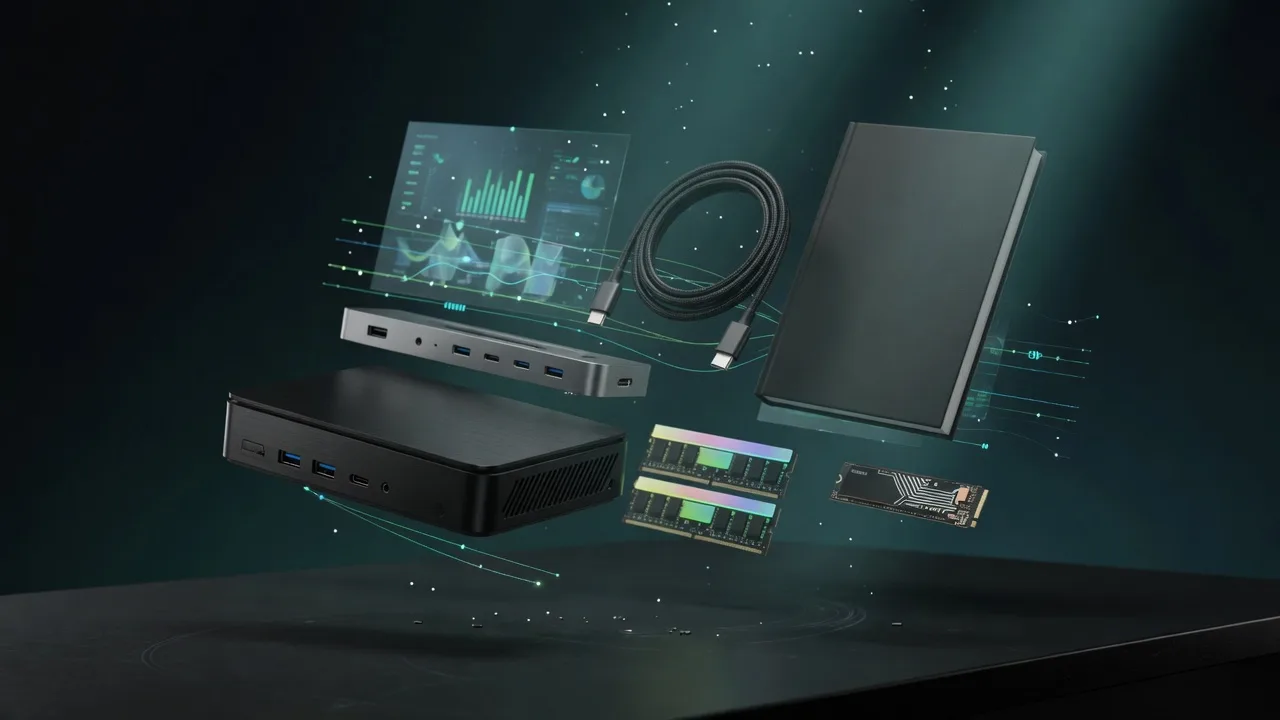
Docks, fast storage, cables, and a UPS sized for a local AI machine.
Rent this class of GPU by the hour before you buy. Live prices from RunPod and Vast.ai.
Find the break-even between buying this hardware and paying for a cloud API.
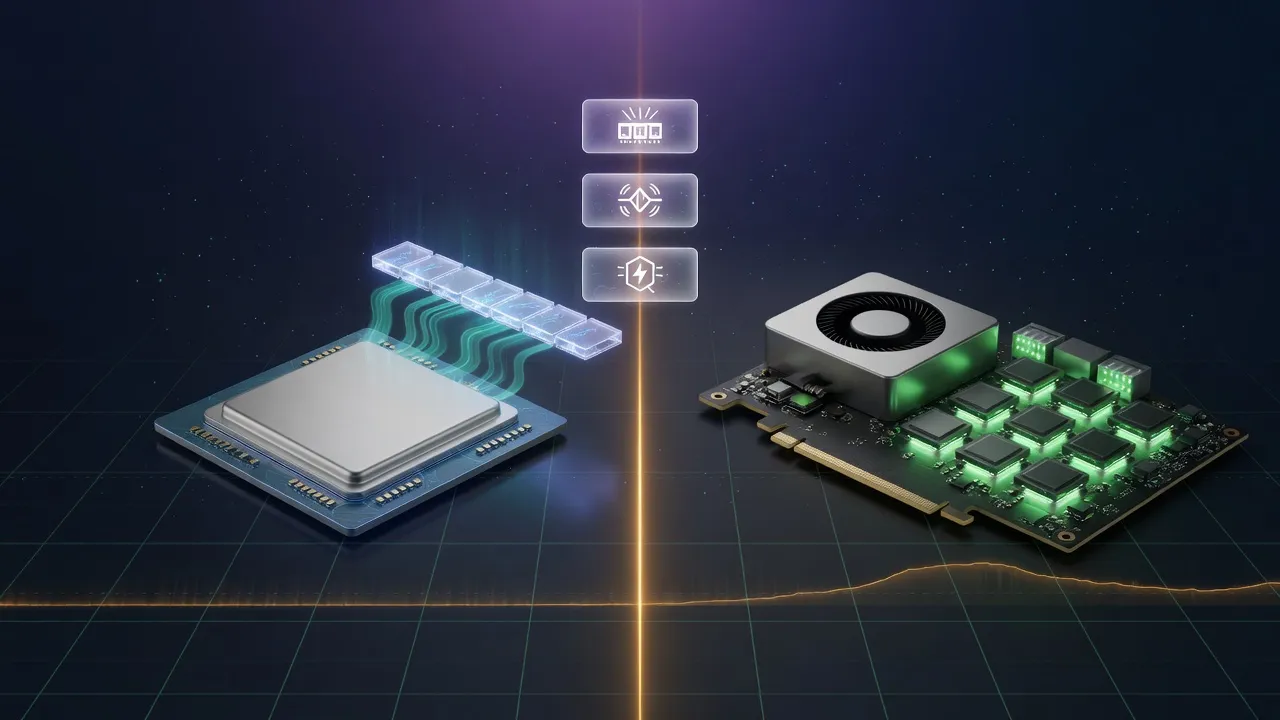
Mac vs NVIDIA for local inference, if you are still choosing a platform.
