- Services
Advertising disclosure: we earn commissions when you shop through the links below.
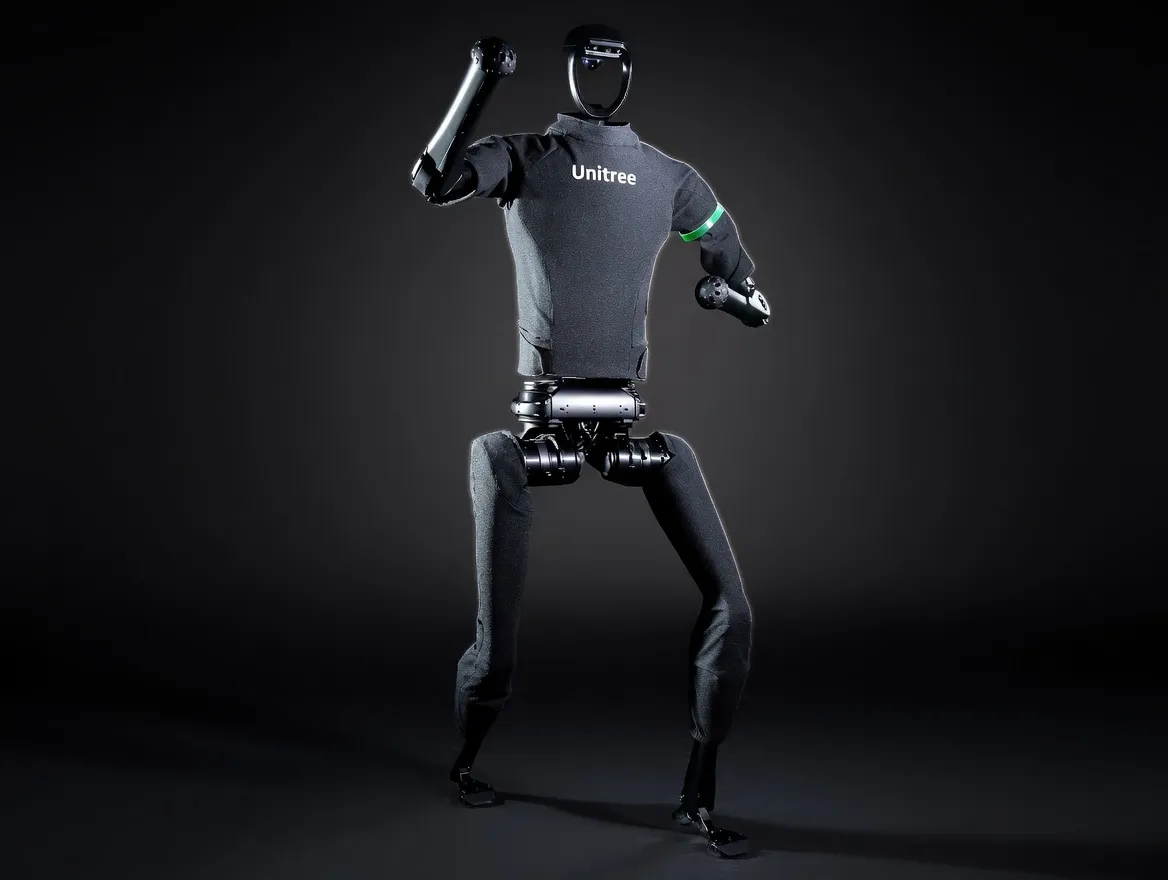
Unitree H1 is a full-size general-purpose humanoid robot from Unitree Robotics, built for industrial and service work. It stands about 180 cm tall, weighs about 47 kg and moves at up to 3.3 m/s with a peak knee joint torque of 360 N.m. Sensing uses 3D LiDAR plus a depth camera for 360 degree coverage, and the 864 Wh battery is quickly replaceable. Control compute is an Intel Core i5 or i7, with an optional Nvidia Jetson Orin NX, and the robot is listed at $90,000.
Manufacturer's suggested retail price. Current prices can be higher or lower. This is not a live price.
The Unitree H1 is an industrial-grade, full-size bipedal humanoid robot developed by Unitree Robotics. Standing approximately 180 cm tall and weighing roughly 47 kg, the platform is engineered specifically for dynamic locomotion research, whole-body reinforcement learning, and embodied AI workloads. Positioned in the enterprise and advanced robotics research tier at an MSRP of $90,000, it provides a physical body for practitioners developing autonomous agents that interact directly with the real world. While general indices sometimes catalog this robot under Unknown hardware for AI development, the H1 is an active, orderable system with an established footprint in academic and industrial AI labs.
Unlike stationary edge inference boxes, evaluating the Unitree H1 for AI workloads requires balancing mechanical power with onboard computation. The chassis pairs high-power M107 joint motors (delivering 360 N.m of peak knee torque) with a 25 kg payload capacity and a top movement speed of 3.3 m/s. For AI teams, the mechanical body acts as an actuator for neural network policies: real-time sensor streams feed directly into control algorithms that stabilize locomotion, map environments in 3D, and execute spatial manipulation.
To deploy agentic workflows onto the H1, engineers must understand the separation between the low-level motor controller and high-level edge inference. The robot ships standard with an Intel Core i5 processor for core kinematics and basic sensor aggregation, but offers an optional Intel Core i7 or an Nvidia Jetson Orin NX module for edge acceleration. This compute split dictates whether your vision-language-action (VLA) models run locally on the chassis or over a low-latency network link to an external workstation.
The H1 relies on a dual-tier compute and sensing architecture. Locomotion, sensor fusion, and high-level reasoning share power from an onboard 864 Wh swappable battery pack (15 Ah, 67.2 V). The sensor payload includes a 360-degree 3D LiDAR unit mounted in the head assembly paired with depth cameras, which continuously stream spatial point clouds and high-frame-rate RGB-D data.
For teams running local AI inference on the robot itself, configuring the optional Nvidia Jetson Orin NX compute module is essential. As the best AI chip for local deployment within small form-factor robotics, the Orin NX provides the following performance profile:
The 102.4 GB/s memory bandwidth is the primary bottleneck for onboard generative models. While the Orin NX provides sufficient compute for low-latency visual odometry, SLAM, and real-time gait stabilization networks, Unitree H1 VRAM for large language models is strictly capped at what fits within the 16GB memory ceiling. Because this 16GB pool must also accommodate the Linux operating system, ROS2 nodes, LiDAR processing, and camera buffers, approximately 10GB to 11GB of VRAM remains accessible for user-deployed AI models.
Unitree H1 AI inference performance depends heavily on whether models run self-contained on the optional Orin NX or via an offboard compute tether.
Deploying a Unitree H1 local LLM directly onto the robot requires aggressive quantization and compact parameter counts. The unified 16GB memory constraint limits onboard execution to small language models (SLMs), compact vision models, and quantized VLA architectures:
llama.cpp. Llama 3.2 1B fits in roughly 1.5GB of VRAM, leaving ample room for perception stacks. Llama 3.2 3B requires roughly 2.5GB to 3GB. Unitree H1 tokens per second on the 3B model hover between 30 and 45 tokens/second, which is fast enough for dynamic voice interaction and low-latency planning loops.Practitioners searching for hardware for running 70B parameter models will find that the H1 cannot host large foundation models like Llama 3.1 70B or DeepSeek-R1 onboard. Running a 70B parameter model at 4-bit quantization requires at least 40GB to 48GB of VRAM, far beyond the physical capability of an Orin NX.
Instead, the standard architecture for complex agentic workflows pairs the H1 with an edge workstation or on-prem cluster via Wi-Fi 6 or ultra-wideband DDS. In this configuration, the offboard server runs the 70B parameter model or an agentic framework (such as LangGraph or AutoGen) to formulate high-level task plans. The plan is passed as discrete actions or waypoints to the robot, where the onboard Intel or Nvidia processor translates those directives into real-time whole-body joint commands.
At $90,000, the Unitree H1 is an enterprise and academic platform rather than a consumer setup for hobbyists running local chatbots. It is designed for:
The H1 is built strictly for dynamic movement and inference, not onboard training. Model fine-tuning or policy training must take place on dedicated data center hardware before exporting to ONNX or TensorRT engines for the robot's onboard control computer.
Evaluating the Unitree H1 against other enterprise bipedal systems highlights distinct trade-offs between dynamic agility, manipulation readiness, and compute capacity.
Agility Robotics Digit is designed directly for industrial material handling and tote movement in logistics centers.
Unitree also offers the smaller G1 humanoid, creating an internal tradeoff for AI development teams:
For engineers seeking the best hardware for running AI models locally within an embodied physical platform, the Unitree H1 remains an exceptional, high-torque dynamic research chassis, provided your architecture offloads high-parameter foundation models to a networked workstation.
The top models this device can run at 4-bit, ranked by fit and speed.
Specs not available for scoring. This product is missing VRAM or memory bandwidth data.
Also in Our Store
Docks, fast storage, cables, and a UPS sized for a local AI machine.

Rent this class of GPU by the hour before you buy. Live prices from RunPod and Vast.ai.

Find the break-even between buying this hardware and paying for a cloud API.
Mac vs NVIDIA for local inference, if you are still choosing a platform.