- Services
Advertising disclosure: we earn commissions when you shop through the links below.
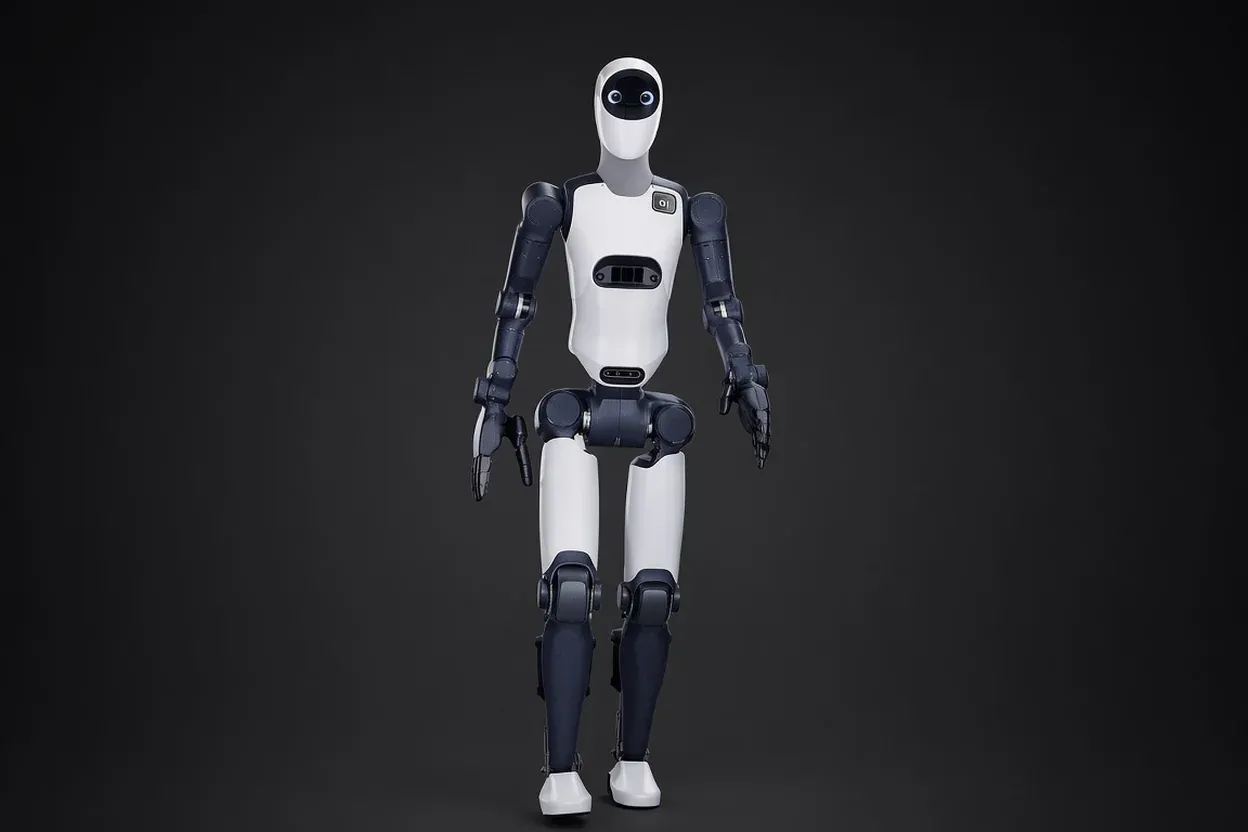
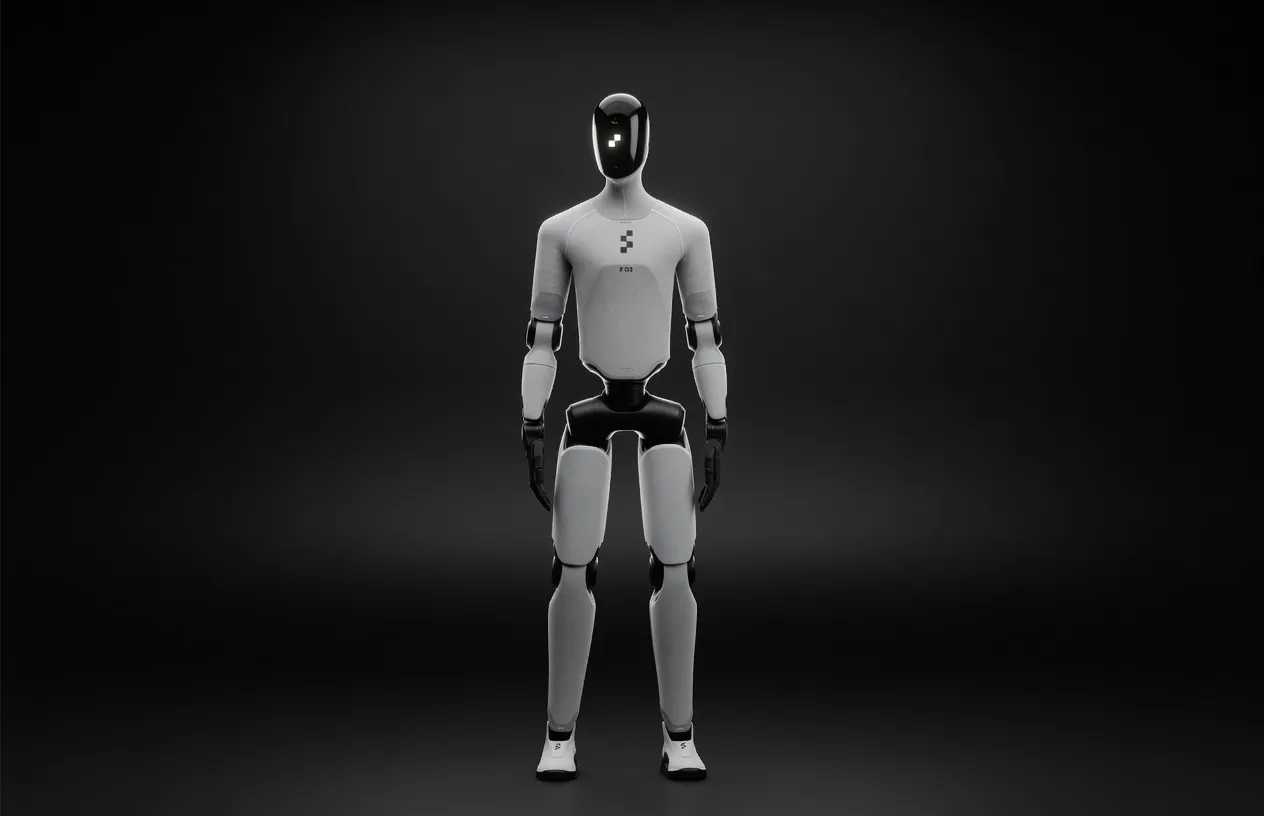
XPENG IRON is a general-purpose humanoid robot unveiled at XPENG AI Day on November 25, 2026. It stands 170 cm tall, weighs 62 kg and has 76 degrees of freedom, with more than 1,500 full-body tactile points and 720-degree panoramic perception. It runs XPENG's Turing Physical AI Architecture VLA 3.0 on three in-house Turing chips delivering 2,250 TOPS of local compute, and it is the first mass-production robot to use an all-solid-state battery. XPENG plans hardware mass production in January 2027, store assistant training in Q1 2027 and an official public launch in Q2 2027, with no price announced yet.
XPENG IRON is an embodied physical AI platform engineered for real-time edge intelligence and autonomous manipulation. Unveiled at XPENG AI Day, the humanoid robot serves as a production vehicle for XPENG's proprietary silicon and edge-native model architectures. Built around a high-strength steel and magnesium-aluminum alloy skeleton wrapped in bionic skin, the 170 cm, 62 kg machine pairs 76 degrees of freedom with an onboard compute node delivering 2,250 INT8 TOPS. Rather than relying on cloud streaming for basic motor control and cognitive planning, IRON executes its physical perception and action loops fully on-device.
For engineers and researchers evaluating XPENG IRON for AI workloads, the system represents an extreme edge computing deployment. It shifts the paradigm away from centralized data center clusters toward localized, low-latency execution of Vision-Language-Action (VLA) pipelines. Driven by three proprietary Turing processors and backed by an all-solid-state battery system, IRON operates on a "strong edge, weak cloud" philosophy. Cloud connectivity is reserved for fleet telemetry and asynchronous knowledge synchronization, while spatial perception, pathing, tactile feedback, and natural language interaction execute locally.
As enterprise teams explore the best hardware for local AI agents 2026 and beyond, IRON enters the space not merely as mechanical hardware, but as a tightly coupled hardware-software co-design. It merges physical actuation with multimodal intelligence, establishing a direct competitor to proprietary embodied platforms like Tesla Optimus, Figure 02, and custom industrial robotics rigs driven by off-the-shelf industrial compute modules.
Evaluating XPENG IRON AI inference performance requires looking closely at the tri-chip Turing compute cluster powering the robot. Generating high-frequency actuation commands alongside visual scene processing demands predictable latency without thermal throttling.
When seeking the best AI chip for local deployment, practitioners must evaluate raw throughput against strict thermal envelopes. Delivering 2,250 TOPS on an internal solid-state power budget gives the platform sufficient headroom to process spatial camera feeds at 60 Hz while running tactile feedback loops at hundreds of Hertz. The specialized Turing architecture prioritizes INT8 and low-precision INT4 matrix multiplication, allowing rapid feature extraction from multi-view video feeds without saturating memory busses.
Running an XPENG IRON local LLM or VLA requires balancing spatial navigation with multi-modal reasoning. Because this is dedicated edge silicon rather than an open-ended server rack housing 80GB enterprise GPUs, the software stack targets edge-native foundation models optimized via structured quantization and attention compression.
XPENG deploys its own Iron model family natively on this hardware, including IronLLM-0.6B and IronViT 1.0. IronLLM-0.6B leverages a hybrid attention backbone and X-MTP (shared-KV multi-token prediction) to eliminate per-depth KV-cache replay. On the Turing cluster, this lightweight model decodes at exceptionally high speeds, often yielding an XPENG IRON tokens per second rate exceeding 120 tokens/sec for pure dialogue and task routing.
For open-source foundation models, the local compute architecture handles compressed models cleanly:
Practitioners looking for hardware for running 70B parameter models will find that XPENG IRON is not engineered for standalone 70B or 405B parameter dense models like DeepSeek-R1 70B or Llama 3.1 70B. Even at aggressive INT4 quantization, a 70B parameter network demands approximately 35GB to 40GB of dedicated high-speed VRAM strictly for weights, plus substantial overhead for long-context KV caching.
Because onboard memory is heavily partitioned across safety-critical motion controllers, real-time visual perception buffers, and tactile arrays, XPENG IRON VRAM for large language models is optimized for sub-10B parameter real-time planners. When complex chain-of-thought operations or massive knowledge retrieval tasks are needed, IRON leverages its "weak cloud" link, offloading heavy reasoning passes to datacenter instances while maintaining local physical safety boundaries on the Turing silicon.
XPENG IRON is targeted at commercial automation, retail environments, and enterprise edge development. It bridges the gap between software-only agents and the physical world.
Evaluating XPENG IRON vs competitors requires comparing integrated humanoid hardware stacks rather than isolated desktop cards. While teams using unknown hardware for AI development often assemble custom wheeled bases with NVIDIA Jetson Orin modules, purpose-built humanoids represent a cohesive alternative.
Tesla Optimus relies heavily on Tesla's custom vision foundation models running on custom onboard compute derived from its autonomous driving hardware. Optimus features 22 DoF hands with tactile fingers, closely matching IRON's 21 to 22 DoF per hand and 76 total DoF. However, XPENG differentiates IRON by standardizing on an all-solid-state battery architecture and publicizing a distinct tri-chip Turing compute layout delivering 2,250 INT8 TOPS. XPENG's transparent work on IronLLM-0.6B demonstrates an edge-native approach focused on fast multi-token verification, while Tesla continues to keep its internal network runtimes and memory allocations strictly proprietary.
Figure 02 relies on dual onboard compute systems paired with specialized low-latency perception suites, using custom high-bandwidth inference engines along with OpenAI-backed multimodal models for high-level speech and action planning. Figure 02 excels in warehouse logistics and industrial assembly lines. XPENG IRON matches this industrial readiness with high-strength structural engineering (steel and magnesium-aluminum skeleton) while positioning itself earlier into commercial retail environments. For developers assessing the best hardware for running AI models locally in the physical realm, IRON's 1,500 tactile sensing points and unified VLA 3.0 pipeline offer an alternative that prioritizes sub-billion-parameter edge models over heavy cloud reliance.
The top models this device can run at 4-bit, ranked by fit and speed.
Specs not available for scoring. This product is missing VRAM or memory bandwidth data.
Also in Our Store
Docks, fast storage, cables, and a UPS sized for a local AI machine.