- Services
Small local AI models for business buy you privacy and data independence, not lower bills. The five levels of data control, plus four apps I built.
📝 Audio Version
Why Small Local AI Beats the Giants
The biggest misconception about local AI is that the goal is running the newest frontier model on your own hardware to get out of paying for an API. That is the least interesting version of the idea, and the math almost never works. Small local AI models for business are the version that does work: one model that does one job well, running on hardware you already own, where no outside provider ever sees a single one of your tokens.
I build these for clients and for myself. This post is the honest version of the argument. Why the cost case falls apart, what you get instead, the five levels of data control you can choose between, and four apps I have built this way.
The real advantage of running AI locally is data independence, not lower cost. A model on your own machine cannot leak what it has no way to send. You get privacy by architecture instead of privacy by policy, plus offline operation, no rate limits, and no vendor who can change the terms or deprecate the model you built on.
That is a different promise from "cheaper than the API", and it holds up in the cases where the cost promise does not. If your data legally cannot leave your control, the price per million tokens stops being the deciding number.
This is not a fringe setup either. F5 surveyed enterprise IT and security leaders and found 78 percent of organizations run AI inference themselves, with only 8 percent relying exclusively on public AI services 1. Most companies are already somewhere on this spectrum. They just have not thought about where.
Because you are trying to out-spend companies whose entire business is buying compute. The frontier models get bigger every few months, memory has become dramatically more expensive rather than cheaper, and the entry price for a machine that can hold one of these models keeps climbing.
Take the largest open-weight model you can download right now. Kimi K3 shipped its weights at the end of July 2026 at 2.8 trillion total parameters, with 104 billion active 2. Unsloth publishes the memory requirement for each of its quantized builds, and the numbers are the whole argument in one table. The 4-bit build is 1,510 GB. Even the 1-bit build, where quality has visibly degraded, is 594 GB 3.
One correction to how this usually gets quoted, including by me in the video. That is not pure VRAM. Unsloth's own guidance is that your RAM plus VRAM should roughly equal the quant size 3, so you can spread it across system memory. It does not help much. A maxed-out 512 GB Mac Studio still cannot hold the 1-bit version.
Now price the machine. You are not in laptop territory. You are in "several cards and a rack" territory, and you are shopping in the worst memory market in decades.
This is the part that changed since most local-AI cost guides were written. DRAM industry revenue rose 81 percent quarter over quarter in the first quarter of 2026 as contract prices surged 4. Memory and storage went from 15 to 18 percent of a laptop's bill of materials to around 35 percent in a single quarter, and Gartner expects the combined DRAM and SSD surge to push PC prices up roughly 17 percent against 2025 with no relief until late 2027 5.
Apple raised Mac and iPad prices by up to $300 in June 2026 because of it. Tim Cook called it a hundred-year flood and said he had never seen anything like it in over 40 years 6.
Buying memory to hold a model is the single worst thing you could be doing with your budget in 2026.
Put real numbers in and it stops being a matter of opinion. I built a local AI ROI calculator for exactly this, so here is a run through it.
Say the hardware costs $15,000 to $20,000. Say it draws 1,000 watts, you are a heavy user, and you pay $0.30 per kilowatt hour. Give it a 48-month horizon, because after four years you are replacing it anyway. Compare that against $300 a month of subscriptions, which is a $200 plan plus a $100 plan.
Inside that horizon you do not reach return on investment. The $300 a month stays cheaper, because it takes a very long time to pay off the hardware. There is a self-host versus rent versus API calculator on the site too, where you can pick a specific device and a specific API model and run the comparison on your own numbers.
I said in the video that your hardware quietly depreciates while you wait. That turned out to be wrong in an interesting way, and it is worth correcting. In this market, GPUs have appreciated. A used RTX 4090 was listing between $2,268 and $2,500 in August 2026 against a $1,599 launch price, making it the first flagship card in fifteen years to gain value after its successor arrived, and used RTX 50-series cards were listing within 14 percent of new 7.
So the resale argument is currently in favour of buying. The conclusion does not change, because the same shortage raised what you pay to get in. You are not losing money on the asset, you are just paying far too much for it to make the token math work.
None of this means local AI is a bad idea. It means saving money is the wrong reason to do it.
Run a small, focused model instead. Something in the 0.5 to 3 billion parameter range, which fits comfortably on hardware you already have.
The models to do this with arrived recently and quietly. Alibaba released the Qwen3.5 Small series in March 2026, from 0.8 billion parameters up to 9 billion, built specifically for on-device use 8. The 0.8B needs roughly a gigabyte of memory to load, supports function calling, and carries a 262K context window. That runs on a laptop, on a Mac Mini, on a small company server, and honestly on an old Android phone.
The formula is simple:
Local AI does not need to be as smart as a frontier model. It needs to be reliable, private, and always available. A model that extracts fields from a contact record, or turns a sentence into a SQL query, or transcribes a meeting, is not doing open-ended reasoning. It is doing a bounded task, over and over, on data you would rather not hand to anyone.
Gartner expects that by 2027 organizations will use small, task-specific models at three times the volume of general-purpose large language models 9. That is the direction, and it is the opposite of the one the "run the frontier model yourself" crowd is pointing in.
If you want to know what your specific machine can run, the hardware calculator takes a device and a parameter range and gives you the model options with rough speed estimates based on memory bandwidth.
Most writing on this treats privacy as a switch: local is private, cloud is not. It is a spectrum, and when I architect a system I place each part of it on that spectrum deliberately. Not everything has to sit at the top, and some things cannot.
From most private to least:
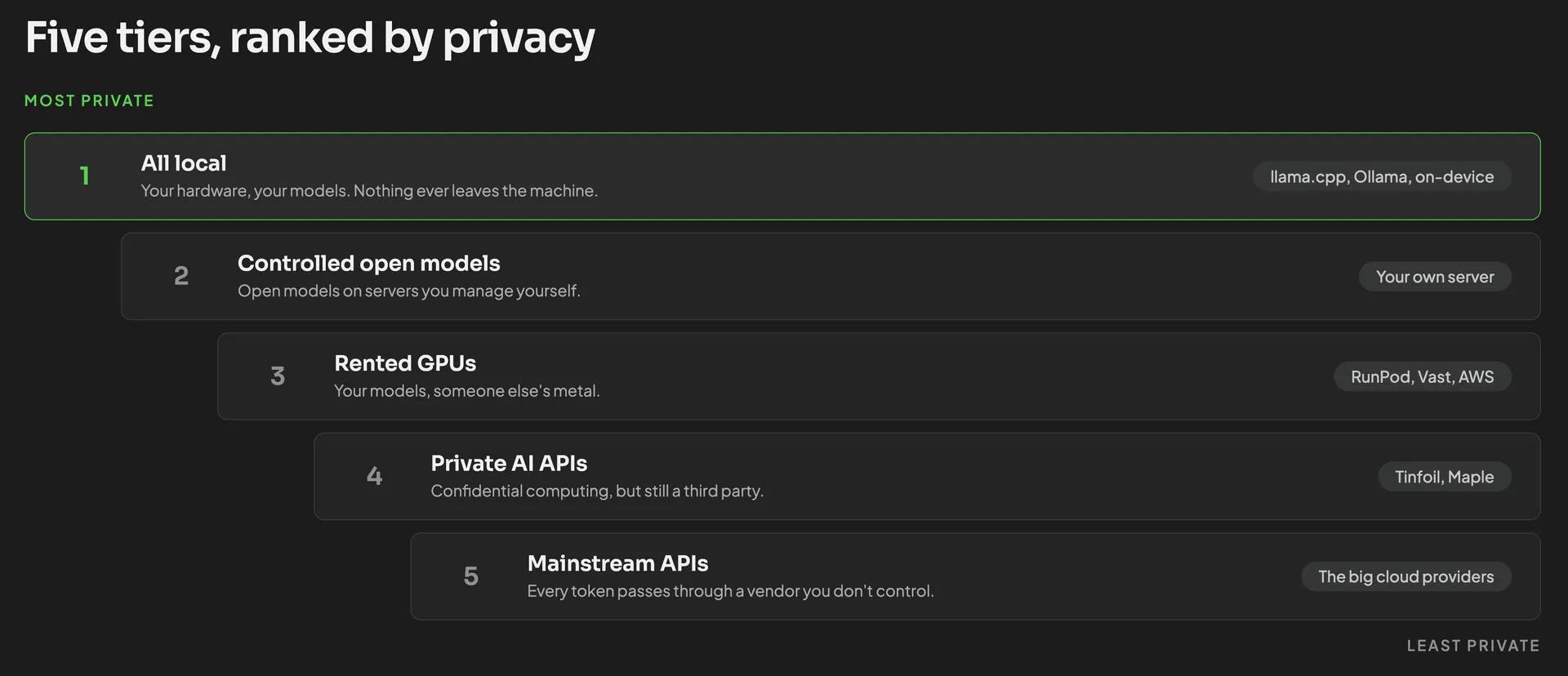
Most real systems end up mixed. The part that touches customer records sits at level one or two. The part that needs genuine reasoning over public information can sit at level five. Deciding that per component, rather than once for the whole product, is the actual skill.
It is worth knowing what level five costs you in practice. Netskope's threat labs measured an average of 223 data policy violations per month per organization involving generative AI apps, with the worst quartile at around 2,100 a month, and regulated data accounted for 48 percent of those violations 10. Nearly half of the people using AI at work were doing it through personal accounts. The leak is rarely the provider misbehaving. It is your own staff pasting things into a tab.
Worth saying plainly, because people conflate them constantly, and I want to be fair to the counterargument.
Running a model locally solves the disclosure problem. Nobody outside sees your data. It does not make the model trustworthy or your setup safe. A local model can still be prompted into doing the wrong thing by text it reads, and if you have given it the ability to write to your database or call your tools, a bad instruction is a bad instruction whether the weights are on your laptop or in Virginia.
Cisco's 2026 privacy benchmark, which surveyed over 5,200 professionals, found that 86 percent still believe locally stored data is inherently more secure, down from 90 percent the year before 11. That belief is doing a lot of unearned work. Local is more private. Secure is a separate job that you still have to handle.
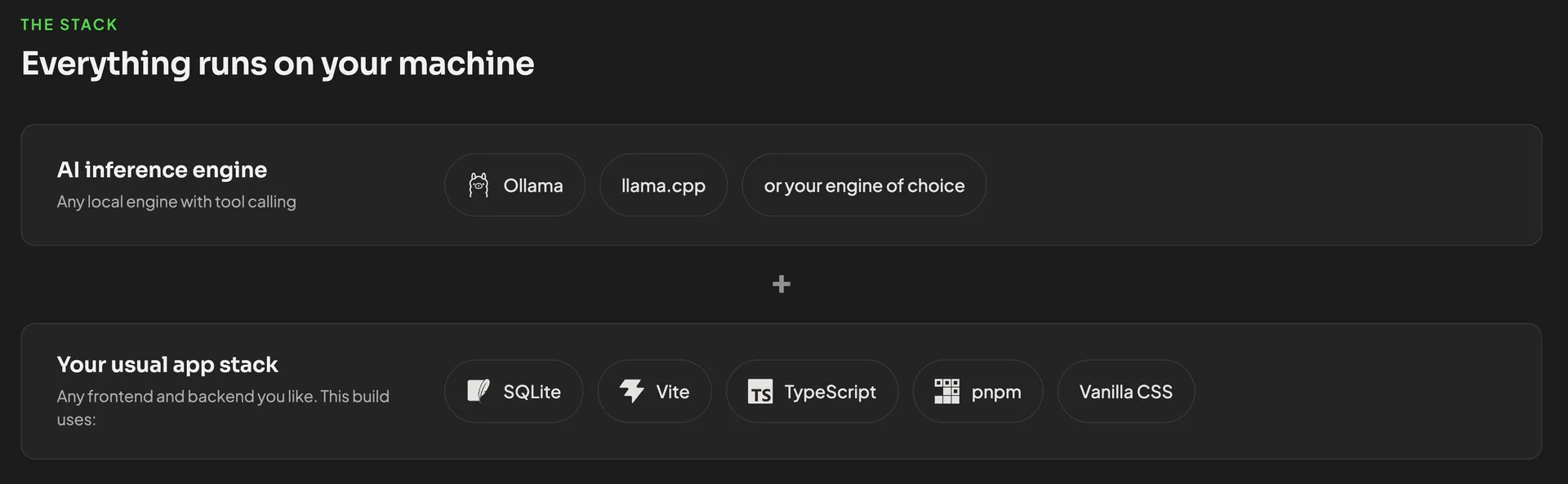
There is exactly one new component. You need something that loads the weights and serves them over HTTP on your machine. That is the inference engine. Ollama is the easiest way in, llama.cpp gives you more control, and there are others that suit different hardware. The site has an inference engine directory with filters and a side-by-side comparison if you want to see the tradeoffs.
Everything else is a normal application. Your usual frontend, your usual backend, your usual database. The engine exposes an endpoint, your backend calls it. Nothing about the rest of the stack changes, which is the part people do not expect.
Size is not the thing to optimize. Capability is. For a natural language to SQL app I need two things: the model has to support tool calling, and it has to be decent at writing SQL. A tiny generalist has neither, and no amount of clever prompting fixes it.
There is good measurement on this now. A 2026 study ran open models of different sizes against BIRD, a text-to-SQL benchmark built on real databases, and the returns flatten fast. A 7B code model scored 39 percent, a 32B scored 50 percent, and the jump from 14B to 32B bought only three points. The author's conclusion was that generation matters more than raw size 12. Choosing a model trained for code beats choosing a bigger model.
I deliberately used one of the smallest models I could find for my prototype, just to show how far a 1 GB model gets you. It was the wrong choice on the merits. Going up a couple of gigabytes to something built for code buys a lot of reliability. The model directory has a wizard for this: say you want something good at coding, low on memory, and fast, and it narrows the list.
One more thing if you are on Apple Silicon. Look for the MLX build of a model rather than the generic one. It is compiled for the hardware and runs noticeably faster.
If your app cannot reach the local server, this is almost always why. In Ollama's settings there is an option to expose Ollama to the network. It is off by default. Turn it on, or your application will fail to connect.
Now the warning that belongs next to that instruction. "Expose to the network" means exactly what it says, and people get it wrong at scale. Cisco Talos went looking and found 1,139 vulnerable Ollama instances reachable from the open internet, which they described as widespread and largely unmitigated exposure 13. An inference server with no authentication in front of it is an open door to your hardware and whatever that model can reach. Bind it to your local network, put it behind your own auth, and never point it at the public internet.
These are not hypotheticals. The pattern is the same in all four: narrow task, small model, data that stays private.
I prototyped a natural language to SQL tool over a business database. You type "inventory below reorder level" and you get the table. There is a toggle that shows the SQL the model wrote, which you can edit and re-run, plus a chart view you can export as an image. Ask for orders by status and you see what is shipped, processing and pending. There is also a browse view over the raw tables, which is how you work out what to ask next.
The privacy argument here is sharper than people realize. It is not only the query results that stay local. Your database schema stays local too, and a schema is a fairly complete description of how your business works. Sending that to a third party to get a SELECT statement back is a strange trade.
This one has a real production precedent at serious scale. The team behind Dream11, a fantasy sports platform with over 250 million users, replaced a hosted frontier model with a fine-tuned Qwen 3 8B running on their own GPUs. Execution success went up, not down, from 95.6 to 98.4 percent, and they cut their prompt from around 17,000 tokens to under 100 by moving the schema knowledge into the model itself 14. A small self-hosted model beat the cloud model on the actual metric.
Be honest about the limits: small models handle straightforward and moderately complex queries well and get shakier on deep multi-join questions.
I built a simple CRM for myself where you paste in messy contact data and a local model pulls it apart into the right fields. With enrichment turned on it then fills the gaps it can find, so a name and a company become a title, a LinkedIn URL, a website, a location, a bio.
It does not find everything. Testing it on two famous names, it got title, profile, site, location, bio and company, and no email or phone for either. That is the correct outcome for public figures, and it tells you something useful about what enrichment can and cannot do.
Customer data is probably the last thing you want a third party reading and processing at volume. This is a high-count, low-difficulty job on your most sensitive records, which is the textbook case for keeping it in-house. It is also the shape of job where a small model is dramatically cheaper: one measured comparison put fine-tuned small models at around $3 per million requests against roughly $6,200 for a frontier model on the same work 15.
The prototype here is a dashboard for an industrial manufacturer that you drive with text or speech. "Create a sales order for pneumatic clamp modules for Volterra Labs." "How many open orders do we have?" "Search the inventory for hydraulic." It creates the order, answers with the number, runs the search.
It also gets things wrong. I asked it for servo brackets and it told me the product did not exist, because it did not, and I was still running the deliberately undersized model. Models are probabilistic and that does not go away. Small models in particular degrade sharply once a task needs several dependent steps rather than one 16. For anything that writes to your database, validate the command against real records first and show the user what you are about to do.
Voice does not need a special integration either. I use a local speech-to-text model on my Mac and talk into whatever text field is in front of me.
Speech-to-text runs well on ordinary consumer hardware, which makes local meeting transcription one of the easiest wins on this list. Record, transcribe, summarize, all on the machine, no third party in the loop and no question about where the recording of your board meeting went. I built a private speech-to-text app for a client on this basis, called Echos, and it is on the App Store and Google Play.
Documents are the same shape of problem. I have a whole walkthrough on local OCR pipelines, using Docling to pull structured content out of invoices, contracts and even handwriting. The models here are genuinely tiny: IBM's Granite-Docling is 258 million parameters, and IBM's own claim is that it rivals systems several times its size 17. Sensitive documents, bounded task, nothing leaves.
The honest column. Local AI is not free, it just moves the bill.
A short rule that covers most cases:
You do not have to pick once for the whole system. Pick per component.
The market is already moving this way. Open-weight models went from 11 percent of the tokens running through Vercel's AI gateway in April 2026 to 29 percent in June, at under 4 percent of total spend 18. Cheap models doing narrow work is where the volume is going, even when somebody else is hosting them.
Privacy beats raw intelligence for a surprising number of real business jobs, and the speed of a small model on modern consumer hardware is closer to a cloud API than you would guess.
So do not start by trying to run the biggest model you can find. Take one job you would rather not send to a third party, give it the smallest model that can actually do it, and see how it holds up for a week. That is a much better test of whether local AI belongs in your product than any calculator.
About the author

Tobias Wupperfeld
Tobias is an independent AI engineer and operator who has shipped AI systems inside startups and scale-ups across fintech, procurement, engineering, and more. He runs Made By Agents focused on agentic coding and consults for companies, where he leads AI integration across processes and product lines.
Keep Reading
We write about coding agents, multi-agent systems, AI pair programming, and the engineering practices we use with clients. Hands-on lessons from real projects, not high-level theory.
Browse All Articles