- Services
Advertising disclosure: we earn commissions when you shop through the links below.
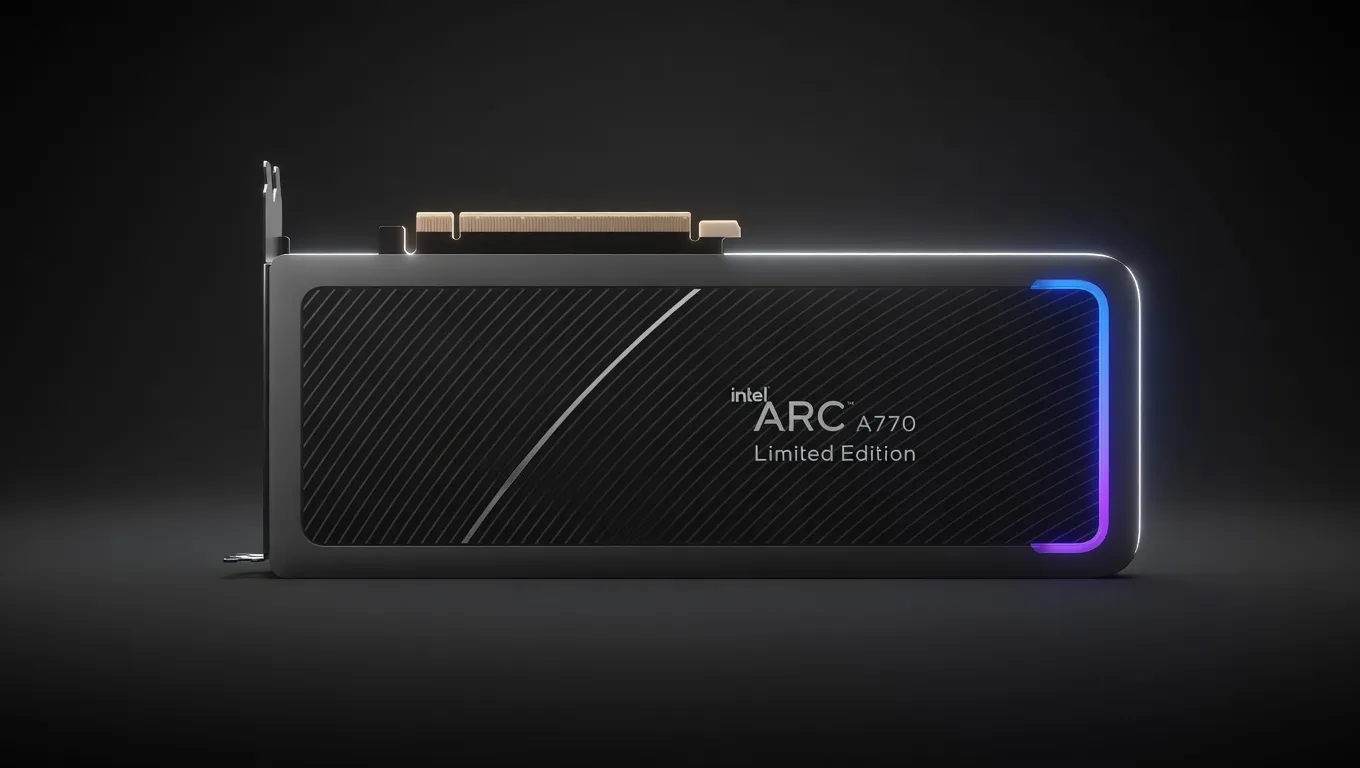
The ASUS UGen Arc Pro B70 is ASUS's first Intel Arc discrete graphics card, a 32GB workstation GPU aimed at local AI inference and professional workloads. It uses Intel's Xe2-based BMG-G31 die with 32 Xe cores and 256 XMX engines, rated at up to 367 INT8 TOPS with 608 GB/s of memory bandwidth. The dual-slot blower card supports up to four cards for 128GB of combined VRAM, which ASUS says can run models up to 120B parameters. ASUS has not announced pricing or a release date.
A 70B Q4 quant fits with usable context budget left over. Sweet spot if you want a single card that handles every open model worth running locally today.
Generated from this product’s spec sheet. Editor reviews refine it over time.
The ASUS UGen Arc Pro B70 32GB marks a strategic shift in workstation-class hardware for local AI workloads. Built on Intel's flagship Xe2 "Battlemage" architecture (the BMG-G31 die), this graphics card packages 32GB of GDDR6 memory with error-correcting code (ECC) into a compact, dual-slot blower form factor. Designed specifically for workstation multi-GPU clustering rather than desktop gaming, it addresses a persistent bottleneck for machine learning engineers: obtaining large pools of usable VRAM without paying the premium commanded by enterprise data-center accelerators.
For practitioners looking for the best hardware for running AI models locally, the UGen Arc Pro B70 occupies a distinct tier between high-end consumer cards and dedicated data-center silicon. Consumer cards typically cap out at 24GB of non-ECC memory and rely on bulky axial coolers that prevent multi-GPU density. In contrast, ASUS engineered this card for scale. Up to four cards can be installed side by side in a single workstation chassis, delivering a combined 128GB of VRAM and establishing it as serious hardware for running 120B parameter models across distributed local pipelines.
While software maturity on non-CUDA platforms remains an active consideration when evaluating hardware for AI development, Intel's open software ecosystem has made significant strides. Out-of-the-box support for the card spans vLLM via the Intel XPU backend, llama.cpp through SYCL and Vulkan, PyTorch via Intel Extension for PyTorch (IPEX), OpenVINO, and Ollama. This software foundation enables engineers to drop the card into automated agentic pipelines and local API servers without building runtime environments from scratch.
At the core of the ASUS UGen Arc Pro B70 is Intel's Xe2-HPG BMG-G31 processor operating at a boost clock of up to 2800 MHz. Compute is driven by 32 Xe cores and 256 dedicated XMX (Xe Matrix eXtensions) AI engines. Together, they output up to 367 INT8 TOPS and 22.94 TFLOPS of FP32 compute.
1+-----------------------------------+---------------------------------------+2| Metric | Specification |3+-----------------------------------+---------------------------------------+4| GPU Architecture | Intel Xe2-HPG (BMG-G31 "Battlemage") |5| Xe Cores / XMX Engines | 32 / 256 |6| Peak AI Throughput | 367 INT8 TOPS |7| FP32 Compute | 22.94 TFLOPS |8| Boost Clock | Up to 2800 MHz |9| VRAM Capacity & Type | 32GB GDDR6 with ECC |10| Memory Bus Width | 256-bit |11| Memory Bandwidth | 608 GB/s |12| System Interface | PCIe Gen 5 x16 |13| Total Board Power (TBP) | 310 W (Single 12V-2x6 connector) |14| Form Factor | Dual-slot blower |15| Multi-GPU Maximum | 4 cards (128GB combined VRAM) |16+-----------------------------------+---------------------------------------+
When evaluating ASUS UGen Arc Pro B70 32GB AI inference performance, memory bandwidth is the primary operational metric for LLM autoregressive token generation. The 256-bit memory bus pushes 608 GB/s. While this is lower than the memory throughput found on top-tier consumer GPUs with 384-bit buses, the 32GB VRAM footprint allows larger models to stay entirely on-chip, eliminating the severe latency penalties caused by system RAM offloading.
Power delivery is managed through a single 12V-2x6 connector rated for a 310W total board power. Because multi-GPU scaling is thermal-dependent, the rear-exhaust blower cooler pushes hot air directly out of the chassis. This thermal design keeps performance steady during sustained matrix calculations and continuous token generation runs across all cards.
Having a 32GB GPU for AI fundamentally changes which model architectures you can run on a single card without heavy quantization degradation. The ASUS UGen Arc Pro B70 32GB VRAM for large language models provides enough headroom to store both model weights and extended context windows.
On a single card, the memory ceiling comfortably accommodates dense models and mixture-of-experts architectures:
The single-card sweet spot is 8-bit quantized 14B models or 4-bit (Q4_K_M) 32B models. At these configurations, memory bandwidth saturation balances cleanly against compute speed, maintaining throughput above 20 to 30 tokens per second for real-time applications.
Clustering four UGen Arc Pro B70 cards across PCIe Gen 5 slots yields 128GB of addressable VRAM:
The UGen Arc Pro B70 is targeted at specific technical profiles rather than general consumers:
When evaluating the ASUS UGen Arc Pro B70 32GB for AI against the broader market, hardware planners typically cross-shop two alternatives: the NVIDIA GeForce RTX 4090 and the NVIDIA RTX 4000 Ada Generation.
The RTX 4090 delivers vastly higher raw compute and 1,008 GB/s of memory bandwidth, giving it faster per-token decode speeds on models that fit within its memory. However, the RTX 4090 is limited to 24GB of non-ECC memory and uses a three-slot to four-slot axial cooler that consumes 450W. You cannot place four RTX 4090 cards into a standard workstation chassis without custom liquid cooling loops. The Arc Pro B70 offers 33% more VRAM per card (32GB vs. 24GB), ECC reliability, and a dual-slot blower format optimized for 4-way density.
The RTX 4000 Ada is a workstation competitor featuring 20GB of ECC VRAM in a single-slot footprint with low 70W-130W power draw. While the NVIDIA card has the advantage of native CUDA maturity, it carries a high cost per gigabyte of VRAM and falls 12GB short of the B70's 32GB frame. The B70 provides significantly more memory headroom for large context windows and higher-parameter models at each node.
If your stack requires strict CUDA compliance, NVIDIA alternatives remain the default path. But for engineers leveraging OpenVINO, SYCL, vLLM, and open-source runtimes, the ASUS UGen Arc Pro B70 stands out as a high-density, memory-forward solution for multi-GPU local AI deployments.
The top models this device can run at 4-bit, ranked by fit and speed.
| Model | Grade | Speed | VRAM |
|---|---|---|---|
| LFM2.5-24B-A2BLiquid AI | SS | 109.0 tok/s | 17.0 GB |
| DiffusionGemma 26B-A4BGoogle | SS | 46.7 tok/s | 22.9 GB |
| Gemma 4 26B-A4B ITGoogle | SS | 44.4 tok/s | 23.8 GB |
| Nemotron 3.5 LightningNvidia | SS | 209.3 tok/s | 18.0 GB |
| North Mini CodeCohere | SS | 58.4 tok/s | 24.0 GB |
Among 5 similar devices, the ASUS UGen Arc Pro B70 32GB ranks #4 for memory and #4 for memory bandwidth.
Also in Our Store
Docks, fast storage, cables, and a UPS sized for a local AI machine.

Rent this class of GPU by the hour before you buy. Live prices from RunPod and Vast.ai.

Find the break-even between buying this hardware and paying for a cloud API.
Mac vs NVIDIA for local inference, if you are still choosing a platform.