- Services
Advertising disclosure: we earn commissions when you shop through the links below.
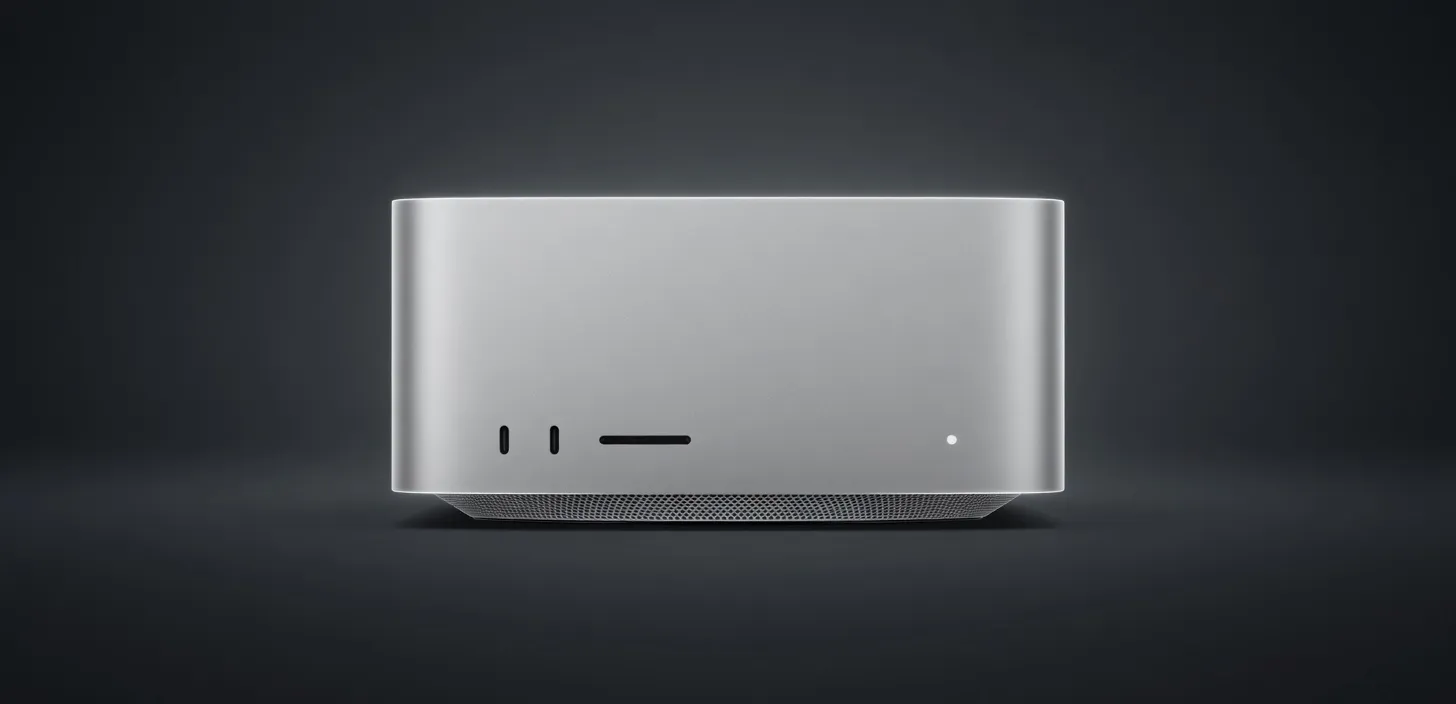
Apple's Mac Studio with M5 Ultra is a compact desktop announced on 25 August 2026 and shipping from 22 September 2026. It targets on-device AI inference and pro workloads, scaling to a 36-core CPU, an 80-core GPU with Neural Accelerators in every core, a 32-core Neural Engine, and up to 512GB of unified memory at 1.2TB/s bandwidth. It starts at $5,499 and includes Thunderbolt 5, Wi-Fi 7, and Bluetooth 6, and multiple units can be clustered over Thunderbolt 5 for distributed inference.
Manufacturer's suggested retail price. Current prices can be higher or lower. This is not a live price.
Sized for production serving of 70B–200B class models at full or lightly-quantized precision. Overkill for a homelab; right call when the workload pays for itself in token volume.
Generated from this product’s spec sheet. Editor reviews refine it over time.
The Mac Studio with M5 Ultra stands as a monumental shift in local machine learning hardware, providing single-box inference capabilities that previously required multi-GPU server nodes. Built around Apple's flagship silicon architecture, this compact desktop delivers up to 512GB of unified memory operating at a blistering 1.2TB/s memory bandwidth. With an entry MSRP of $5,499, the system eliminates the traditional memory wall faced by local AI practitioners, allowing full-scale frontier models to reside directly in system memory with zero offloading bottlenecks.
Positioned between high-end desktop workstations and rackmount enterprise servers, the system redefines what is possible on a local desk. Deploying the Mac Studio with M5 Ultra for AI tasks gives engineers and researchers the capacity to run, evaluate, and fine-tune large language models without depending on cloud APIs, metered infrastructure, or multi-thousand-watt power supplies. Whether evaluated independently or cataloged among Unknown hardware for AI development platforms, this desktop addresses the critical constraint in modern AI engineering: accessible, high-bandwidth memory capacity.
For engineers evaluating the best hardware for running AI models locally, the appeal of the M5 Ultra lies in its architectural efficiency. The unified memory pool acts functionally as a 512GB GPU for AI deployments, shared seamlessly across the CPU, GPU, and dedicated neural silicon. Coupled with Thunderbolt 5 support for native distributed clustering, it serves as a cornerstone platform for edge deployment, complex agentic workflows, and local LLM pipelines.
Evaluating hardware for machine learning requires analyzing the exact bottlenecks of modern neural networks: memory capacity, memory bus bandwidth, compute density, and interconnect latency. The Mac Studio with M5 Ultra targets each of these variables directly.
The M5 Ultra scales compute across multiple specialized engines designed to handle heterogeneous workloads:
In autoregressive token generation, performance is almost entirely memory-bandwidth bound. Every single token generated requires passing the entire active parameter set across the processor bus. The 1200 GB/s (1.2TB/s) bandwidth of the M5 Ultra ensures that large-scale parameters transfer at throughput speeds approaching dedicated enterprise accelerators.
Unlike traditional x86 workstations where model weights must be segmented over PCIe lanes across discrete cards, the Mac Studio with M5 Ultra VRAM for large language models operates as a unified, zero-copy pool. The entire 512GB allocation is addressable by both the 80-core GPU and the 36-core CPU. This architecture eliminates PCIe transfer overheads, out-of-memory driver crashes during model initialization, and complex tensor-parallelism configurations on single-node deployments.
For research teams requiring scale beyond a single box, the inclusion of four Thunderbolt 5 ports introduces high-speed peer-to-peer clustering. Mac Studio units can be linked over Thunderbolt 5 to pool compute and memory, delivering up to 3x faster performance for distributed AI inference when compared to a standalone workstation. This provides a clean scaling path for teams hosting local inference farms without investing in complex InfiniBand networking.
The massive 512GB pool changes the calculus for local model deployment, making this arguably the best AI chip for local deployment when dealing with massive parameter footprints.
As dedicated hardware for running 70B parameter models, the M5 Ultra operates with massive headroom. Models such as Llama 3.1 70B and Qwen 2.5 72B require roughly 140GB in unquantized 16-bit precision, or roughly 40GB to 48GB at 4-bit and 5-bit quantization.
Prior to 512GB unified workstations, running a dense 405-billion-parameter model locally was functionally impossible without a multi-GPU cluster costing tens of thousands of dollars.
The sweet spot for the M5 Ultra is 6-bit (Q6_K) and 8-bit (Q8_0) quantization. Because practitioners are not forced to compress weights to squeeze under the 24GB ceiling of consumer graphics cards, models retain near-unquantized perplexity scores. Furthermore, the 512GB capacity allows allocating 64GB or more exclusively to KV cache buffers, enabling 128k to 1M token contexts on large models without out-of-memory penalties.
The Mac Studio with M5 Ultra targets high-demand technical environments requiring autonomy, privacy, and low maintenance.
Developers building multi-agent systems require systems that can handle continuous, long-running agent loops. As the best hardware for local AI agents 2026, the M5 Ultra can host an unquantized 70B orchestration model, an embedding model, a vision-language model, and a vector database simultaneously without swapping memory to disk.
For legal, healthcare, and enterprise teams operating under strict regulatory compliance, cloud APIs are frequently non-starters. The Mac Studio functions as an air-gapped, on-premise inference server drawing less than 300W under peak load. It operates silently in an office setting, avoiding the high acoustic noise and dedicated 240V circuits required by enterprise server racks.
While the Mac Studio with M5 Ultra AI inference performance is exceptional, engineers should distinguish between inference and heavy pre-training:
Understanding the trade-offs of the Mac Studio with M5 Ultra vs multi-GPU PC workstations or enterprise server nodes is critical before capital allocation.
A standard custom AI workstation running four NVIDIA RTX 4090 cards yields 96GB of aggregate VRAM across four discrete pools, with roughly 1800W of system power draw and complex cooling requirements.
Pairing dual NVIDIA RTX 6000 Ada generation GPUs provides 96GB of enterprise VRAM at a hardware-only cost exceeding $14,000, excluding the host Threadripper platform.
The top models this device can run at 4-bit, ranked by fit and speed.
| Model | Grade | Speed | VRAM |
|---|---|---|---|
| minimax-m2.5MiniMax | SS | 42.6 tok/s | 22.7 GB |
| Mixtral 8x7B InstructMistral AI | SS | 85.0 tok/s | 11.4 GB |
| AliceAI-Foundation-80B-A3B-Baseyandex | SS | 113.2 tok/s | 8.5 GB |
| K2-Horizon-MoVA-36B-A4BInstitute of Foundation Models | AA | 49.3 tok/s | 19.6 GB |
| Holo4-27BHcompany | AA | 56.7 tok/s | 17.0 GB |
Among 6 similar devices, the Mac Studio with M5 Ultra ranks #1 for memory and #1 for memory bandwidth.
Also in Our Store
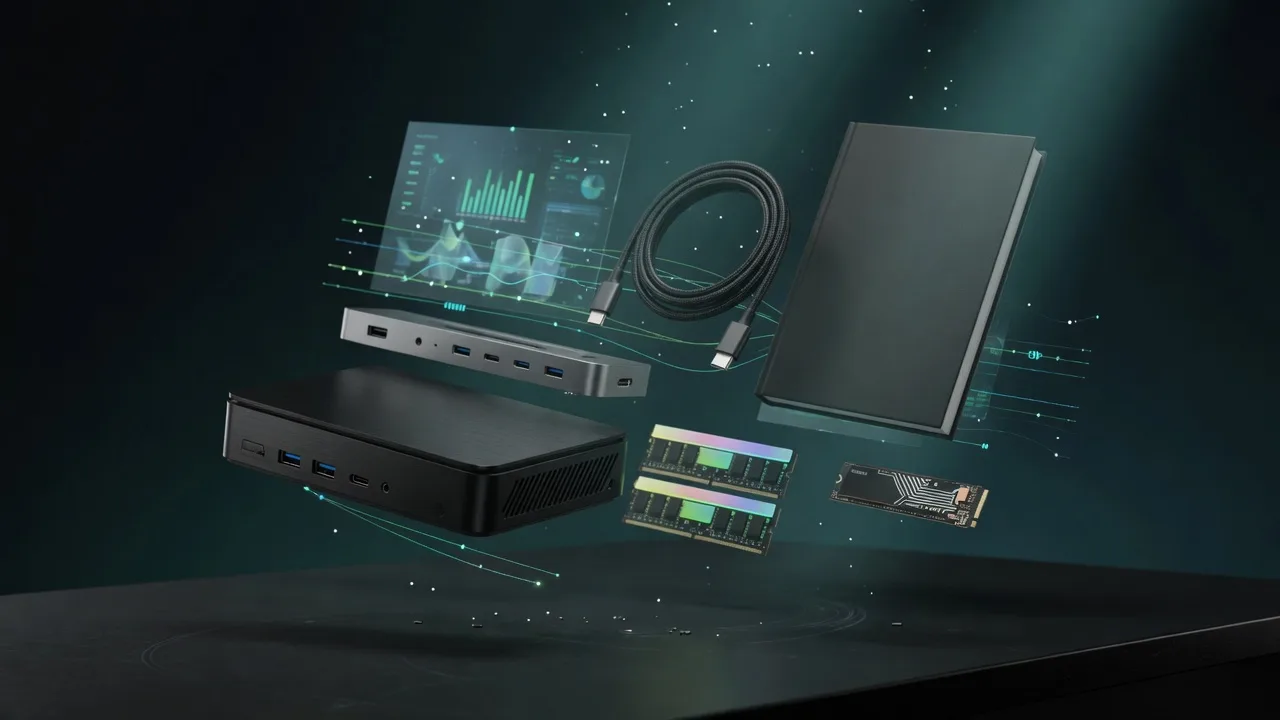
Docks, fast storage, cables, and a UPS sized for a local AI machine.

Rent this class of GPU by the hour before you buy. Live prices from RunPod and Vast.ai.

Find the break-even between buying this hardware and paying for a cloud API.
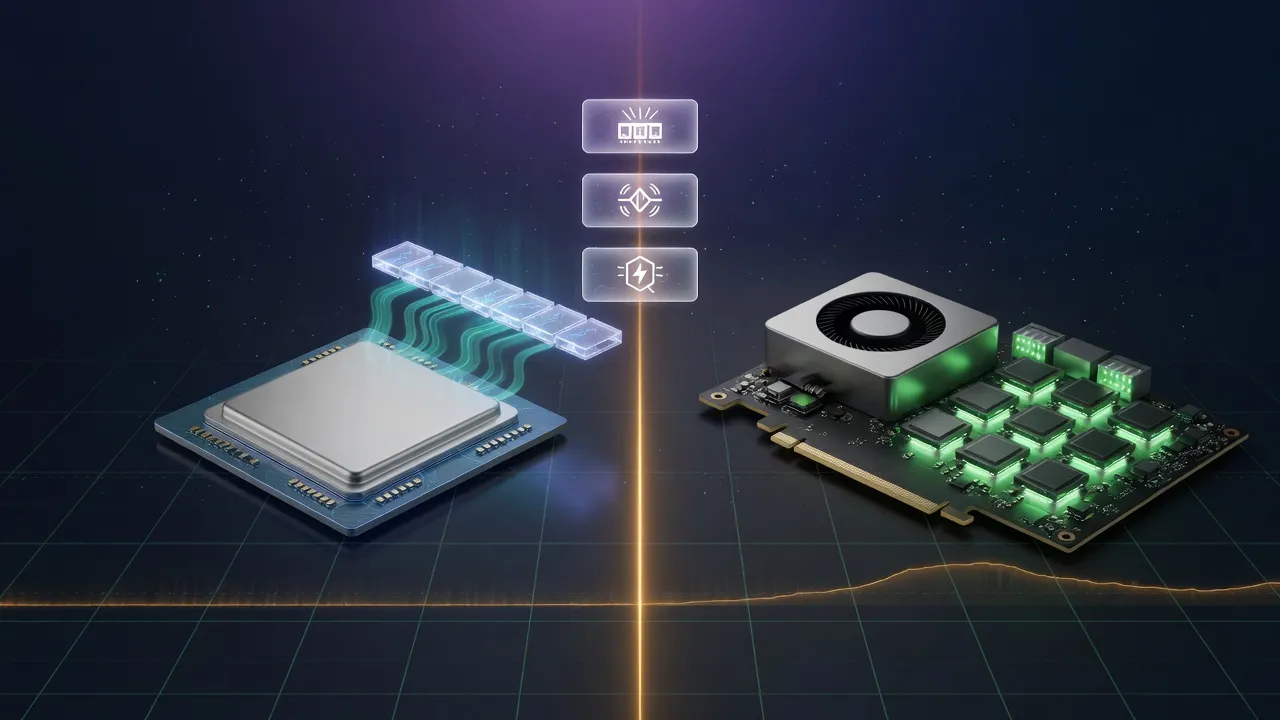
Mac vs NVIDIA for local inference, if you are still choosing a platform.