
- Services
Perplexity Decider Flash v1.3 is a small open-weight decision model built on Qwen3.5-4B and distilled from the 27B Decider v1.3. It answers choice, yes/no, score and locate questions about one shared input in a single forward pass, returning probabilities instead of generated text. It accepts text and images, and locate questions return character spans for named entity recognition, personal information identification and extractive question answering. Weights are on Hugging Face under Apache 2.0, and the model is served through OpenRouter and the Perplexity Decisions API at $0.01 per million input tokens with output tokens free.
A solid 4B-parameter dense decision model from Perplexity. Treat the modality benchmarks above as the leading indicator of fit — composite scoring across modalities is still maturing. Newly released, so production-readiness is still being shaken out.
Generated from this model’s benchmarks and ranking signals. Editor reviews refine it over time.
Access model weights, configuration files, and documentation.
No benchmark data available for this model yet.
Benchmark data sourced from: Hugging Face, Arena.ai, Artificial Analysis.
The top devices for this model at 4-bit, ranked by fit and speed.
| Device | Grade | VRAM |
|---|---|---|
| ACEMAGIC M1A Pro (i9-13900HK + ARC A770)ACEMAGIC | SS | 3.0 GB |
| Acer Veriton GN100 AI MiniAcer | SS | 3.0 GB |
| AI TOP ATOM ATAGB10-9003Gigabyte | SS | 3.0 GB |
| AMD Instinct MI300XAMD | SS | 3.0 GB |
| AMD Instinct MI325XAMD | SS | 3.0 GB |
Cheapest current cloud rentals with at least 3 GB VRAM, refreshed hourly.
Advertising disclosure: we earn commissions when you shop through the links below.
| Option | Cost / GPU-hour |
|---|---|
NVIDIA GeForce RTX 3080 TiVast.ai · Spot · 12 GB VRAM | $0.03 |
NVIDIA GeForce RTX 3080Vast.ai · Spot · 10 GB VRAM | $0.06 |
NVIDIA GeForce RTX 4060 TiVast.ai · Spot · 8 GB VRAM | $0.07 |
NVIDIA GeForce RTX 5060 TiVast.ai · Spot · 16 GB VRAM | $0.07 |
NVIDIA GeForce RTX 4060 TiVast.ai · On-Demand · 8 GB VRAM | $0.07 |
Per-GPU rate across RunPod, the Vast.ai marketplace, DigitalOcean, and Vultr.
Spot tier is interruptible. Plan for restarts when comparing against on-demand prices.
Perplexity Decider Flash v1.3 4B is an open-weight, dense decision and classification model built on top of Qwen3.5-4B and distilled from Perplexity's larger 27B Decider v1.3. Released under the Apache 2.0 license, it departs from conventional generative text models. Instead of streaming text tokens through iterative autoregressive loops, Decider Flash evaluates structured classification questions about an input context in a single forward pass, returning calibrated probabilities, ordinal scores, and verbatim character spans.
This model targets agentic workflows, deterministic routing, and high-throughput evaluation pipelines where using a general-purpose generative LLM introduces unnecessary latency, schema parsing failures, and unpredictable token costs. By leveraging bidirectional attention across shared input states, it handles complex categorical decisions, binary conditions, and multimodal inputs containing both text and images with latency profiles measured in milliseconds.
For engineers evaluating a local AI model with 4B parameters in 2026, Decider Flash v1.3 occupies a distinct niche. It is not built to write essays or generate conversational responses. It functions as an ultra-fast System 1 triage engine designed to sit in front of larger local models, handling tasks like intent detection, input guardrailing, document routing, and extraction without the overhead of prompt-engineered JSON generation.
Decider Flash v1.3 is founded on the dense 4B-parameter Qwen3.5 architecture. While standard autoregressive language models mask future tokens to force unidirectional processing, Perplexity adapted the model with bidirectional attention mechanisms across the input context. This allows every token in the prompt to attend to all other tokens before reading out decision logits.
Instead of generating text characters to represent choices, Decider Flash utilizes custom readout heads attached to the transformer backbone. When passed a query schema, the model evaluates questions against the input state concurrently.
Because outputs are derived directly from output logits rather than multi-token generation paths, inference time remains virtually invariant to the complexity of the criteria. You eliminate the compute overhead of decoding, sampling, and output parsing.
Decider Flash operates on a request schema defining a shared state (the raw context to analyze) and one or more questions. The model executes four distinct task primitives:
true - false) to rank documents or query candidates without probability saturation.start, end, score) for named entity recognition (NER), personal information (PII) detection, and extractive question answering directly from the state.locate primitive before storing logs or forwarding context to external endpoints.To run Perplexity Decider Flash v1.3 4B locally, practitioners need to consider how its architecture interacts with standard local inference software. Because the model relies on custom decision heads and bidirectional attention implemented through the pplx_decider library, it is primarily executed via PyTorch and Transformers rather than drop-in GGUF loaders like Ollama.
Running the model locally requires sufficient memory for the 8.5 GiB weight base, plus KV cache and activation overhead based on your input length.
| Precision / Quantization | Weights VRAM | Recommended Minimum VRAM (Short Context) | Recommended VRAM (Long Context / Vision) |
|---|---|---|---|
| BF16 (Native) | ~8.5 GB | 12 GB | 16 GB - 24 GB |
| FP8 / INT8 (bitsandbytes / torchao) | ~4.5 GB - 5.0 GB | 8 GB | 12 GB - 16 GB |
| INT4 (AWQ / GPTQ) | ~2.5 GB - 3.0 GB | 6 GB | 8 GB - 12 GB |
Because Decider Flash v1.3 bypasses autoregressive token generation, calculating traditional "Perplexity Decider Flash v1.3 4B tokens per second" is not applicable. Instead, benchmark Perplexity Decider Flash v1.3 4B performance using task latency. In production benchmarks, single-request decision latency routinely hits roughly 150 ms to 180 ms on modern hardware.
For most local deployments, running in native BF16 delivers the highest classification calibration without quantization-induced logit drift. If you are memory-constrained and evaluating how to run a 4B model on a consumer GPU with 8GB VRAM or less, the best quantization for Perplexity Decider Flash v1.3 4B involves using 8-bit weights (via bitsandbytes or torchao). Extreme 4-bit quantization can compress the logit margins, degrading fine-grained probability calibration on subtle multi-class routing choices.
Understanding where Decider Flash v1.3 fits requires comparing it to standard small generative models repurposed for classification and routing.
Practitioners often attempt to handle classification by prompting general-purpose small instruct models (like Qwen2.5-3B or Llama 3.2 3B) to return structured JSON.
If your workflow requires synthetic data generation, open-ended reasoning, or conversational dialogue, Decider Flash v1.3 cannot perform those tasks. It is strictly an analytical instrument. However, when your pipeline demands high-speed triage, programmatic content routing, or precise span extraction without cloud API dependencies, Decider Flash v1.3 4B delivers unmatched efficiency for its hardware footprint.

Explore the Provider
Aggregate stats, leaderboard, release timeline, and benchmark coverage across every Perplexity model we track.

Check which of your devices can run this model and how fast.

Compare hosted per-token prices before you commit to local hardware.

Break-even math for self-hosting, renting a GPU, or paying per token.
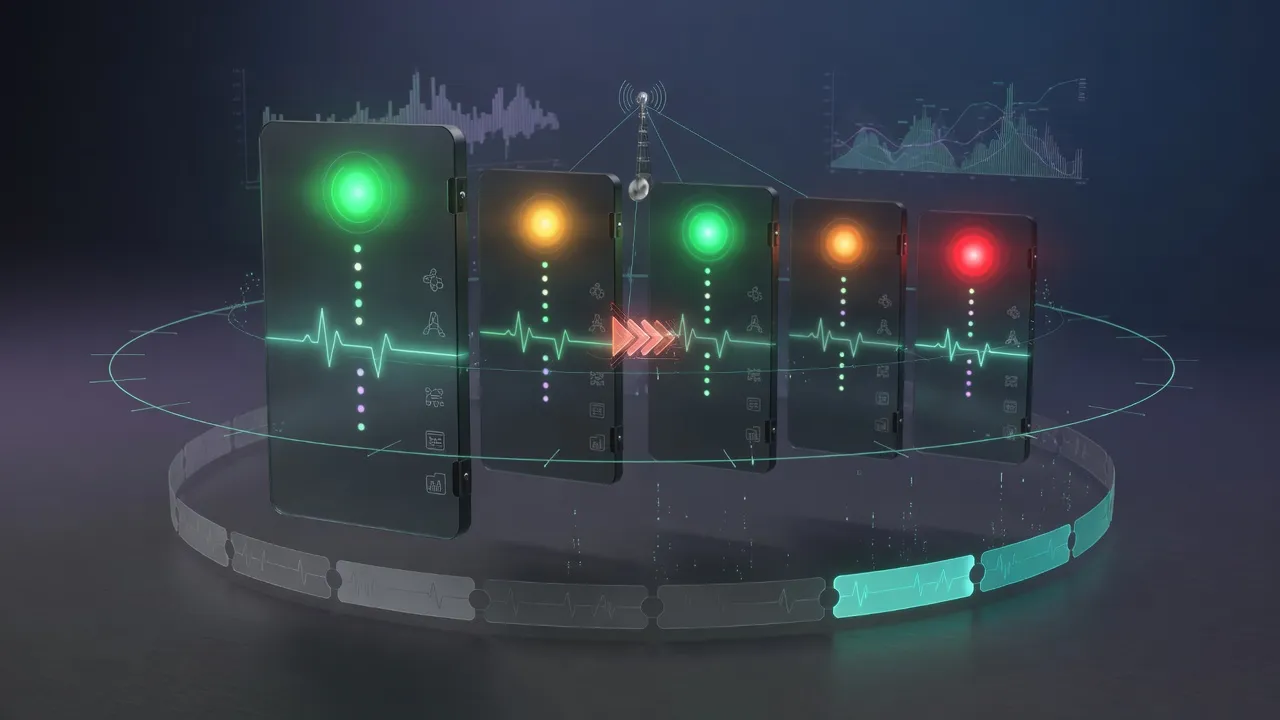
Live status for the hosted APIs you might use instead of running this locally.
 View on Hugging Face
