- Services
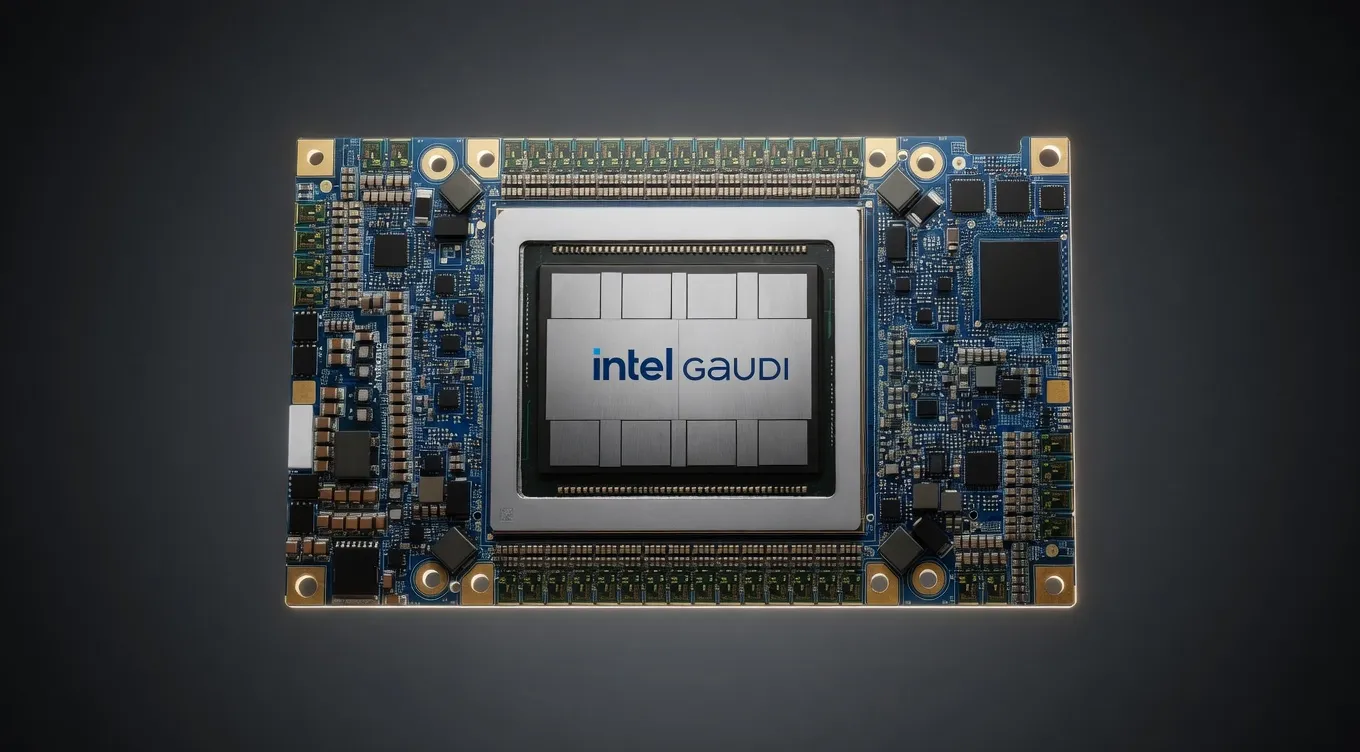
Every open model in our directory, ranked by how well it runs on Intel Gaudi 2 AI Accelerator (96GB) at 4-bit. Grades weigh whether the model fits in memory and how fast it should run.
Intel Gaudi 2 AI Accelerator has 96 GB of VRAM, enough to run 377 of the 457 open models we track at 4-bit. The largest that still fits well is Sarvam-105B-1711 (105B), and the top-rated is Kolibri 1.1 at about 203 tok/s.
377 of 457 models run comfortably on Intel Gaudi 2 AI Accelerator.
See full Intel Gaudi 2 AI Accelerator specs and pricingThe top models this device can run at 4-bit, ranked by fit and speed.
| Model | Grade | Speed | VRAM |
|---|---|---|---|
| Kolibri 1.1aleph-alpha | SS | 203.1 tok/s | 51.3 GB |
| KolibriAleph Alpha | SS | 75.2 tok/s | 69.7 GB |
| AliceAI-Foundation-80B-A3B-Baseyandex | SS | 231.2 tok/s | 53.9 GB |
| Sarvam-105B-1711Sarvam AI | SS | 100.3 tok/s | 74.6 GB |
| Llama 3 70B Instruct |
| SS |
| 43.2 tok/s |
| 45.7 GB |
| Nemotron 3.5 Bolt 74B-A9B 24GBNVIDIA | SS | 327.9 tok/s | 43.7 GB |
| NVIDIA Nemotron 3.5 Bolt 74B-A9B 24GBNVIDIA | SS | 327.9 tok/s | 43.7 GB |
| Apertus 70BEPFL, ETH Zurich, CSCS | SS | 45.5 tok/s | 43.4 GB |
| Llama 2 70B ChatMeta | SS | 45.5 tok/s | 43.4 GB |
| Granite Switch 4.1 30BIBM | SS | 40.0 tok/s | 49.3 GB |
| Muse Glimmer-30BMeta | SS | 40.0 tok/s | 49.4 GB |
| Inkling 2 MiniThinking Machines Lab | SS | 63.6 tok/s | 44.3 GB |
Kolibri 1.1aleph-alpha | 75.13B(3.44B active) | SS | 203.1 tok/s | 51.3 GB | |
KolibriAleph Alpha | 78B(3B active) | SS | 75.2 tok/s | 69.7 GB | |
| 81.29B(3B active) | SS | 231.2 tok/s | 53.9 GB | ||
Sarvam-105B-1711Sarvam AI | 105B(10.3B active) | SS | 100.3 tok/s | 74.6 GB | |
| 70B | SS | 43.2 tok/s | 45.7 GB | ||
| 74B(9B active) | SS | 327.9 tok/s | 43.7 GB | ||
| 74B(9B active) | SS | 327.9 tok/s | 43.7 GB | ||
Apertus 70BEPFL, ETH Zurich, CSCS | 70B | SS | 45.5 tok/s | 43.4 GB | |
Ad Tools for AI BuildersAll the hardware and tools you need to run private AI at your office or at home.Shop Now | |||||
Llama 2 70B ChatMeta | 70B | SS | 45.5 tok/s | 43.4 GB | |
| 29.99B | SS | 40.0 tok/s | 49.3 GB | ||
Muse Glimmer-30BMeta | 30B | SS | 40.0 tok/s | 49.4 GB | |
Inkling 2 MiniThinking Machines Lab | 26.4B(3.4B active) | SS | 63.6 tok/s | 44.3 GB | |
GoTo-AI 27B InstructGoTo Group | 27B | SS | 45.0 tok/s | 43.8 GB | |
Gemma 3 27B ITGoogle | 27B | SS | 45.0 tok/s | 43.8 GB | |
Comet 60BMultiverse Computing | 61.1B(12.8B active) | SS | 236.4 tok/s | 36.4 GB | |
Mistral Small 3 24BMistral AI | 24B | SS | 50.6 tok/s | 39.0 GB | |
Ad Vast.aiAffordable on-demand GPU rentals for training and inference. Pick from thousands of hosts.Rent a GPU | |||||
K2-Horizon-MoVA-36B-A4BInstitute of Foundation Models | 36B(4B active) | SS | 100.6 tok/s | 38.2 GB | |
Mixtral 8x7B InstructMistral AI | 46.7B(12.9B active) | SS | 173.6 tok/s | 31.0 GB | |
Qwen3-32BAlibaba | 32.8B | SS | 36.6 tok/s | 53.9 GB | |
LLaMA 65BMeta | 65B | SS | 50.2 tok/s | 39.3 GB | |
SenseNova-Loop-9Bsensenova | 9.41B | SS | 44.3 tok/s | 44.5 GB | |
Recursive FlintRecursive | 39.8B(2.5B active) | SS | 274.2 tok/s | 28.8 GB | |
Qwen3.6 35B-A3BAlibaba | 35B(3B active) | SS | 231.2 tok/s | 27.1 GB | |
Qwen3.5-35B-A3BAlibaba | 35B(3B active) | SS | 231.2 tok/s | 27.1 GB | |
| AdTools for AI BuildersAll the hardware and tools you need to run private AI at your office or at home.Shop Now | |||||
MiniCPM-V 4.7 35B-A3Bopenbmb | 35.21B(3B active) | SS | 231.2 tok/s | 27.2 GB | |
Model Compatibility
Use the calculator to weigh this device against any other, model by model, with speed and fit scores.
Straight answers to the questions we hear most often.
Can't find what you're looking for? Book a Discovery Call
Kolibri 1.1 is the highest-rated model that runs on Intel Gaudi 2 AI Accelerator at 4-bit, at about 203 tok/s. In total, Intel Gaudi 2 AI Accelerator can run 377 of the 457 open models we track.
We size each model at 4-bit (Q4_K_M), add the KV cache for its context length and a fixed runtime overhead, then compare that to this device VRAM. Each model is graded on how comfortably it fits and how fast it should run on this card.
It is an estimate of decode speed in tokens per second at 4-bit, based on this device memory bandwidth and each model size. Real speed depends on your runtime, batch size, and context length, so use it to compare models, not as a hard promise.
Lower-bit quantization shrinks a model so more of them fit. These grades already assume 4-bit, which is the common local default. Going below 4-bit can squeeze a larger model in at some quality cost; going above needs more VRAM and may not fit.
Mixture-of-experts models only activate a fraction of their parameters at a time, so their runtime memory is closer to the active size than the headline size. We score fit on the active parameters, which is why some very large models still fit.